Film Review: Adrift in Time and Tide – Mark Jenkin’s “Rose of Nevada”
By Steve Erickson
A Cornish folk-horror reverie where sound and image eclipse story, evoking the erosion of community and the fragility of working-class life.
Rose of Nevada, directed by Mark Jenkin. A special advance screening at Coolidge Corner Theatre on June 23 will feature a post-film discussion with the filmmaker.
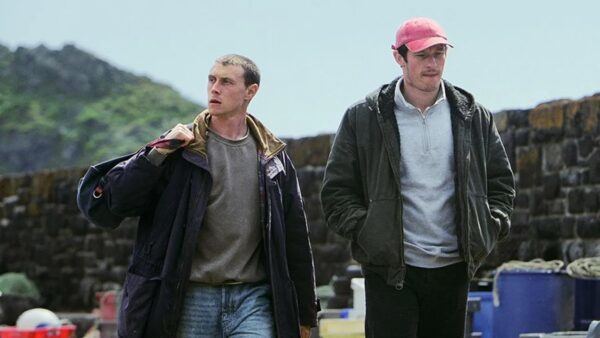
George MacKay and Callum Turner in a scene from Rose of Nevada. Photo: Venice Film Festival
To its credit, Rose of Nevada sustains a mood of eerie alienation. The film’s shots seem disconnected, the narrative’s characters trapped in the square frame of the Academy ratio. Cornish director and writer Mark Jenkin shoots and edits in a manner that emphasizes people’s isolation from one another: his cuts don’t neatly suture a story together. Rather, images collide into one another. There is a thematic logic to the approach: the visuals reflect the death of communal spirit in contemporary England. Jenkin set out quite consciously to achieve these strange effects. His cinematography was hand-cranked 16mm. Subliminal mismatches between actors and their voices were exploited because the sound is entirely post-synced. Rose of Nevada continues the aesthetic of Jenkin’s 2022 feature Enys Men (Arts Fuse review) which brought elements of the experimental avant-garde into conversation with British folk-horror.
Set in a fishing village in Cornwall, England, Rose of Nevada is named after a boat. The vessel mysteriously vanished 30 years ago. When it reappears out of the blue, reasonable explanations for its reappearance are scarce. Struggling to support his family in an economically shattered region, Nick (George MacKay) takes a job serving as one of its crew, alongside Liam (Callum Turner). The ship offers a number of ominous portents, including a message carved into the wall. When Nick and Liam emerge from the boat, thinking they’ve headed back home, they find that they have gone through a time loop and returned to 1993. They’re accepted by the townsfolk of the past — because they pretend to be the men who vanished.
“Kneebone Barton,” a track from Rose of Nevada’s soundtrack, features a ship’s horn that unfurls into faint, seemingly endless echoes. Heard on its own, the film’s score, composed by Jenkin, evokes a mood of chilly loneliness, rendering the the story’s fascination with time’s mysteries legible, even without its images. By foregoing live recording, Jenkin crafts an extraordinarily vivid soundscape in which ordinary noises resolve into musical rhythms. Life aboard the ship takes on the cadence of a drum solo—utensils slam against the walls, boots tap in steady patterns. In place of an alarm clock, the captain rouses Nick and Liam by striking a metal pot.
Jenkin, who was also the cinematographer, is enamored with signs of both life and decay. His camera glides over rusted metal and rotting wood, drawing out the beauty in their mottled surfaces. Visually, Rose of Nevada skillfully echoes images from its early passages—a house’s crumbling roof that lets water flood in, foreshadowing events aboard the boat. Day after day, a seagull circles in the bright blue sky above, as if caught in its own loop. The director emphasizes the medium’s focus on physicality, the tangible reality of the narrative’s environments. To that end, he leaves imperfections intact: flashes of light briefly render an actor’s face unreadable, and the beginnings and ends of reels have been left visible at times in the final cut. The soundtrack’s artificiality pulls against the material grain of the images, creating a provocative tension.
The director has long been devoted to filming the Cornish seaside in southern England. His commitment to elevating the region’s culture was recognized by the College of Bards of Gorsedh Kernow. For the first time, in Rose of Nevada, Jenkin introduces introduces recognizable movie stars into his work. But both MacKay and Turner strategically underplay their roles, choosing to recede into their characters rather than assert themselves over lesser-known performers in the cast. Jenkin’s spare script only heightens this demand for restraint.
Jenkin’s turn toward horror has also made his recent films more commercially viable. Distributed by Neon, Enys Men reached American multiplexes—a surprising push for such a singular work. Rose of Nevada, by contrast, sustains a similarly eerie atmosphere but eschews an easily legible narrative. Character recedes in favor of the sensuous force of sound and image. As in his earlier films, Jenkin explores the precariousness of working-class life, though he avoids the blunt metaphors common to much A24 horror. Instead, he relies on the medium’s considerable affective power to evoke the fragility of blue-collar existence. That said, Rose of Nevada is less a story than an assertion of sustained mood—an exceptionally potent one.
Steve Erickson writes about film and music for Gay City News, Slant Magazine, the Nashville Scene, Trouser Press, and other outlets. He also produces electronic music under the tag callinamagician. His latest album, Bells and Whistles, was released in January 2024, and is available to stream here. He presents a biweekly freeform radio show, Radio Not Radio, featuring an eclectic selection of music from around the world.