
Theater Review: Quick Changes, Big Laughs in “The Mystery of Irma Vep”
By David Greenham
Gabriel Graetz and Paul Melendy power Charles Ludlam’s camp classic, even as a stripped-down design leaves some comic potential untapped.
The Mystery of Irma Vep by Charles Ludlam. Direction and scenic design by David R. Gammons. Costume design, Seth Bodie. Lighting design, Jeff Adelber. Sound design by Nate Tucker. Props, Lauren Corcuera. Produced by Central Square Theater, Massachusetts Avenue, Cambridge, through June 21.
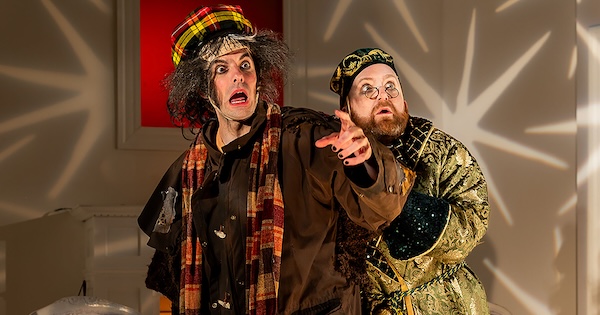
Paul Melendy & Gabriel Graetz in the Central Square Theater production of The Mystery of Irma Vep. Photo: Maggie Hall Photography.
Charles Ludlam was a force of nature. For just over 20 years, his Ridiculous Theatrical Company upended the comfortable traditions of theatrical performance from their tiny West Village stage. The Mystery of Irma Vep, his most famous creation, has now been revived at Central Square Theater.
All is not well at Mandacrest, a gothic estate on the moors. Famed Egyptologist Lord Edgar (Gabriel Graetz) and his new wife, Lady Enid (Paul Melendy), are trying to make the best of things. Once, Edgar and his late wife Irma Vep lived happily with their young son Victor and Irma’s beloved pet wolf, also named Victor.
One day, the two Victors went for a walk—only the wolf returned. Their son’s body was found in the mill run, his throat ripped apart by a wild animal. Irma insisted that her wolf was not to blame, but Edgar was determined to kill it. She set the animal free before he could act. Irma died soon after, also of mysterious causes, and a heartbroken Edgar continued to hunt the wolf.
For her part, Lady Enid struggles to feel comfortable in the disturbing manor. Irma’s portrait hangs over the mantel in the main room, three years after her death, serving as a kind of shrine. On top of that, their prickly maid, Jane Twisden (also Graetz), disdains the new mistress of the house. “She’s so common. She’ll never live up to the high standard set by Lady Irma,” she disdainfully declares. Nor does Twisden welcome the unwanted advances of rough-hewn swineherd Nicodemus Underwood (also Melendy). “You are beneath me and beneath me you are going to stay,” she says to him. “Someday you might want to get beneath me,” he snarls with a grin.
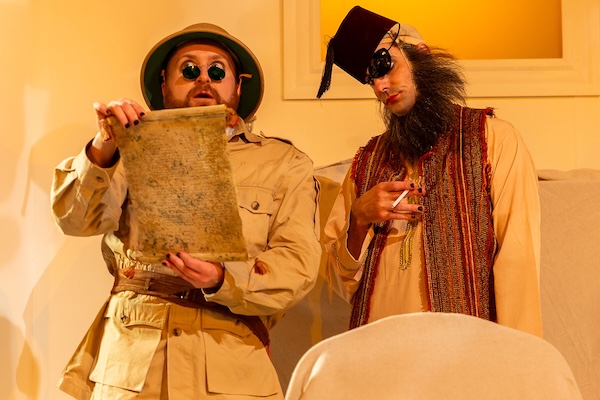
Paul Melendy & Gabriel Graetz in the Central Square Theater production of The Mystery of Irma Vep. Photo: Maggie Hall Photography.
The wild story unfolds through a series of 31 short scenes across three speedy acts, running just two hours with an intermission.
The joyously theatrical conceit of Ludlam’s wildly inventive tale is that the leads (Graetz and Melendy) play the four main characters, along with a clown car’s worth of incidental roles.
This vibrant send-up of classic gothic whodunits is peppered with myriad references, from literary nods to William Shakespeare, James Joyce, and Omar Khayyám to such movies as Rebecca and The Ten Commandments. As Tony Kushner notes in the program essay, “The theater of Ludlam was a delirious, glorious ransacking of the contents of the entire world, all of history, everything written, every story ever told.”
The challenge presented by Ludlam’s campy lampoon (and lampoon of camp) is that it can feel like a long series of costume changes interrupted by moments of outrageous farce. Director David R. Gammons and his talented actors stage some delightful moments onstage, but the audience quickly suspects that even more frenetic performances are taking place backstage, as the actors fly from one costume to the next at breakneck speed. Costume supervisor Rebecca Straniere and wardrobe supervisor Emma J. Hunt clearly have everything under control; the changes are seamless.
Gammons also served as the staging’s set designer, and here he made an unusually bold choice. His Mandacrest Manor resembles a symmetrical tiny house. A stylized fireplace sits upstage center, with a projection screen above the mantel representing the space where Irma’s portrait hangs. Oft-used doors line the left and right walls, and a long box downstage center houses footlights that cast exaggerated shadows across the action. Most strikingly, the set is entirely white—a blank canvas.
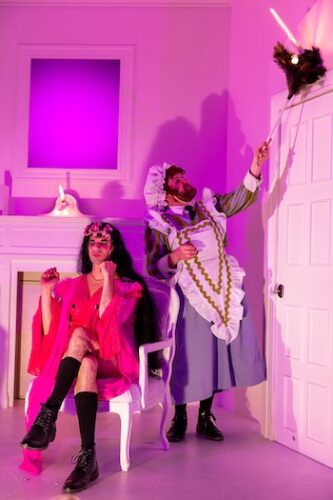
Paul Melendy & Gabriel Graetz in the Central Square Theater production of The Mystery of Irma Vep. Photo: Maggie Hall Photography.
Lighting designer Jeff Adelberg has set up suggestive fixtures above the doors and below the “portrait,” while two rounded ceiling lights hang overhead, reinforcing the production’s visual playfulness. Flashes of clip-art-like lightning appear on the projection screen, but Irma’s portrait itself is never shown. The visuals on the screen remain abstract. The fireplace is rendered as a grid of bare bulbs that intensify when worked with bellows.
Similarly, sound designer and composer Nate Tucker offers a modern take on a gothic soundscape. Wolf howls and musical underscoring ebb and flow, creating an appropriate atmosphere without leaning into pastiche.
Gammons’ apparent intention was to focus attention squarely on the actors and costumes—and in that, he succeeds.
Costume designer Seth Bodie and costume technician/magician byu Heidi Mermiller provide an over-the-top impression of period by way of a succession of colorful, inventive—often hilarious—designs. Maid Jane Twisden sports a tidy dress, frilly apron, mop cap, and a tight-curled wig. Nicodemus Underwood’s rough coat, plaid scarf, battered hat, and wildly unkempt wig are memorably absurd. Lord Edgar appears in a parade of proper suits, shimmering smoking jackets and, eventually, an iconic Egyptian safari ensemble. Lady Enid proves the most extravagant eyeful of all; her increasingly outlandish gowns reliably draw applause on each entrance.
The Mystery of Irma Vep stands or falls on the strength of its busy-to-the-max cast members. Graetz and Melendy kick things into the statosphere. Graetz’s Twisden is an engaging mix of cynicism and melancholy and he underlines Lord Edgar’s brittle bravado. Melendy is a force of addled nature: his Nicodemus and Lady Enid teeter, delightfully, on the edge of madness. Both performances are exuberant, yet they are grounded in telling Ludlam’s story — not egotistic exercises in hogging the spotlight. Still, by the time the action reaches Egypt, Melendy is unleashed—this is a full-fledged comedy showcase.
Graetz and Melendy supply nearly all the fuel this production needs to take glorious flight. That said, the decision to strip the set and sound of overt camp accoutrements (this is a mansion without grotesque Victorian bric-a-brac) is gutsy but somewhat disappointing. It leaves some of the script’s audio-visual comic potential untapped; a more densely populated, playful design would have offered a richer playground for the physical comedy. Still, this is a minor quibble. The performances and costumes take center stage, as they should.
David Greenham is an arts and culture consultant, adjunct lecturer on Drama at the University of Maine at Augusta, and is the former executive director of the Maine Arts Commission. He can be found at https://davidgreenham.com/
Tagged: "The Mystery of Irma Vep", Charles Ludlam, David R. Gammons, Gabriel Graetz, Gothic farce