Classical Album Review: Sea Songs in Full Sail
By John Tamilio III
Arpeggione Ensemble turns music by Schubert, Mendelssohn, and Mahler into a resonant chamber seascape.
Songs of the Seafarer, Arpeggione Ensemble. (Navona Records)
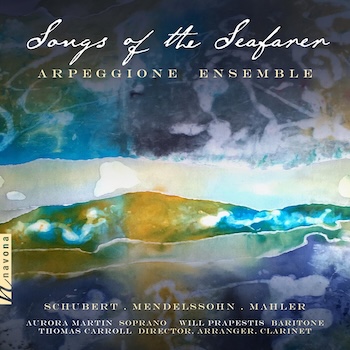 Songs of the Seafarer presents novel chamber arrangements of selected works by Franz Schubert, Felix Mendelssohn, and Gustav Mahler. The German text ventures across seascapes and landscapes as it tells a tale with profound existential overtones. The storyline explores the emotional demands of departure, desire, grief, illusion, and transcendence. Listeners are ushered over blue-gray breakers and docile shorelines via poignant vocal solos and sublime orchestration. The Arpeggione Ensemble’s performances, directed and arranged by clarinetist Thomas Carroll, serve two compelling soloists.
There is a clear Boston connection to this recording. It was initially envisioned as a tribute to Gloucester, Massachusetts’ 400+ years of maritime heritage. It was also inspired by Arnold Schoenberg’s Verein für musikalische Privataufführungen as well as the Hub’s Mendelssohn Quintette Club.
The first nine selections were arranged by Carroll; the remaining four were orchestrated by Schoenberg. The intricate structure of this release, as well as its content, demands a track-by-track critique.
The entrée to the collection, Schubert’s “Die Schöbe Mülerin, D. 795 – I. Das Wandern,” is a jovial folk tune that could be featured in a musical, sung by the patrons in the pub of a fishing village, such as Gloucester. The simple instrumentation for this cheery frolic buoys a well-crafted exchange between robust baritone Will Prapestis and the smooth soprano Aurora Martin.
This track is followed by Schubert’s equally buoyant “Fischerweise, D. 881.” The orchestration here is more elaborate, offering new opportunities for Prapestis’ to draw on his range. It segues nimbly into “Die Forelle, D. 550,” which spotlights the Arpeggione Ensemble’s dynamics.
The collection takes a turn toward the more somber and passionate on “Schwanengesang, D. 957: XII. Am Meer.” Martin’s voice is hypnotically heart-wrenching in this lament for the deceased, wafted out to sea. The piece’s lyrics come from a poem by Heinrich Heine; according to the liner notes, it “depicts a final meeting of lovers on the shore before parting.” The performance is as melancholic as one would expect a “seaside swan song” to be.
“Meeresstille und glückliche Fahrt, op. 27” is the only selection by Mendelssohn on this release. It begins as a sonorous yet somber instrumental, making use of a gathering of low-tone strings that wash over the listener with ease. The soundscape paints a compelling picture of a tranquil sea and a prosperous voyage, as the title suggests. This gentle aura is soon augmented by an anticipatory piano and a jocund wind ensemble, which infuse a buoyancy that propels the piece to a mirthful finish.
But, of course, the sea is full of surprises. It has, as T.S. Eliot once wrote about the East Gloucester seascape, “many voices, / Many gods and many voices.” Martin’s angelic voice returns on Mahler’s aptly titled “Es Sungen drei Engel.” Prapestis is at the center of Mahler’s “Des Knaben Wunderhorn: XI. Des Antonius von Padua Fischpredigt.” The orchestration is somewhat murky here, in contrast to the clarity of the vocal arrangement. We are adrift in a minor key that seems to move into the discordant.
With “Des Knaben Wunderhorn: III. Lob des hohen Verstandes,” Martin turns from the contemplative to the ecstatic. Her operatic delivery is replete with euphoric vibrato. The track is lively and effervescent — almost to a fault. There is a moment, halfway through, in which Martin mirrors the high register of the strings, supplying a dual shriek after what sounds like a quick, spoken aside. Other recordings of “Lob des hohen Verstandes” feature the same grating moment, so the blemish (if one wishes to call it that) is in Mahler’s notation, not Martin’s performance.
An adroit amalgam of wind and reed instrumentation flowers over a piano, creating an idyllic ambiance of rousing trills over which Martin soars to elegant heights in “Das Himmlische Leben.” The English translation of the German title (“The Heavenly Life”) is quite fitting; the track is awash with vigorous climbs and delicate plateaus of contemplative beauty. This is Mahler at his best. The lull of the finale allows listeners to catch their breath.
As those notes linger upon the pulse, a gentle, silken concoction of reeds compels listeners into the next selection, the first of a four-part excursion. The title that precedes each track mirrors that of the album. “Lieder eines Fahrenden Gesellen” means “Songs of a Wayfarer.” The first movement (“Wenn mein Schatz hochzeit macht”) reinforces the power of Prapestis’ majestic expression, which laments an unrequited love, not unlike Goethe’s Werther or Eduard. A pregnant pause at the 1:52 mark allows for a slight change of direction, only to return to where we began — a structural motif that reappears throughout this album.
Vivacious strings, a jocund flute, and pensive timing propel Prapestis’ voice over the surf of the melody, which builds and breaks on the next track, “Lieder eines Fahrenden Gesellen: Ging heut’ morgen übers Feld.” But, much like the mesmerizing movement of breakers, the drama recedes into a soft diminuendo, much as a trek over such a morning field might feel after a long night at sea.
But the tension returns with the next track. A love lost literally cuts like a knife (“ein glühend Messer”) here, a blade that gleams and slashes deep into the breast of a quivering Prapestis. With “Lieder eines Fahrenden Gesellen: Die zwei blauen Augen von meinem Schatz,” Songs of the Seafarer sails to a satisfying close. The libretto is available, in both the original German and an English translation, on the Navona Records website. The Arpeggione Ensemble has put together a sumptuous musical cruise that discerning listeners will want to take, again and again.
John Tamilio III, PhD, is the Pastor of the Congregational Church of Canton, a professor of Philosophy at Salem State University, and a professional guitarist who plays solo acoustic and for the Boston-based classic rock band 3D. His playing has been applauded by David Brown (Simon & Garfunkel, Billy Joel), Jack Sonni (Dire Straits), and Carter Allen (WZLX). An aficionado of classical music, particularly the Baroque era, Tamilio’s publications are vast, covering not only music, philosophy, and theology, but the poetry of T.S. Eliot as well. He resides in Beverly with his wife Cynthia.
Tagged: "Songs of the Seafarer", Arpeggione Ensemble, Aurora Martin, Thomas Carroll