
Concert Review: War, Remembered in Song
By Steve Provizer
At Shalin Liu, Skylark pairs Poulenc’s Figure humaine with Civil War–era music in a program of striking contrasts.
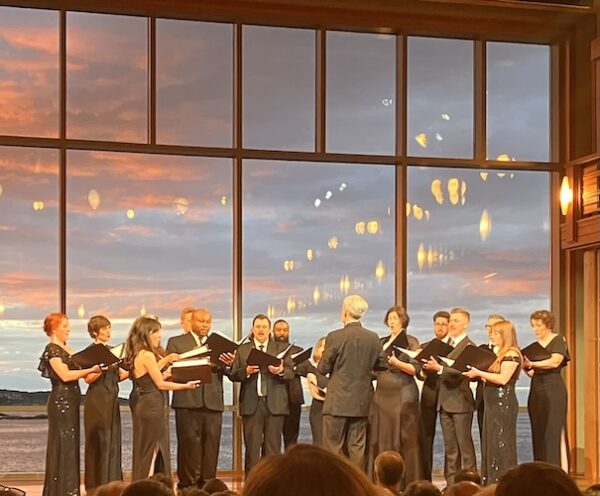
The Skylark Vocal Ensemble performing at the Shalin Liu Performance Center. Photo: Steve Provizer
I was already familiar with some of the work “classical” composers produced in response to World War II — Dmitri Shostakovich, Arnold Schoenberg, Sergei Prokofiev, and, of course, the most well known: Olivier Messiaen’s masterful and disturbing Quartet for the End of Time, composed while he was a prisoner of war. But the concert I attended on May 28 at the Shalin Liu Performance Center, performed by the vocal ensemble Skylark, introduced me to another significant wartime work: Figure humaine by Francis Poulenc.
Composed in 1943, Figure humaine sets eight poems by Paul Éluard. Both men knew the horrors of war intimately. Poulenc served as a conscript in World War I and, briefly, again in World War II. Éluard’s duties during World War I included writing to the families of the dead and wounded and digging graves at night. During the second war, he assembled poems by Resistance writers in L’Honneur des poètes (The Honour of Poets), evading Nazi reprisals by taking refuge in the asylum at Saint-Alban.
Skylark’s program, Clear Voices in the Dark, was intelligently conceived. The 16-member ensemble alternated the eight sections of Figure humaine with American Civil War–era songs, a juxtaposition that sharpened the modern intensity of Poulenc’s work while underscoring the persistence of its themes.
Some of the American selections were familiar — “The Battle Hymn of the Republic,” “Johnny, I Hardly Knew Ye” (“When Johnny Comes Marching Home”), and “Abide with Me.” Others were less so: “When This Cruel War Is Over,” “Working for the Dawn of Peace,” and “Soldier’s Memorial Day.” The arrangements varied: some adhered closely to what a 19th-century choral setting might have sounded like, while others employed more contemporary techniques.
A protégé of Erik Satie, Poulenc also benefited early on from the support of Ravel and Stravinsky. In Figure humaine, he writes in a distinctly mid-20th-century idiom, scoring the work for double choir in six parts each. The demands are considerable, and Skylark met them fully. Under the direction of Matthew Guard, whose conducting is pithy and decisive, the ensemble responded with precision and energy. The singers navigated dense, dissonant harmonies, wide intervallic leaps, and abrupt dynamic shifts with assurance. The eight women and eight men executed the score with impressive clarity. In the Civil War repertoire, the sopranos adopted a pure, period-appropriate tone, while the basses grounded the ensemble with firmness and clarity.
It was somewhat surprising that no spirituals were included. While many were performed sub rosa through much of the 19th century and only gained broader recognition with the Fisk Jubilee Singers in the 1870s, pieces such as “Go Down Moses” were known during the Civil War, and “Joshua Fit the Battle of Jericho” — apt for the program’s theme —might have made a compelling addition.
In the program notes, Guard writes, “Art born from turmoil can shed extraordinary light on what it meant to live through tragedies of the past” — an allusion to the familiar warning that those who do not learn from history are doomed to repeat it. Whether art can truly advance such an agenda is open to question. What seems less debatable is that it must try — and when it does so with imagination and aesthetic conviction, little more can be asked.
Steve Provizer writes on a range of subjects, most often the arts. He is a musician and blogs about jazz here.