
Book Review: “The Sound of Utopia” — Music in the Shadow of Power
By Jonathan Blumhofer
Michel Krielaars’ portrait of Soviet musicians reveals art shaped—and warped—by fear, ideology, and longing.
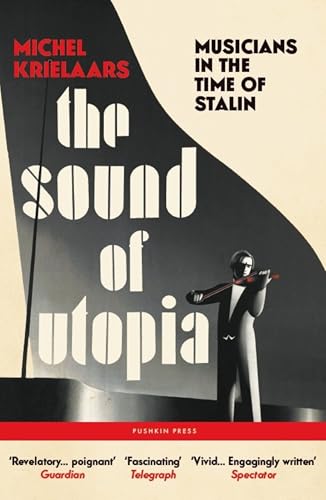
The Sound of Utopia: Musicians in the Time of Stalin by Michel Kreilaars. English translation by Jonathan Reeder. Pushkin Press, 321 pp., $19.95
Version 1.0.0
“The past is never dead,” William Faulkner tells us. “It’s not even past.”
That’s certainly the case in The Sound of Utopia, Michel Krielaars’ absorbing survey of composers and performers working and living in the Soviet Union. Out in a new, English-language translation by Jonathan Reeder, the book, subtitled “Musicians in the Time of Stalin” seems to imply a set timeframe. Yet the Amsterdam-based author makes clear that’s hardly the case: the dictator’s shadow continues to loom.
Krielaars, a journalist with the Dutch newspaper NRC, isn’t a musicologist. But he’s got a solid grasp of his chosen topic, with a background in Russian history and having spent several years as a correspondent in Moscow. He also possesses a deep appreciation for the musical arts.
Though his selection criteria seem a touch haphazard, the subjects of Utopia cover a broad spectrum: there are chapters devoted to singers Klavdiya Shulzhenko (the “Russian Vera Lynn”) and Vadim Kozin, as well as the composer Tikhon Khrennikov. (Dmitri Shostakovich is a more peripheral figure in these pages than usual.) Additionally, the organization of materials, while not strictly chronological, involves enough overlap to craft three-dimensional portraits of each individual and their circles.
Two of the most familiar names under discussion belong to Sviatoslav Richter and Sergei Prokofiev.
The latter, ironically, managed to leave Russia before the worst of the Bolshevik’s excesses commenced and spent much of the 1920s in the United States, London, and Paris, where he eventually settled. But the lure of the Motherland—not to mention the sweet enticements of Stalin’s cultural operatives—proved too hard to resist and Prokofiev returned to the Soviet Union in 1935.
Soon after, his promised freedoms started to dry up, and his music was subjected to criticism: the Cantata for the 20th Anniversary of the October Revolution was decried as “unintelligible” while his patriotic opera Semyon Kotko was dismissed as “difficult.” Prokofiev’s marriage, too, fell apart in the wake of his affair with a much younger poet, Mira Mendelson, whom he later married.
His successes over these years—the ballet Cinderella won the Stalin Prize and the triumph of his Fifth Symphony secured his international reputation—were overshadowed by the specters of illness and state terror (his first wife, Lina, was arrested by the NKVD shortly after Prokofiev had, essentially, thumbed his nose at Alexei Zhdanov’s notorious anti-formalist decree). That he died less than an hour before Stalin did on 5 March 1953 is one of history’s great ironies.
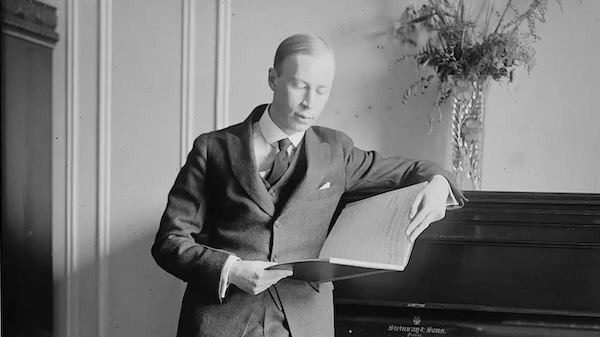
Sergei Prokofiev (ca. 1918). Photo: Bain Collection, Library of Congress
Richter outlived both of them by nearly half a century. Born in the Ukrainian city of Zhytomir, he grew up in Odessa and studied at the Moscow Conservatory with Heinrich Neuhaus. A tumultuous family life—his father was executed on trumped-up espionage charges in 1941 after his mother, who was having an affair with a local musician, refused to evacuate the country without her lover—coupled with the pianist’s closeted homosexuality resulted in the artist’s famously inscrutable personality.
Yet for all his public reticence (Richter rarely gave interviews and, by the end of his life, was famous for presenting concerts on short notice), he was deeply connected with the Soviet artistic elite. And, though he disdained mixing music and politics, the pianist was hardly above making pointed statements: in 1948, he presented music by Prokofiev shortly after the composer had been singled out by the Zhdanov decree. Later, in 1961, he defied the authorities outright by playing at Boris Pasternak’s funeral.
In many regards, Richter benefited from fortunate timing: the latter half of his career was bolstered by appearances in the West that came on the heels of the USSR and the United States’ signing a cultural exchange pact in 1958. Others weren’t so lucky.
Kozin, for instance. Born in 1903, he found acclaim as a singer of popular fare in the ‘30s and ‘40s (his accompanist at one point was David Ashkenazy, father of pianist-conductor Vladimir). But the tenor was less discreet about his homosexuality than Richter was—the orientation was deemed illegal in the USSR in 1934—and found himself exiled to Siberia in 1944. Released in 1950, he was rearrested in 1959 and finally freed for good in 1963; by that time, however, Kozin’s singing career was over and efforts to rehabilitate him petered out. By the time of his death in 1994, he was, as Krielaars puts it, “entirely forgotten.”
So was Vsevolod Zaderatsky, a pianist-composer contemporary of Prokofiev’s. His music was banned because of his refusal to toe ideological lines that his more famous compatriot resisted; he toiled in obscurity. Alexander Mosolov fared slightly better, though his feisty personality and suspicions about his avant-garde efforts during the pre-Social Realism era made him persona non grata among Soviet compositional circles for most of the remaining forty years of his life.
The posthumous fortunes of other figures in Kreilaars’ narrative, like Shulzhenko, Mieczysław Weinberg, and Maria Yudina, have waxed and waned over the years. Perhaps the most intriguing character sketch to emerge is that of Khrennikov, who was either a devoted apparatchik or an unfortunate, set-upon victim of circumstance (depending on who’s telling the story).
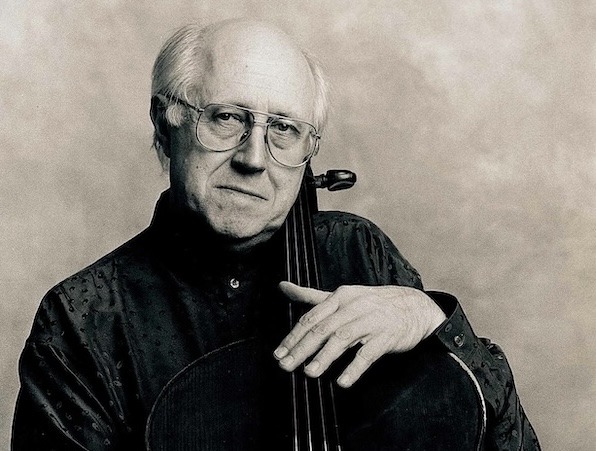
Cellist Mstislav Rostropovich. Photo: Medici.TV
There’s no question, though, of where Mstislav Rostropovich stood. The great cellist, whose stupendous musicianship was perhaps surpassed only by his extraordinary humanitarianism, is a benevolent presence among Utopia’s characters. A man of unbending moral courage, he hardly had it easy: his career was derailed by government interference, and he was forced into exile in the West in 1974. Yet the cellist never gave up on his country, dying in Moscow in 2007 where the national mourning was led by none other than Vladimir Putin.
The centripetal pull of the Motherland, then, is the real puzzle at the heart of Utopia: how does loyalty to an ideal of a country and a cultural identity survive even the most horrid, senseless situations? In Utopia, there’s no single or simple answer, though some sort of mystical spell seems to be hard at work time and again.
What that suggests about the human spirit—its complexity, adaptability, and capacity to endure unimaginable hardships—is one of the things you’re left pondering long after you’ve put the book down.
Also, its staggering ability to process absurdity. One of Utopia’s more haunting passages involves a conversation between the author and Zaderatsky’s son, also named Vsevolod. What exactly, Kreilaars asks, was formalism, that pivotal doctrine of Stalinist cultural practice and thought?
“Nobody knew,” comes the reply. “When I wanted to perform Debussy in 1946, they didn’t let me do that either. Suddenly even Debussy was a formalist. Apparently an overzealous civil servant thought he was pleasing the authorities by outlawing his music.” We have a laugh about it, Kreilaars writes, and, for a brief moment, forget how terrible those days really were.
Jonathan Blumhofer is a composer and violist who has been active in the greater Boston area since 2004. His music has received numerous awards and been performed by various ensembles, including the American Composers Orchestra, Kiev Philharmonic, Camerata Chicago, Xanthos Ensemble, and Juventas New Music Group. Since receiving his doctorate from Boston University in 2010, Jon has taught at Clark University, Worcester Polytechnic Institute, and online for the University of Phoenix, in addition to writing music criticism for the Worcester Telegram & Gazette.
Tagged: "The Sound of Utopia", Jonathan Reeder, Michel Kreilaars, Mstislav Rostropovich, Sergei Prokofiev, Stalin