
Visual Arts Review: Witness and Wonder — Winslow Martin’s Armenia in Fragments of Daily Life
By Lauren Kaufmann
At Project Save, 30 black-and-white photographs capture the tenderness, turmoil, and enduring spirit of the Armenian experience.
Winslow Martin: My Armenia (1999-2008), Project Save Photograph Archive, 600 Pleasant Street Gallery, Watertown, MA, on view through May 30.
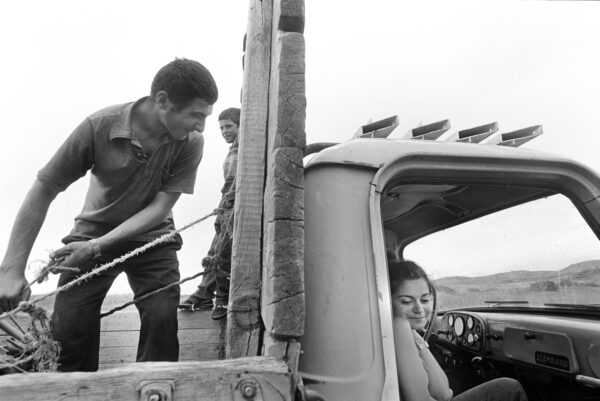
Winslow Martin, Pavstos Buzand Street, Yerevan. Photo courtesy of Project Save Photograph Archive.
Project Save Photograph Archive in Watertown is devoted to collecting and preserving photographs that record the Armenian experience. With more than 150,000 images, the archive documents the everyday lives of Armenians, in their home country and around the globe. Massachusetts is home to a sizeable Armenian population — about 30,000, according to the 2020 census — and Project Save Photograph Archive is one of several Boston-based organizations devoted to bringing the history and culture of the people into sharper relief.
Founded in 1975, the organization recently doubled its space at its Watertown home. The additional room gives Project Save Photograph Archive the opportunity to mount exhibitions of contemporary photography and host public programs. The organization is celebrating the expansion with a stunning exhibition of photographs: Winslow Martin: My Armenia (1999-2008).
Martin’s 30 black-and-white photographs are dreamy, humorous, unsettling, and poignant. Placed together, his stirring images evoke the warmth of the people, the rugged beauty of their land, and the heartache that has touched so many lives.
Although he isn’t Armenian, Martin has immersed himself in the culture, taking more than 17 trips since 1999. Using his camera to capture everyday rituals, pastoral settings, family gatherings, and unexpected violence, Martin has produced a body of work that carries the emotional weight and natural beauty of life in Armenia.
Martin began his sojourns to Armenia with Father Dajad Davidian, the pastor from St. James Armenian Church in Watertown. Since then, Martin has made dozens of solo trips, returning with images that capture the interplay of religion, family life, and political uncertainty woven into everyday Armenian life. The tempestuous history of the country seems never-ending, and Martin’s photographs mirror the ups and downs of everyday life.
In The Day After October 27, 1999, Martin captures a moment of uncertainty, as a crowd gathers to learn what has happened in the House of Parliament. An older man angrily points his finger while onlookers search his face for answers. That day, a group of armed men had stormed the Parliament, killing the prime minister and several government officials. The incident led to a state of emergency and increased political tension.
On a much lighter note, Wedding Reception shows a celebratory gathering at a table piled high with food and drink. The label explains that Martin was on his way to Stepanavan one night when he noticed lights and muffled sounds from a building in the distance. When he arrived at the building, Martin was greeted by a man who invited him in, and introduced him to the crowd of 600 revelers. Martin took photographs of the event and partook in a series of vodka toasts. The photo and its description comprise a lovely snapshot of a chance encounter that reveals the warmth and openness of the Armenian people.
In Chkalofka, two men sit together, chatting. Martin says that he had just returned from a wedding when he noticed the men. He notes that this image is another sign of the hospitality that is woven into the fabric of Armenian life. He says that the tradition is especially notable in small villages, where people gather together while sharing coffee, fresh fruit, and chocolate.
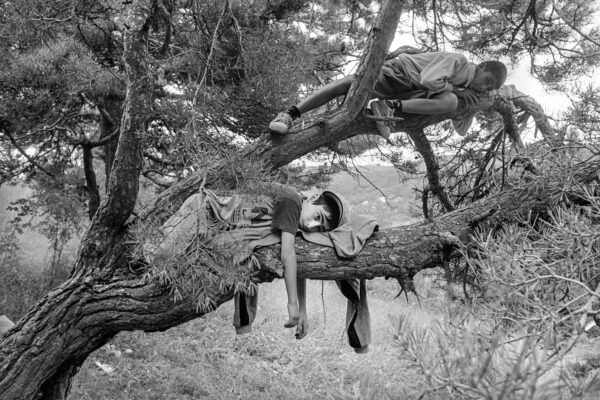
Winslow Martin, Picnic in Tsaghadzor. Photo Courtesy of Project Save Photograph Archive.
In Picnic in Tsaghadzor, Winslow has come upon two teenage boys dangling across two large tree limbs, one right above the other. The boy splayed across the top limb gazes out at Winslow, while the boy below stares off into the distance. The boys are in the countryside, and their expressions are inscrutable. Are they weary after completing a difficult chore? Where is the picnic? Who else is at the picnic, and where are they? The composition — the boys lying in a tree against a misty pastoral background — is strangely captivating.
Shushi, Artsakh offers another image of contrasts. A young child with raised arms appears to be jumping in front of abandoned buildings. The text informs you that Shushi had been a place of “living hope” until its citizens were killed by ethnic cleansing in 2023. The caption reads: “A homeland was gone, a history was stolen by armed force and threats of extinction. A joy that cannot be is what now persists.”
In a lovely photograph called Pavstos Buzand Street, Yerevan, a man stands in the back of a pick-up truck, turning to smile at the woman sitting in the cab. She smiles to herself without turning to meet his gaze. A young boy stands next to the man, perhaps their son. It’s a sweet slice-of-life shot, a passing moment in these people’s lives. There’s no label accompanying this image, but you feel a tenderness passing between the man and woman. Despite the lack of background context, the image speaks for itself.
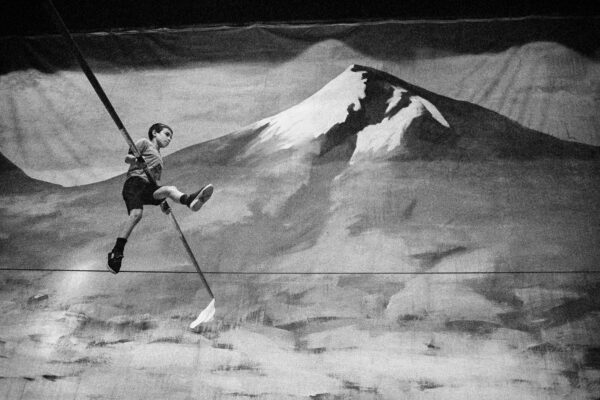
Winslow Martin, Tightrope Walker. Photo courtesy of Project Save Photograph Archive.
Of the 30 photographs in the exhibition, 10 are accompanied by interpretive text. In most cases, the title of the photograph provides you with the necessary information. And, even when you’re not sure of the back story, the images are so striking and artfully composed that you can appreciate them for their intrinsic beauty. That said, there are a few images that would benefit from some explanatory text. For example, a magical photo called Tightrope Walker has a surreal quality; a young boy walks a tightrope with a mountain looming in the background. But then I wondered: Is it really a mountain or is it a backdrop? It’s such a dreamy image that it’s hard to know exactly what you’re looking at. While I thoroughly enjoyed the photograph, I left wanting to know more.
Martin’s work is full of these fleeting moments. The appeal of his work lies in his gift for catching the ephemeral nature of life. Through his many trips to Armenia, Martin has used his camera to express the simple, yet profound, beauty of a people who cherish their country and culture. It’s a beauty that’s all the more precious knowing all that these people have endured over so many years.
Lauren Kaufmann has worked in the museum field for the past 14 years and has curated a number of exhibitions.
3 Comments
Leave a Comment

Lovely review, Lauren! Makes me want to go and see the exhibit. Thank you!
Thanks, Elaine! You should head over there to see it. The photos are very special.
Beautiful review of such well deserved photographs by Winslow Martin. Thank you Lauren and I encourage everyone to see the show and the Project Save exhibition space.