Jazz Album Review: Club d’Elf Blends Gnawa and Jam-Band Energy on “Loon & Thrush”
By Paul Robicheau
Mike Rivard’s rotating collective has blended dub, jazz, Moroccan trance, funk, electronica, hip-hop, and prog into its heady stew.
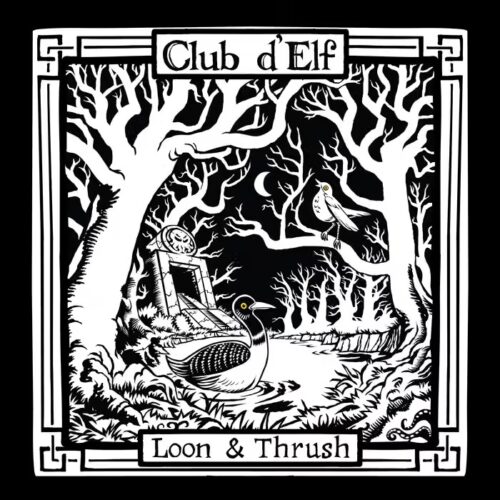 For 27 years, Club d’Elf has forged experimental grooves across genres, from its origins at Cambridge’s Lizard Lounge to renown in underground circles throughout the Northeast. In the process, bassist Mike Rivard’s rotating collective has blended dub, jazz, funk, electronica, hip-hop, and prog into its heady stew, though the roots of that sound can largely be traced initially to Miles Davis’s turn-of-the-’70s fusion and more recently to the ecstatic rhythmic repetitions of Gnawa. That Moroccan trance music was introduced to Rivard by core member Brahim Fribgane, whose 2024 passing lent spiritual inspiration to the group’s new album Loon & Thrush.
Like other improvisation-steeped outfits, Club d’Elf also developed another cultural fan base in its attempts to expand its musical appeal: the jam-band world — from a longtime alliance with John Medeski to recent live guest Mike Gordon. Club d’Elf even recast “Sand” by Gordon’s band Phish, for a tribute covers album.
So perhaps one couldn’t blame Rivard for catering to that crowd by showcasing two Grateful Dead tunes on Loon & Thrush. Naturally, the Dead’s improvisational space was among Rivard’s wide influences as a teenager. However, Club d’Elf spins a bold changeup on the album-opening “Bird Song,” where guitarist Duke Levine flexes a twangy electric sitar — a startling contrast to Jerry Garcia’s clean, relaxed tone — over a North African chaabi groove. And “New Speedway Boogie” proves even less recognizable, Levine tucking that song’s melody within his pithy slide work across chugging African-trance textures anchored by Rivard’s sintir, the camel-skinned lute that serves as the Moroccan equivalent of a bass guitar.
Another accessible move comes in the plainly titled “Second Line,” a bouncy New Orleans march elevated by Paul Schultheis’s organ solo and painted with Tom Hall’s tenor sax, Alex Lee-Clark’s trumpet, and Brian Thomas’s trombone. The unison lines of that horn section also bring conventional strokes to the intermeshed title track, which floats on the intuitive interplay of Levine and lap-steel partner Kevin Barry.
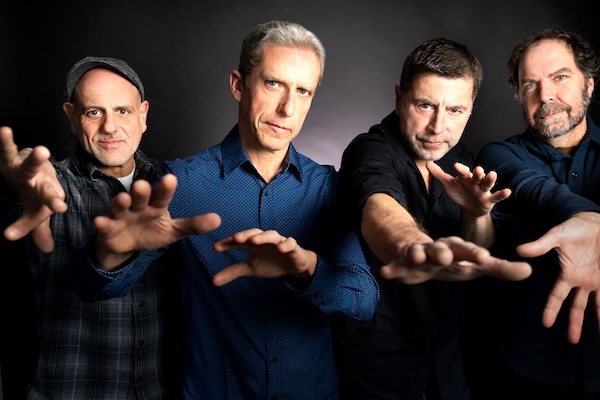
Club d’Elf members Mister Rourke, Mike Rivard, Dean Johnston, and Paul Schultheis. Photo Liz Linder
Dean Johnston frames the short “Dux Lux” as a grooving drum solo under the crystalline guitar latticework of Randy Roos and DJ voicings of Mister Rourke. His odd conversational snippets (often drawn from psychedelic philosopher Terence McKenna) add intriguing icing to live shows, but come off as more forced and cloying at times in this studio setting — such as the “yeah, yeah, yeah” voice that pops out of the title track.
The inclusive Rivard pulls in additional d’elf associates for a perkier rehash of “Left Hand of Clyde” (from the group’s live 2000 debut), including original drummer Erik Kerr, newer guitarists Lyle Brewer and Jeff Lockhart, and keyboardist Amy Bellamy. More unexpected in cast and sound is the closing track, “Level Up Your Soul.” Lifted by Rivard’s winding Moroccan-styled bass line, this delirious number rides a hippie-rave swirl, reinforced by background vocals from Hayley Jane, the atmospheric guitar of Reeves Gabrels (the Cure, David Bowie), and propulsion from drummers Dave Mattacks (Fairport Convention, Paul McCartney) and Rivard’s old Hypnosonics mate J Hilt.
Hard to believe the deceptively expansive 67-minute album was recorded with minimal overdubs. Older fans may miss the experimental edge of some earlier d’elf releases, but the results are richly balanced by Rivard’s own crisp, earthy production, which makes Loon & Thrush one of the group’s best-sounding records. As such, perhaps two of the most striking tracks are the slowest. The textures in both the serene “Softly” and dreamy, horn-laced “Like a Silence” best evoke reflection — both on the absent Fribgane’s spirit behind the proceedings and the continuing process and intoxicating prowess of Boston’s resident curio, Club d’Elf.
Paul Robicheau served more than 20 years as contributing editor for music at the Improper Bostonian, in addition to writing and photography for The Boston Globe, Rolling Stone, and many other publications. He was also the founding arts editor of Boston Metro.
Tagged: Club d’elf, Dean Johnston, Mike Rivard, Mister Rourke