
Poetry Review: The Tongue of the Invisible — Juan Ramón Jiménez’s “Eternities”
By Michael Londra
Juan Ramón Jiménez’s Eternities could be considered a gallery of invisible tongues schmoozing at heaven’s bandwidth.
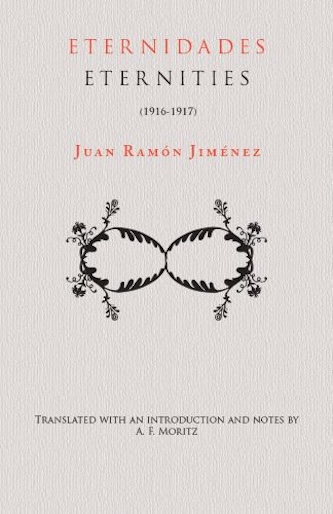
Eternities by Juan Ramón Jiménez, translated by A.F. Moritz, The Bitter Oleander Press, 336 pp, $28.
 Among the assigned fiction I read in high school, Ray Bradbury’s Fahrenheit 451 stood out. Not, however, for its wooden characters and clunky plot. What hijacked my heart was the melody of the novel’s first sentence: “It was a pleasure to burn.” Referring to the main character who gleefully sets fire to books, this phrase has, over the years, instead reminded me of the right way to live. As much as possible, it was my preference to burn hedonistically inside from an overflow of passion. But this wasn’t my only adolescent takeaway. Bradbury’s epigraph by Juan Ramón Jiménez also struck a chord: “If they give you ruled paper, write the other way.” Intended to express Bradbury’s disdain for authoritarianism, Jiménez’s aphorism spoke directly to my nonconformist instincts. This dude was my kind of gangster. But I’d never heard of him before. Who was he?
Nobel laureate Jiménez (1881–1958) hailed from Andalucía, the same part of Spain where, seven years later, Federico García Lorca was born. His family maintained lucrative wine and tobacco interests. No surprise, then, that Juan Ramón majored in law at the University of Seville. Rather than become another salaryman, however, he published his first books of poems in 1900. Initially guided by Nicaraguan journalist and poet Rubén Darío — inaugurator of the fin‑de‑siècle, Madrid‑based movement Modernismo — Jiménez quickly became disenchanted with his mentor’s flamboyance. Preferring what he called “naked poetry,” Jiménez reimagined distinctive stanzas that combined clarity with eroticism.
Eternities was the result. Originally published in 1918, Jiménez’s landmark collection changed world literature. These innovative lyric utterances influenced such 20th‑century luminaries as fellow Nobel Prize winners Pablo Neruda and Octavio Paz, among others. Eternities radically crystallized the ineffable into simple language. Jiménez’s reinvention of poetic syntax presaged the impending revolution of European literary modernism — four years before T.S. Eliot’s The Waste Land — by seeking to tap into the mythical origin point of human language. Over and over, Jiménez searches for the unsayable, a paradoxical “eternal word” that exists in this world and also in the beyond, allowing him to fuse, telepathically, with infinity. Pursuing that “secret word” across 137 individually numbered poems, his stanzas try to connect to a realm where barriers are dissolved: “Let my word be / the thing itself.”
Indeed, the volume reads like the work of a mystical seer. Reminiscent of 14th‑century Sufi poets Rumi and Hafiz, Eternities is a book‑length love poem dedicated to his wife, where romantic love is presented as our best opportunity to praise and become one with the divine: “Love is, between you and me, / as impalpable, serene, absorbed / as the invisible air, / as the invisible water, between the moon / of the sky / and the moon of the stream.” The poet and his beloved mirror the dialectical fullness of infinitude: “The horizon is your body. / The horizon is my soul. / I arrive at your limit: more sand. / You arrive at my limit: more water.” Sex inspires hallucinogenic visions: “Your sun struck my blood, / the dew evaporated / and I stood there without a sky.” And in “Eden,” his inamorata is the Biblical tree of good and evil, civilization’s proverbial primeval root: “I am happy stretched out / in your shadow, against your smooth trunk… // And it seems to me / that the sky, your crown, / sways its azure over my soul.”
Hospitalized for depression multiple times, Jiménez’s melancholy suffuses his vision: “Sometimes I cry beyond consoling / for sorrows in long, disconsolate / dreams that fill my soul.” Still, despite joy‑crushing despair, there is humor: “Close the door, push it closed / the way she liked it!” Pithy verses of metaphysical wisdom are also presented: “Each new moment alone judges / all the others. In the room / of your soul, turn off / your earlier lights.”
Translated by A.F. Moritz, this bilingual edition includes his introduction and notes, as well as a superfluous appendix, “Eleven Poems Pertaining to Eternities.” For the most part, Moritz’s English scans competently. Nevertheless, creaky moments pop up. There’s one in the poem “El Enlace.” The title is interpreted by Moritz as “The Tie” — a more appropriate choice of title, to my ear, would have been “The Bond.” As for the verse, Moritz’s version gives us: “How far, azure, the sky / from the poor earth! But / the pair are the good day.” My Englishing of this description of the love match between Mother Earth and the sky is cleaner: “How distant and blue / is the sky from the humble earth! / But both make for a beautiful day.” Moritz deserved a sharper editor.
Of all the poems in Eternities, Jiménez’s best‑known is “I am not I.” It is the gravitational center of Jiménez’s poetic career and the first thing written by him that I discovered after encountering the Fahrenheit 451 quote. I immediately memorized it. My favorite interpretation of this poem remains the one in Robert Bly’s Lorca & Jiménez: Selected Poems, which I recently repurchased, along with Bly’s Hafiz translations, The Angels Knocking on the Tavern Door. Dubbed “tongue of the invisible” by his medieval devotees, Hafiz is a simpatico precursor to Jiménez. “I am not I” is the finest example of their shared gift — bestowing speech on the unseen and the ethereal.
In that sense, Eternities could be considered a gallery of invisible tongues schmoozing at heaven’s bandwidth. Unlike Bly, Moritz does not consistently do justice to this transcendental dimension. His take on “I am not I” is awkward: “I am the one / who goes beside me and I don’t see him.” Instead, my vote goes to Bly’s definitive rendering. I hope the last words I hear before my death will be these: “I am not I. / I am this one / walking beside me whom I do not see / whom at times I manage to visit, / and whom at other times I forget / who remains calm and silent while I talk, / and forgives, gently, when I hate, / who walks where I am not, / who will remain standing when I die.”
Michael Londra — poet, critic, fiction writer — recently introduced the Poets Confront AI and Surveillance Capitalism event at Poets House. He talks New York writers in the YouTube indie doc Only the Dead Know Brooklyn (dir. Barbara Glasser, 2022). His poetry was translated into Chinese by scholar-poet Yongbo Ma. Two of his Asian Review of Books contributions were named Highlights of the Year for 2024 and 2025. “Life in a State of Sparkle — The Writings of David Shapiro” from The Arts Fuse was selected for the Best American Poetry blog. “Time is the Fire,” the prologue to his soon-completed novel of Delmore Schwartz and Lou Reed appears in DarkWinter Literary Magazine. He can also be found or is forthcoming in Lana Turner: A Journal of Poetry & Opinion, Restless Messengers, The Fortnightly Review, spoKe, Cha: An Asian Literary Journal, and The Blue Mountain Review, among others. He added six essays and the introduction to New Studies in Delmore Schwartz, coming next year. Born in New York City, he lives in Manhattan.