
Concert Review: Opera Meets Realpolitik — “Nixon in China” Resonates Amid the BSO’s Own Power Drama
By Aaron Keebaugh
Last Friday night, conductor Andris Nelsons and the musicians came on stage together wearing red carnations as symbols of solidarity. The applause was immediate and fervent.
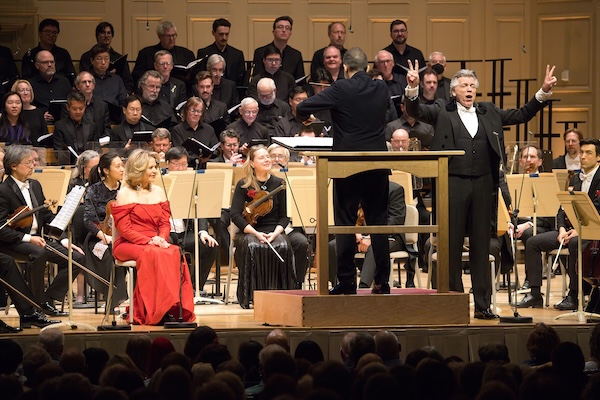
Thomas Hampson as Richard Nixon with the Boston Symphony Orchestra and Andris Nelsons in a performance of Nixon in China. Photo: Hilary Scott
In the winter of 1972, the composer John Adams joined millions of Americans in watching Air Force One land in Peking, China. The scene that followed, broadcast on black-and-white televisions around the globe, struck many as improbable. President Richard Nixon, America’s most virulent anti-communist, descended from the jet stairs with his wife Pat and Secretary of State Henry Kissinger in tow and shook hands with Chinese premier Chou En-lai ahead of a private meeting with Communist Party leader Mao Tse-tung.
While both Nixon and Mao reported that their meeting was warm and collegial, the event was, in fact, a carefully staged political stunt. Adams remembered it as a virtual clash of titans: on one side stood the symbol of free markets, private profits, and the poster child of American business; on the other, the purveyor of the social welfare state fresh from the ravages of the Cultural Revolution. “Nixon and Mao virtually embodied the twentieth century’s great agonistic struggle for human happiness,” Adams wrote in his memoir Hallelujah Junction. “The characters were so vivid they literally cried out for operatic treatment.”
But the success of Adams’s Nixon in China established it as a new kind of American opera, a musical work that wrestled with political hubris. The score, with its nods to white jazz bands, sonorous harmonies, and minimalistic rhythms, dives deep into the psychology of power, pomp, and the painful realities that arise when political promises fade into memory.
In the wrong hands, a production of Nixon in China can easily devolve into a parade of caricatures. Yet, when portrayed with proper nuance, the drama explores the deep contradictions that beset the 37th president and his entourage. Singers Thomas Hampson and Renée Fleming, fresh from their performances of Nixon in China with the Opéra National de Paris, dramatized those personal complexities when they performed scenes from the piece with the Boston Symphony Orchestra last weekend. Conductor Andris Nelsons led the way.
The Latvian conductor has remained in the headlines lately because of his own political crisis, which followed the BSO Board of Trustees’ decision not to renew his contract. In response, many of the orchestra’s musicians and some regular audience members have come out in force behind him. Last Friday night, Nelsons and the musicians came on stage together wearing red carnations as symbols of solidarity. The applause was immediate and fervent.
The performance that ensued wasn’t always pitch perfect, but the enthusiasm with which the orchestra, the Tanglewood Festival Chorus, and guest soloists performed Adams’s scenes matched the collective triumphal spirit. Hampson sang the role of Nixon with stalwart conviction — even as he leaned into comedic impressions of the president’s well-known mannerisms. He flashed the double “V for victory,” wiped his brow nervously, and shook his head in frustration as Nixon drifted off into paranoia. As for his vocals, Hampson was assured throughout, his bold voice capturing the oratorical heft of the opening “News” aria.
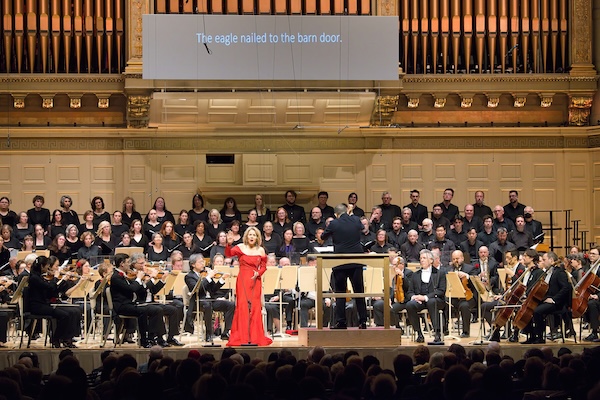
Renée Fleming singing “This is Prophetic” with the Boston Symphony Orchestra. Photo: Hilary Scott
Fleming sang with a beaming tone that captured Pat Nixon’s hopes for a simpler and happier life in “This is Prophetic” from Act 2. That said, Fleming’s version of the First Lady fell into mere subservience to Nixon’s bouts of delusion. Her soaring high notes betrayed surprise when Nixon uttered the ultimate flip-flop: “I opposed China. I was wrong.”
The Tanglewood Festival Chorus sang crisply as the dutiful populace in the opening choruses and cheering masses in the banquet scene. Nelsons led the forces with a firm hand, though the scenes didn’t transition as smoothly as they should. Still, his brisk tempos kept the energy churning forward.
Antonín Dvořák’s From the New World Symphony made for a colorful complement in the program’s second half.
Here, Nelsons was more comfortable as he accented the music’s thick textures and inspirational climactic points with dark lyricism. As renditions go, this was an insider’s view of Dvořák’s familiar score. Nelsons took time to sculpt every passing phrase. He milked key passages, like the first movement’s flute solo, encouraging a generous rubato that never robbed the music of its momentum.
The Largo showcased the depth of the BSO woodwinds, led by Robert Sheena’s languid English horn solo. The Scherzo bounded impishly, offset only by the bucolic Trio. Nelsons drew as much power and assurance from the finale as possible, bringing the audience to its feet. The applause quickly turned into stadium-style cheers. The message was clear: Nelsons has become a living symbol of the power of the band and the public is behind him. Whether the arc of history will curve toward the ousted conductor remains uncertain.
Aaron Keebaugh has been a classical music critic in Boston since 2012. His work has been featured in the Musical Times, Corymbus, Boston Classical Review, Early Music America, and BBC Radio 3. A musicologist, he teaches at North Shore Community College in both Danvers and Lynn.
Tagged: Andris Nelsons, Boston Symphony Orchestra, John Adams, Nixon in China, Renée Fleming