
Theater Review: In “Giant” on Broadway, John Lithgow Towers Above the Material
By Christopher Caggiano
The play is preachy. But John Lithgow is magnificent.
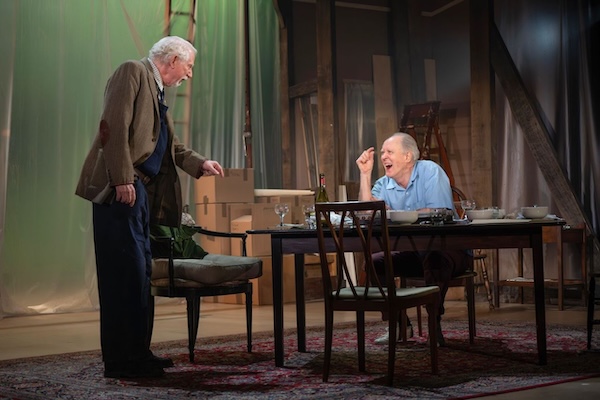
David Manis and John Lithgow in Giant. Photo: Joan Marcus
Let’s get the most important thing out of the way first: John Lithgow is giving one of the finest performances currently on a New York stage, and that alone is reason enough to head to the Music Box Theatre. The play he’s in — Mark Rosenblatt’s Giant, a theatrical reckoning with Roald Dahl’s antisemitism — is another matter. It is earnest and timely but undercut by its own convictions.
The play is set in the summer of 1983. Dahl — newly engaged to his mistress, Liccy, and weeks away from the publication of The Witches — has just published a review of God Cried, a photobook by Tony Clifton and Catherine Leroy documenting the civilian toll of Israel’s 1982 invasion of Lebanon. The review quickly abandoned its ostensible subject and became something uglier: a screed in which Dahl wrote of “a race of people” who had switched from victims to “barbarous murderers,” railed against the “powerful American Jewish bankers” who controlled US foreign policy, and all but announced himself as an antisemite.
His publisher sends two representatives to his English country home: Tom, a British managing director, and Jessie Stone, an American sales director. They are hoping for a statement. Possibly an apology. Dahl refuses. And that, essentially, is the end of the story. Everything that follows is a prolonged back-and-forth with Dahl — irascible, impervious, impish, infuriating — in which the same arguments are revisited from slightly different angles without ever escalating toward a decisive turning point.
For, you see, Giant is a play that is emphatically about something. The difficulty is that the argument has been settled before the curtain rises. Rosenblatt accepts that Dahl is in the wrong and proceeds from there, which is understandable as a moral position, but dramatically limiting. The confrontations feel one-sided — Dahl is positioned to be corrected rather than understood. Jessie Stone — a character Rosenblatt has invented for the play — functions less as a fully realized dramatic presence than as a vehicle for the playwright to interrogate, and at times outright rebuke, his subject. She speechifies for Rosenblatt rather than for herself.
And this is the play’s central missed opportunity. No one is asking Rosenblatt to defend Dahl’s views. But drama thrives on complexity, and Giant never bothers to make a case for why Dahl believed what he believed, no attempt to give his positions internal logic, however wrongheaded, or to suggest that a man capable of writing some of the most beloved children’s books of the twentieth century might have arrived at his ugliest opinions through some twisted, traceable path. Without that analysis, the play feels pat. The irony, of course, is that a more nuanced exploration, yielding a more genuinely unsettling portrait, would have left the audience more deeply disturbed, not less.
There’s also a broader question worth asking. What’s the point of seeing Dahl as a cardboard villain? The pleasure of a character like this — in life as in theater — lies in the provocation, the wit, the benighted charm. Flatten him into a target and you lose all of that.
The didactic impulse is evident in the writing’s texture, too. The exchanges between Dahl and his guests have a relentless, heavy-handed quality; the play stays in an intense, argumentative register for long stretches without any shifts in rhythm — moments of humor, vulnerability, distraction — that might offer the audience a different way into the material. The result can feel exhausting rather than illuminating.
Rosenblatt makes some attempt to humanize Dahl and vary the pace in the second act, offering exchanges like this one:
ROALD: Tough discovery.
LICCY: What?
ROALD: That your elderly fiancé is a Nazi.
LICCY: You’re not elderly.
That tired comic construction lands with a rimshot and not much else. The play’s circularity — which is perhaps intentional, meant to evoke the unresolvable nature of the argument — registers less as a formal choice than as dramatic stasis. We end more or less where we began, with Dahl unrepentant and the moral scales exactly as they were.
One other detail is telling: the night I saw the play, the Playbill contained an insert with an author’s note clarifying which words in the play are taken directly from Dahl. (“Two things, however, are the real Dahl’s: his book review and the play’s final phone call are quoted verbatim.”) That this clarification was apparently deemed necessary suggests the production team was aware that audiences might feel that the playwright had been putting words — or at least attitudes — in Dahl’s mouth.
And yet. None of this is reason to stay home. John Lithgow is giving one of the finest performances in recent memory. Watching him work is awesome in the old sense of the word, something you find yourself leaning toward even when the play around him gives you reason to lean back.
Lithgow’s Dahl is at his most magnificent in the scenes when the character provokes his guests under the guise of merely trying to understand them — drawing them out, asking innocent questions, extending just enough rope. There is a quality of deep, predatory patience to it; you can see Dahl deciding, moment by moment, exactly how much farther to push. Lithgow plays all of it with mercurial precision, flashing between a scowl and a twinkle, between thundering indignation and almost tender curiosity. He finds the nuance in Dahl that the writing fails to provide.
The pity is that Rosenblatt gives him less to work with than he deserves. A more dimensionally written Dahl — less a bundle of provocations, more a fully inhabited human being — would have been an even greater gift to an actor this capable.
Giant is not a play for the ages. It is a topical exegesis in theatrical form: well-intentioned, politically engaged, and dramatically constrained by its own certainty. But it is an excellent excuse to watch John Lithgow do something that very few actors can. That, on its own, is worth a trip.
Christopher Caggiano is a freelance writer and editor living in Stamford, CT. He has written about theater for a variety of outlets, including TheaterMania.com, American Theatre, and Dramatics magazine. He also taught musical-theater history for 16 years and is working on numerous book projects based on his research.
I agree that Lithgow is supremely capable in this role, and that he could have handled an even deeper and more nuanced characterization of Dahl. However, the play convincingly, and sufficiently, succeeds in illuminating many of the simultaneously contradictory facets of Dahl’s character.
I also found the tempo to be near pitch perfect in its inclusion of humor, tenderness, and its willingness to highlight the flaws in each of the characters in turn. I did not find the story arc to suffer from any static qualities – Dahl could be self destructively vile, and to be true to the man, that is simply where the story must lead.
I also believe that Giant, and its ability to illuminate ages old bigotry, particularly when confoundingly vented by people we love, people that are fully capable of compassion and tenderness, is by definition a play for the ages. I also see that, unfortunately, the specific Mid-East conflicts this play revolves about will remain topical for a long, long time.
I don’t think there is one explanation for bigotry. Certain people latch onto it and they may be educated and successful themselves and yet they have this need to be narrow minded and even cruel. Whether it makes them feel somehow superior or gives them a way to express old resentments it certainly not unusual or even to wonder why. It’s as if the reviewer thinks every prejudiced person has been traumatized somehow.
That hardly accounts for the centuries of scapegoating the Jews have endured.
What was interesting to me was how Dahl is so self destructive and needs to hurt people who care for him.
In that was it was more about human nature.
You can’t account for people like Lindbergh or the bigots at Harvard who have quotas for Jews.
Just that there is an ugly side to human nature and we all have aspects of it.