
Doc Talk: From Fiume to Gaza, Salem Film Fest Stares Down History
By Peter Keough
The world almost makes sense at the Salem Film Fest, March 26 through 29.
As in previous years, the Salem Film Fest (for which I am serving as a juror) once again treats viewers to documentaries that do what that genre does best.
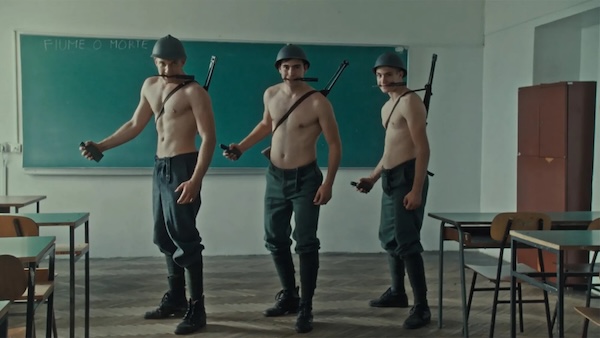
A scene from Fiume O Morte! Photo: courtesy of International Film Festival Rotterdam
For example, in the midst of chaos, injustice, and anxiety, it offers films that analyze the origins and machinations of seemingly incomprehensible events. And in the case of Croatian filmmaker Igor Bezinović’s Fiume O Morte! (2025; screens March 28 at 1 p.m. at the National Park Visitor Center with a recorded Q & A), it does so with engaging inventiveness, mordant wit, and illuminating insight.
In a mostly forgotten historical footnote worthy of a Thomas Pynchon novel, Gabriele D’Annuzio, a Nobel Prize-winning poet, celebrated debauchee, and aspiring Fascist, decided in 1919 to take over the disputed former Habsburg port of Fiume (now the Croatian city of Rijeka) for his beloved homeland, Italy. To that end, he entered the city with a battalion of disgruntled Italian grenadiers and was welcomed by the Italian population. Predictably, the other nationalities who inhabited this polyglot community were not so happy, and the new regime’s popularity plummeted further when D’Annunzio turned the town into his own private kingdom where he and his minions indulged in decadent soirees and pointless military demonstrations. While D’Annunzio and his growing army of Italian malcontents celebrated in their tacky Roman Empire revival, the factories and shipyard shut down, the economy collapsed, unemployment skyrocketed, and Fiume became an international pariah.
Sound familiar? Unlike most would-be tin-pot dictators, D’Annunzio actually won a Nobel Prize, was a genuine — if erratic — genius, and had served in the military during World War I. Nonetheless, when Bezinović queries people on the streets of Rijeka about D’Annunzio, most have never even heard of him. Those who do remember him recall a malignant narcissist (“He was very popular with the ladies and had no teeth,” one interviewee says) whose brief fascist reign proved catastrophic for the town.
To revisit this sordid episode Bezinović enlists current residents of the city to play roles in reenacting the events. They include several aquiline-looking bald men serving as stand-ins for the vain and pompous D’Annunzio, and numerous bemused young people cosplaying as his motley, fanatic troops and retinue. The result is a freewheeling, farcical collage charged with the mordant irony of a more subdued Radu Jude. Archival footage and photos are intercut with present-day, often absurdist recreations, wryly edited to underscore the contrasts between the past and the present, the real and the make-believe. In one scene, a bystander accosts a “soldier” manning a 1920s-era barricade on a bustling Rijeka boulevard and tells him he should instead be at a disco with a pretty girl. He replies that he’s just playing a role and will probably head to a disco later.
But despite the seeming whimsy, Bezinović does not forget the grim toll of such folly. When D’Annunzio’s playacting proves deadly in a final confrontation with reality, the film’s tone turns grave as it depicts the gruesome aftermath of the resulting battle. It is a montage of casualties, the jovial reenactors now seen with wounds expertly recreated by all-too-convincing makeup and prosthetics.
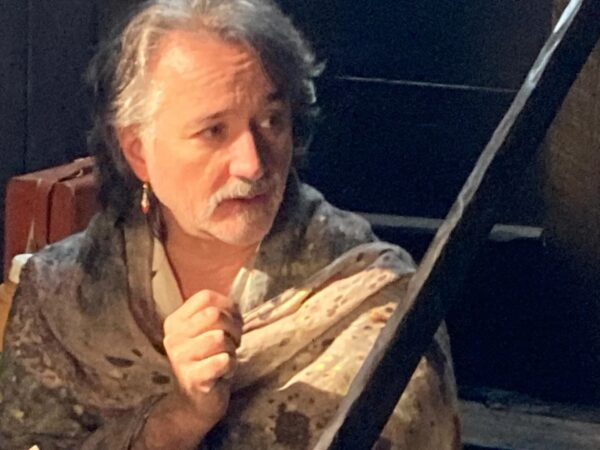
A scene from Tornado Tastes Like Aluminum Sting. Photo: Film Freeway
The nature of artifice and reality takes a different turn in James Rutenbeck and Harmon dot aut’s exhilarating, palimpsest-like short Tornado Tastes Like Aluminum Sting (2025; screens March 27 at 2 p.m. at the Peabody Essex Museum as part of the Shorts Program), which features the production of the latter’s first play of the same name. Diagnosed with autism, synesthesia (as reflected in the title), and ADHD, the queer, nonbinary dot aut survived years of isolation but persevered in recording in notebooks their life of enjambed perception and neurodivergent cognition. That experience is reflected in the inventive, unconventional structure and imagery of the film, which combines rehearsals of the play, interviews with dot aut and others, and visionary animation by Xilia Faye and Ben Luce, who are also on the autistic spectrum.
In the play, which debuted in 2024 at the Contemporary American Theater Festival, dot aut is represented by an alter ego named Chantal Buñuel (after the filmmakers Chantal Akerman and Luis Buñuel), an inspired embodiment of its fusion of the real and surreal. This is a triumph not of outsider art but of insider art, dramatizing and validating the subjectivity of a unique, brilliant individual, with a high point in the play and the film being Chantal drawing on their own inner life to console their father’s nightmarish memories of the war in Afghanistan.
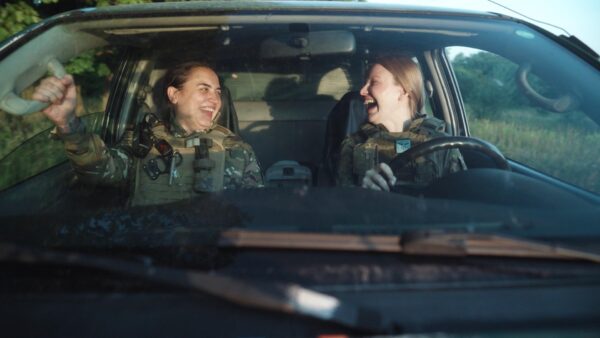
A scene from Cuba & Alaska. Photo: courtesy of the artist
In Yegor Troyanovsky’s Cuba & Alaska (2025; screens March 28 at 3:15 at the Cinema Salem), the contrast between artifice and reality can be abrupt and devastating. Cuba, code name for Yulia, is an aspiring fashion designer whose day job is working as a medic on the front lines of the war in Ukraine. One moment she can be in Paris presenting her latest creations (combining “traditional Ukrainian designs” with “images of a futuristic female warrior”), and the next, injecting painkillers into a blood-soaked soldier screaming in pain. Her partner and best friend, Olexandra — code name Alaska (“Because I’m distant and stone-cold”) — likewise lives on a razor’s edge between a normal life and war’s abrupt horrors: one minute she and Cuba are dancing in celebration of her passing an English exam, the next she’s flying several meters in the air after being blown up by a Russian drone. Gravely wounded, she’ll spend months in rehab learning to walk again.
But the two stay in touch via their often ribald texts, which, along with the intense GoPro first-person footage and Frederik van de Moortel’s subtle, affecting soundtrack, contribute to the film’s compelling clash between the everyday and the outrageous, between moments of hilarity and outbreaks of horror.

A still from Poh Si Teng’s American Doctor. Photo: courtesy of Sundance Institute/ Ibrahim Al Otla
As in Cuba & Alaska, caregivers are prime targets in Poh Si Teng’s American Doctor (2026; screens March 29 at 3 p.m. at Cinema Salem). Children too, it seems. In the opening scene, one of the subjects, Dr. Mark Perlmutter, berates the director when she suggests blurring certain images of casualties from an Israeli strike in Gaza, to preserve their dignity, she explains. “Israel took away their dignity,” says Dr. Perlmutter. “You’re not dignifying them unless you let their bodies tell the story of this genocide.” When a cut is made to the image, held longer than you’d like, you can understand the director’s concern: six infant corpses lie in a row—battered, blood-stained, their tiny grey faces wide-eyed in death.
Dr. Perlmutter, who is Jewish, is one of the physicians of the title. The others are Palestinian American Dr. Thaer Ahmad and Dr. Feroze Sidhwa, who is of Iraqi Zoroastrian origin. All three have volunteered their services to aid victims of the siege of Gaza and have returned home to share their experiences with anyone in the United States willing to listen. Their firsthand accounts of hospitals deliberately bombed and children shot in the head do not seem to have changed many minds — certainly not hawkish politicians like Ted Cruz, whom they have confronted in Washington.
Though discouraged, they have not given up. Perhaps a film like this, with its unemphatic, even-handed tone and unforgettable images of demolished landscapes and destroyed bodies, will make a difference. As with the six little victims seen at the beginning of the film, you must not look away.
Peter Keough writes about film and other topics and has contributed to numerous publications. He was the film editor of the Boston Phoenix from 1989 to its demise in 2013 and has edited three books on film, including Kathryn Bigelow: Interviews (University Press of Mississippi, 2013) and For Kids of All Ages: The National Society of Film Critics on Children’s Movies (Rowman & Littlefield, 2019).
Tagged: "American Doctor", "Cuba & Alaska", "Fiume O Morte", "Tornado Tastes Like Aluminum Sting", Gabriele D'Annunzio, Harmon dot aut, Igor Bezinovic, James Rutenbeck, Poh Si Teng, Salem Film Festival