
Theater Review: Eddie Izzard’s “Hamlet”: A Bare-Stage Rebellion Against a World Out of Joint
By Michael Marano
I’m thinking that a one-person performance of Hamlet by a Brit transwoman might get under Trump’s necrotic skin.
Eddie Izzard’s Hamlet, adapted by Mark Izzard and directed by Selina Cadell.
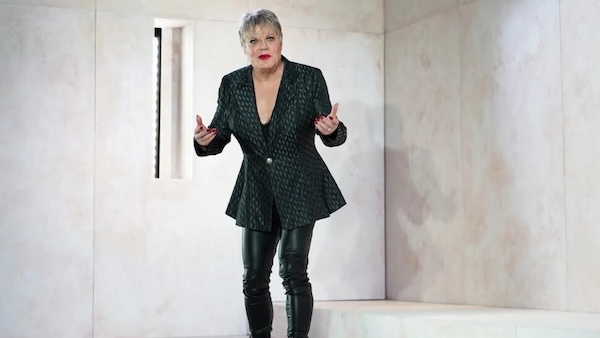
Eddie Izzard in Hamlet. Photo: Carol Rosegg
In her informal prologue to the audience just before Eddie Izzard began her one-person performance of The Tragedy of Hamlet at the Shubert Theater on Sunday (in which she enacts 23 roles alone on a plain stage), she conflated the play — in her words, “about a family tearing itself apart” — with our current political reality.
She has been doing this one-person iteration of Hamlet around the world for about two years now, so it’s safe to say she’s evolved the work to suit the times. Or, perhaps, the times have devolved to suit the work. It’s worth noting in this context that she’s booked for one week at the Klein Theatre in Washington, DC, as of this writing, just a 17-minute bike ride from Trump’s desecrated (and now closed) Kennedy Center. Just as Claudius can’t tolerate a performance about fratricidal murder, Trump can’t tolerate anything that’s “woke,” whatever that means. I’m thinking a one-person performance of Hamlet by a Brit trans woman might get under his necrotic skin.
The Trumpian era is one that’s “disjoint and out of frame,” which raises the question of what cultural function Hamlet serves in our current situation. How does Izzard’s The Tragedy of Hamlet land now that we have a lecherous, treasonous, incestuous, usurper tyrant on the throne? We also have in this cultural moment Chloé Zhao’s Hamnet and Mamoru Hosoda’s visually stunning fantasy anime Scarlet, the titular heroine of which is a gender-flipped warrior Princess Hamlet who battles her usurper Uncle Lord of the Rings-style across a nameless void that is a kind of Purgatory.
Hamnet and Scarlet are purely cinematic and immersive experiences. Izzard’s Tragedy functions at the almost opposite end of the spectrum. It’s profoundly intimate and, through the occasional nudge or wink to the audience, it’s outright Brechtian, nearly a cabaret act, at times even verging on burlesque. By her own admission, the production is an extension of her work as a street performer. What’s remarkable about her Tragedy is what the production lacks. There are no props, or costume changes. The stage is two stylized walls with a narrow window in each. The area in which she performs is defined by Negative Space. She seems to have been inspired by Peter Brook’s statement: “I can take any empty space and call it a bare stage. A man walks across this empty space whilst someone else is watching him, and this is all I need for an act of theatre to be engaged.”
The barrenness of Izzard’s Tragedy is its greatest strength. Like Brook’s famous 1981 staging of Carmen that reduced Bizet’s magnum opus to less than 90 minutes and used only a carpet for a stage, Izzard’s Tragedy does much more with less. Her shifts from character to character are not overblown; she forsakes broad differences in diction and affect, save for a killer take on Rosencrantz and Guildenstern that I’ll not spoil. It’d be easy to do an over-the-top one-person Hamlet; Izzard’s restraint forces the audience to invest in her staging in a way that is active rather than passive. Sly winks now and then, especially as they relate to our current political reality, break the Fourth Wall. Izzard herself says this interaction was intended to recall how audiences at the Globe participated in the original stagings of Shakespeare’s plays.
I think it’s this minimalist approach, which requires dynamic audience investment, that led to some of the theater critics’ brutal reviews of Izzard’s Tragedy when it debuted in the UK in 2024. Nick Curtis, in his one-star review at The Evening Standard, wrote: “With little classical experience, this clown wasn’t going to get to play Hamlet unless she did it herself. So she did, and it’s a disaster that diminishes both play and performer.” In another one-star review in The Guardian, Arifa Akbar found the starkness of the production to be an enormous detriment, writing as her coup de grâce, “Never mind the murder at the heart of Hamlet. This production feels like its own massacre.”
But Izzard’s Hamlet doesn’t function as theater in the way for which these UK critics bashed it. Yes, this is theater. But that’s only one-third of what this evening is. This is also performance art and street performance. It’s agitprop, albeit not entirely successful. Izzard rushes her delivery, at times. A few pauses and beats would have improved the production a hell of a lot.
By making this Tragedy performance art and street performance, she’s pushing Hamlet’s “time out of joint” into our own space, which is “out of joint.”
Is this entirely successful live theater? No.
But this is a bold work of performance, maybe better produced in the round or, in the way Peter Brook proved his point about making any space a stage, performed in town squares, street corners, and parks. Izzard doesn’t break the diegetic barrier. She dismisses it. And her Hamlet is more challenging and interesting than most because of that.
Is Izzard’s Tragedy of Hamlet the thing that will catch the conscience of the mad king? Not at all. But if you let it, it might catch your imagination and help you cope with certain things that are rotten in DC.
Author, critic, and personal trainer Michael Marano was first exposed to Hamlet via Richard Chamberlain’s production on the Hallmark Hall of Fame. At five, he had no idea what was going on, but was mesmerized.
Saw this in Tāmaki Makaurau Auckland. An extraordinary performance. Challenging. Fast dialogue. But stunning. Thrilling. It will stay with me for years.