Film Review: Echoes of Passion — Arnaud Desplechin’s “Two Pianos” Plays on the Keys of Loss and Love
By Erica Abeel
Here’s a drama that explores with uncommon pathos the ways that people confront—with grace or with fury—what they’re compelled to give up.
Two Pianos, directed by Arnaud Desplechin. Screening at Rendez-Vous With French 2026 through March 15.
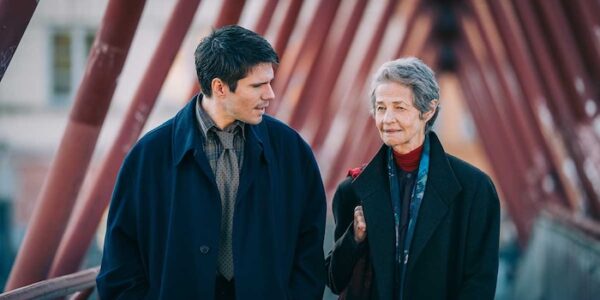
François Civil and Charlotte Rampling in Two Pianos. Photo: Emanuelle Firman/Why Not Productions, Courtesy of TIFF
Two Pianos from French auteur Arnaud Desplechin is kind of a mess—but it’s a glorious mess that captures, lightning in a bottle, the feel of lives lived. At moments the film risks imploding from its mix of melodrama, hurtling pace, and chaotic plot. But once I settled in for the ride, I found deeply affecting both the characters and their dilemmas, and the film’s inquiry into how the past leaches into the present. How, in William Faulkner’s formulation, “The past is never dead. It’s not even past.”
I can forgive, too, the sometimes outlandish swerves of Desplechin’s plots because he’s never formulaic, never feels contrived by committee—as too many awards contenders do. His work plays like memoir plumbed from the deepest recesses of himself, idiosyncratic as hell yet resonant for us all.
Premiering in New York in Rendez-Vous with French Cinema (courtesy of Unifrance and Film at Lincoln Center), Two Pianos offers a tone poem more than simply a duet. It mimics the dissonance of a musical piece as a means of creating dramatic tension before the melody—and the plot line—finally resolves. Desplechin requires work; he asks us to float with him in this suspended state before we latch onto the film’s intent.
Mathias (François Civil), a former piano prodigy, has been summoned back to Lyon by Elena (Charlotte Rampling), his one-time teacher and mentor, from a mysterious, self-imposed exile in Japan. Elena hopes that Mathias, her most cherished student, will join her in a series of duets that will reset his career and cap her own. (This premise briefly gave me pause because Mathias’s eight-year sabbatical would have likely torpedoed the thirty-year-old’s career as an international virtuoso.)
A second story foregrounds, bien entendu, an all-consuming love. Claude (the luscious Nadia Tereszkiewicz, adored by the camera) is contentedly married to a gallerist and the one-time best friend of Mathias. An incident early in the film, though, points to deep history between Mathias and Claude. Fresh off the plane from Japan, Mathias attends a party at Elena’s. The elevator door opens on Claude—and Mathias faints dead away in semi-comic fashion. Vintage Desplechin! You can’t accuse his people of tepid emotions. The story also flirts with the supernatural, when Mathias becomes obsessed with a boy he notices in a playground, as if he’d spotted the ghost of his own boyhood. This seeming visitation proves to have a plausible explanation.
Desplechin is partial to the manifold cruel ways life throws you a clip from behind. So sure enough, an unexpected tragedy abruptly puts Elena back in play. She’s now free to explore her amorous history with Mathias. And do they ever explore—in the mother of all sex scenes, in a vestibule, fully clothed yet! Trust the French to remind us.
The hand-held camera of cinematographer Paul Guillaume is right in there with them and contributes throughout to the film’s sense of immediacy. For all its vibrancy, Two Pianos is suffused with loss, a motif reflected in the autumnal hues of the production design. Elena is an inspired vehicle for Charlotte Rampling, and her Elena is a magnificent creation. Set against the volatility of Mathias and Claude, she’s a clear-eyed Minerva, unwavering in her marriage to her art. But now her memory is betraying her; she’s eyeing what she regards as her own irrelevance, and in a searing scene, loses her usual steely composure.
What happened in the past between Claude and Mathias I leave you to discover. Suffice it to say that she chose to marry his best friend, the gallerist, instead of him. The head has its reasons. Gorgeous Claude comes off as flighty and narcissistic. In a cuckoo exchange with Mathias, she remarks she has no interest in music (!) and laments that she’s no femme fatale. Such a female character is a throwback that might alarm the PC police (though in France they’re not easily alarmed).
In truth, Claude may have married her gallerist out of a sense of self-preservation and need for stability. A grand passion may not be tailored for the long term. In the world of Desplechin, true artists come off as inherently unstable and unsuitable partners, wed as they are, like Elena, to their work—or tipping toward madness, like Mathias, who’s also saddled with a drinking problem (again a bit counterfactual, since a keyboard virtuoso requires relentless discipline).
Never mind Desplechin’s liberties with the facts. In Two Pianos he’s orchestrated a rich ensemble piece for grownups and cinephiles. Here’s a drama that explores with uncommon pathos the ways that people confront—with grace or with fury—what they’re compelled to give up.
Erica Abeel is a novelist, critic, and former professor at CUNY. Among her novels are Wild Girls, named a Notable Book by Oprah Magazine and now available on Audible; and The Commune, a comic satire on the launch of Second Wave Feminism that Kirkus called “a joyous literary romp with hidden depth.” Her novel The Solstice Summer is forthcoming from She Writes Press.
Tagged: "Two Pianos", Arnaud Desplechin, Charlotte Rampling, Hippolyte Girardot