Visual Arts Feature: “Picturing Isabella” — The Art of Staying Elusive
By Hannah Brueske
The exhibit suggests that Isabella Stewart Gardner wanted her art curation, intellect, and fashion sense — the areas of her life she had the most agency over — to be her legacy, not her image.
Picturing Isabella at the Isabella Stewart Gardner Museum, Boston, through June 21.
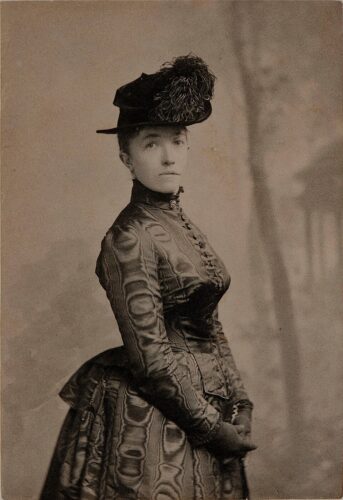
Isabella Stewart Gardner in 1888. Photo: Isabella Stewart Gardner Museum
This year, via multiple exhibits, the Isabella Stewart Gardner Museum had decided to explore the theme of “Persona” in photography — and who better to dissect under gallery lights than the museum’s founding mother herself?
But it turns out that she was an evasive subject. In Picturing Isabella, on display in the museum’s Fenway Gallery, curator Sylvia Hickman has attempted to put together a photographic chronicle of a deeply private woman. This cultural mover and shaker was somewhat elusive, at least when it came to being photographed. During her lifetime, Isabella Stewart Gardner was among Boston’s most eccentric socialites, one who made a lasting, indelible imprint on the city. But, even though her lavish lifestyle and fashion sense sent disapproving tongues wagging, she was sparsely photographed.
“This seemingly contradictory attitude is the central tension of her biography and image making,” Hickman said. “The through line of this exhibit is her desire to be a private person, to not be photographed … combined with, by all accounts, somebody who was very theatrical and outgoing in a social setting.”
Isabella made a great effort to assert control over her public image, constructing an impenetrable boundary between her public and private self. So in a tiny gallery that Hickman affectionately calls a “walk-in closet” sits a relatively small collection of recorded photographs of the patron of the arts. The display is split into four carefully curated sections: “Early Photographs,” “Dodging the Camera,” “Selectively Posing – Curating Spaces as Persona,” and “Selectively Posing.”
In the shots taken at the height of Isabella’s fame, during her middle age, she is almost always veiled and located in public spaces, such as a well-kept backyard or the construction site of the museum itself. A few selectively posed images come along during her later life, photos that suggest her personality and reveal her face, such as one of her holding a book, taken by trusted friend Adolf de Meyer, who would become the official photographer for Vogue.
“As with many things Isabella, we have a lot of material and a lot of knowledge, but not a lot of why,” Hickman said. “She didn’t write a lot about why she did things, and we don’t have her side of a lot of her correspondence.”
There’s only one quote directly from Isabella in the show, an excerpt from a letter to a friend, and it offers little clarification for why she was camera-shy: “I’m never photographed unless by some Kodak fiend who does it on the sly and without my permission. I’m sorry to disappoint you.”
In order to put the exhibit together, Hickman relied on some creative interpretation and guesswork, digging into the museum’s archives to select materials, including newspaper clippings about Isabella that could pass as fodder in modern tabloids and gossip columns.
The centerpiece of the show is a 1908 picture of Isabella with her friends A. Piatt Andrew and Jack Mabbett. Her face is strikingly shrouded by a black veil — but her matching gloves, funky hat, and elaborate gown reveal things about her personality.
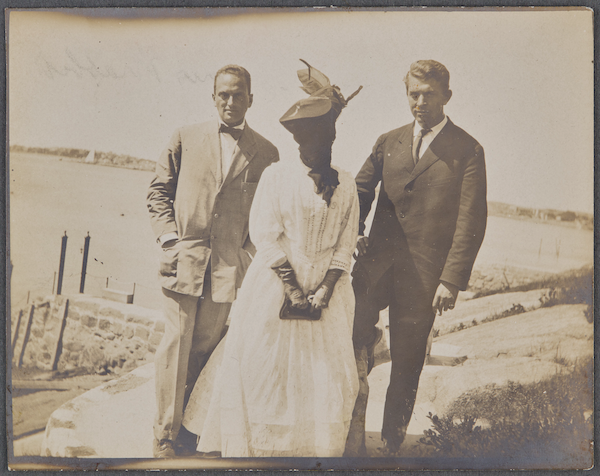
Isabella Stewart Gardner with her friends A. Piatt Andrew and Jack Mabbett in 1908. Photo: Isabella Stewart Gardner Museum
The exhibit suggests that Isabella wanted her art curation, intellect, and fashion sense — the areas of her life she had the most agency over — to be her legacy, not her image. “I would love people to take away this idea of her curating and creating spaces as an extension of her legacy and her persona,” Hickman said. “And I would love it if people, walking through the galleries in spaces beyond this room, think about how the creation of that space and the way we put it together is an extension of herself as well.”
There is no doubt that she succeeded. Isabella’s imprint on the museum, where she lived in private living quarters on the fourth floor until her death in 1924, remains indelible. As proof, Hickman pointed to one of Isabella’s custom gowns in a photograph with her close friends. She said visitors to the museum will recognize a panel of the dress’s fabric, which Isabella cut herself, and today still hangs under the museum’s crown jewel, Titian’s Rape of Europa.
[Note: For those less interested in Isabella herself, the exhibit usefully offers an intriguing look at the evolution of photo technology, exploring the ways the medium changed over the course of Isabella’s life — the daguerreotype was introduced just a few years before her birth in 1840.]
Hannah Brueske is a senior journalism student at Emerson College, with a special interest in feature stories, arts reporting, and documentary filmmaking. She is active in campus publications as a projects editor for The Berkeley Beacon, Emerson’s only independent student newspaper, and the editor-in-chief of The Independent, an arts magazine that covers independent art. She just finished directing her first documentary short about the experience of transfer students and hopes to work on more documentary films soon. After graduating next December she plans to move to New York City to continue chasing and contributing to the worlds of art and culture.