Film Festival Review: Sundance 2026 — Sayonara
By David D’Arcy
Reviews of Josephine, the film that won Sundance’s top award for 2026 and of Aanookibijigan and The Gallerist.
The Sundance Film Festival as we knew it is over. The festival is moving to Boulder, Colorado, another town filled with real estate that you can’t afford.
But why now, just at a time when the infrastructure in Park City, Utah had grown into what Sundance needed, like good projection and comfortable theaters? The official-enough story is that Park City no longer wanted the festival that put it on the map, that it no longer needed the crowds in late January — once a dead time for tourism. Those crowds put money in the town’s pocket
It could be that the ski area operators thought that Sundance filled the town with people who kept skiers off the slopes. Didn’t the rising lift ticket prices do that? COVID took the rich out of crowded cities and crowded them into resort towns. So Park City became unaffordable for anyone but the ultra-wealthy. Still, people at all levels of the film business somehow found a way to keep coming.
I can’t imagine the next Sundance Film Festival will have an easy transition to Boulder, a college town that was once a pre-Austin hub for startups, highly paid engineers, entrepreneurs, and people living on trust funds with expensive outdoor clothes. Boulder is an established place, and there’s not much room for expansion — if Sundance has any grand ambitions. Lodging will be expensive. Back in January, the Sundance Festival was chasing after places for its 2027 volunteers to stay. Liberal Boulder is also a place where parking spaces are as scarce as Trump voters. Of course, there’s always Denver, an hour away or more, which, depending on traffic, is farther than Salt Lake City is from Park City. That’s a long bus ride for a movie.
Can Boulder beat the logistical odds? I’m happy to be proven wrong, though it might not be necessary. Most of the audience may just want to see films remotely, given the logistics. Still, Boulder has a football stadium that can seat 50,000 people and, if you can seat them, you have to house those who aren’t heading home through the inevitable traffic jams. 50,000 is more than the theatrical audience in the US for all but a handful of docs. “Stadium seating” for independent films? Don’t rule it out. By next January, they may try anything.
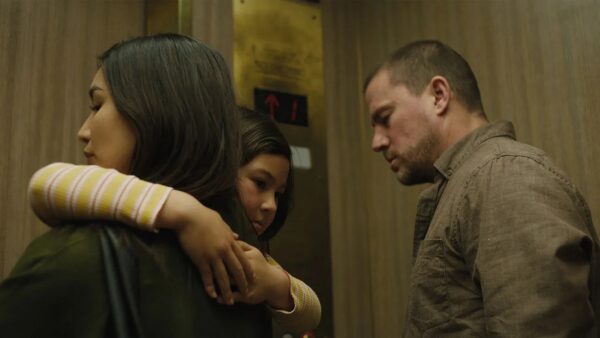
A scene from Beth de Araujo’s Josephine. Photo: Sundance Film Festival
The film that won Sundance’s top award for 2026, and kept coming up in conversation, was Josephine, directed by Beth de Araujo.
It was typical of a feature that premieres at Sundance: a low-budget look, a small cast including a pair of stars working for less than they usually earn, an absolute unknown (young Mason Reeves) in the defining role of the film, a moving, but conventional, approach to drama and cinema, and enough of an edge that mainstream investors might not have been the first to support the project.
That edge is the central event of the story. A young girl, Josephine (Mason Reeves), is out running with her buff athletic father (Channing Tatum), in Golden Gate Park in San Francisco. (“Quiet” sections of parks in San Francisco are notoriously dangerous.) As father and daughter both run toward their next destination on separate paths, the little girl sees a woman runner stop and walk into a public bathroom. A bearded man follows her. We hear screams. The woman escapes, and runs outside, and the aggressor catches her and rapes her. Josephine observes the whole thing.
The father arrives. So do the cops. The victim refuses a rape kit. But Josephine may be able to testify. A family crisis follows. Josephine asks her parents about rape, a new word that she has just learned. Both parents struggle with how to protect their daughter, who seems emotionally numbed by what she had witnessed.
San Francisco being San Francisco, the attacker reappears; there seem to be no restrictions on his bail. The porous security provided by the legal system comes into question. I won’t spoil the drama of the film’s crescendo in a trial, but the emotionally contained ending defies audience expectations. Young Josephine, as a witness, exudes a new sense of composure. Trauma hasn’t destroyed her, nor has the legal system. Maybe that’s the best her parents can expect.
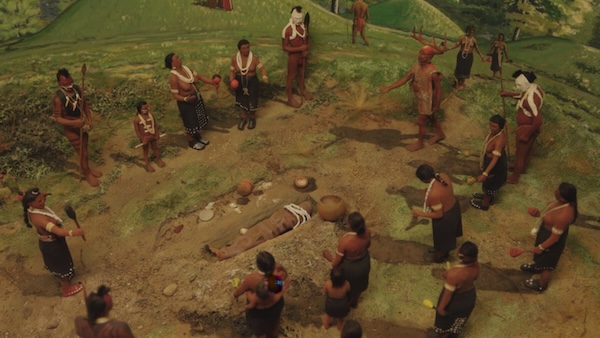
A scene from Adam and Zack Khalil’s Aanookibijigan. Photo: Sundance Film Festival
Another film with themes that Sundance has explored for decades was Aanookibijigan, directed by Adam and Zack Khalil. The documentary examined the treatment of indigenous human remains by US institutions, spurred by an investigation of claims by Indigenous people of Michigan tribes against Michigan State University.
The title, unpronounceable by almost everyone at Sundance, is actually longer, with the appendage “[ancestor/great grandparent/great grandchild]”. The name reflects the notion that native tribes see generations as closely connected, a respect that is the source of the reverence for the dead and for Indigenous burial sites.
As a narrative, the film operates on two levels. It observes a campaign to recover human remains from Michigan State, and it tracks the once-accepted practice of institutions to collect and study those remains, often to justify racialist notions of native inferiority. We’re told that the practice began in the U.S. when Thomas Jefferson exhumed native burial sites. That process of cultural accumulation expanded under the new Smithsonian Institution, which began to collect in massive quantities. Native populations were declining from disease and wars, so the Smithsonian (founded 1846), also bought human remains internationally. Lonnie Bunch, its director — for now, at least, given Trump’s antipathy toward him — has publicly apologized for the stockpiling and mishandling of human remains.
MAGPRA, the Native group that organized repatriation efforts in Michigan, eventually triumphs in its negotiations with Michigan State, which gives the filmmakers a chance to film a reburial ceremony from a distance. Sorry for the spoiler, but this is all a matter of record now. Native traditions ban the filming of human remains. The Kahlil brothers, veterans of the contemporary art scene, use abstraction and some colorful spotlighting to make do in an effort to fill in the gaps where images can’t be used. What seems to have been decisive in moving institutions to do the right thing is a rise in the political power of Indian tribes since the seizure of Alcatraz in 1969. A long march indeed.
The struggle is far from over, we’re told. In much of the United States, Indian claims for the remains of the dead are much less advanced than in Michigan. And burial sites are everywhere, though not, of course, in Christian cemeteries. Note that tribes were not Christian and Indians have not been covered, until recently, by legislation protecting graves. We can expect more disputes wherever people or businesses want to build, experts warn.
We can also expect more films about human remains. To cite one major example from another festival as evidence, In the last two years, the Berlin International Film Festival has shown wrenching films about the collecting and trade in body parts from German colonies in Namibia (Southwest Africa, where a war of extermination is seen as a rehearsal for the more extensive killing campaigns to come under Hitler), and in Tanganyika (now Tanzania, East Africa) where shipments of skulls and other human remains were sent to museums and the collectable market in Europe.
Lars Kraume’s Measures of Men (Arts Fuse review), a scripted drama, was set in “the Kaiser’s Holocaust” in Namibia in the early 20th century. The Empty Grave, a documentary from co-directors Agnes Lisa Wegner and Cece Mlay, tracks the shipments of bodies and skulls to Germany following the mass executions of natives charged with rebellion in German East Africa. Africans searching through museum archives for these bodies call their project a never-ending funeral.
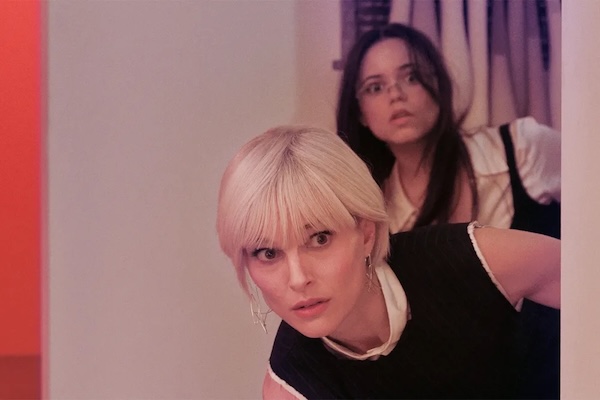
A scene from Cathy Yan’s The Gallerist. Photo: Sundance Film Festival
The Gallerist, a contemporary art world farce with Natalie Portman in the lead, is not a film that’s intended to be taken seriously — at least I hope not. The setting for Cathy Yan’s comedy is Art Basel Miami Beach, a stop on an ever-expanding tour for the art crowd. A web of offshoots has just added Qatar to the list of locations. Follow the money, for now at least.
A young stylish dealer (Portman) has just opened a gallery. She’s showing a long, pointed object that looks like a spear. It’s an enlarged version of an instrument that’s used to neuter male livestock. Does that sound vengeful enough? Enter into the gallery a cocky and slovenly influencer (Zach Galifianakis) who mocks the work and the artist, a young Black woman, and proposes that the dealer sign the space over to him for a pop-up site. Note the inference: real estate is more valued in Miami than art. (Maybe the sequel will be set in Boulder after Sundance opens.) The dealer turns the guy down, they trade insults and, as he turns to leave, the pompous ass slips on a puddle fed by water dripping from a leaky ceiling. He falls on the spear — and dies. Suddenly, crowds approach the gallery, and there’s nowhere to put the body. It (or he) becomes part of the work of art.
It’s easy to mock contemporary art and the market for it — there’s a new version of “my kid could paint that” every day. The filmmakers seem to be aiming for an expansive market beyond the art world — the reasoning is, the broader the comedy, the better (and the more critic-proof). Portman, who spent time at Art Basel Miami Beach to prepare for the role, looks the part here. She is dressed to kill. Fashion promotions are crucial for the success of films like this one. And, in an art market dependent on growth, getting Portman’s young fans through the turnstiles at art fairs is another revenue stream. (Side note — stories about art being stolen or sold seem to be crowding out art criticism in the media.)
And there’s a pedigree for this farce about making a killing on a work of art. Fans of the pre-Indie low-budget film director Roger Corman will remember A Bucket of Blood (1959), in which a hapless busboy at a beatnik cafe kills his landlady’s cat by mistake and hides the carcass in plaster. Instant sculpture. In this version of “art is whatever you can get away with,” “Dead Cat” impresses a hip audience. Even better, the object sells, as do other corpses disguised as sculptures that follow. Skepticism about modern art goes way back. In 1956, Time magazine mocked Jackson Pollock by dubbing him “Jack the Dripper.” You can watch the spoof of Beat culture in A Bucket of Blood online for free. If there was an acknowledgement in the credits of The Gallerist, I didn’t see it.
David D’Arcy lives in New York. For years, he was a programmer for the Haifa International Film Festival in Israel. He writes about art for many publications, including the Art Newspaper. He produced and co-wrote the documentary Portrait of Wally (2012), about the fight over a Nazi-looted painting found at the Museum of Modern Art in Manhattan.
Tagged: "Aanookibijigan", "Josephine", "The Gallerist", Adam and Zack Khalil, Agnes Lisa Wegner, Beth de Araújo, Cece Mlay, Measures of Men, Natalie Portman, Sundance Film Festival, Sundance Film Festival 2026