Theater Review: Gamm’s “Ghosts” — Ibsen’s Domestic Inferno Burns with Contemporary Heat
By Bill Marx
Director Tony Estrella’s version of Ibsen’s tragedy carves out an energetic path — the action moves along with compelling alacrity.
Ghosts by Henrik Ibsen. Adapted and directed by Tony Estrella. Staged by the Gamm Theatre at 1245 Jefferson Blvd., Warwick, RI, through March 22.
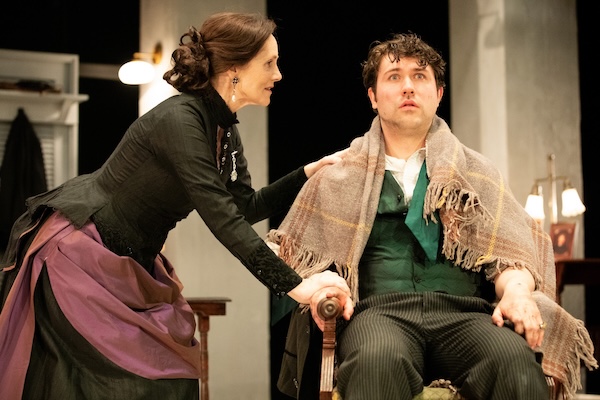
L to R: Jeanine Kane (Mrs. Helen Alving) and Liam Roberts (Oswald Alving) in the Gamm Theatre production of Ghosts. Photo by Cat Laine
At first sight, the Gamm Theatre’s poster for its staging of Ghosts — the letters of the play’s title aflame — seems somewhat off. Ibsen’s spirits are hidden specters, phantom-like sins from the past that do their corrosive work mainly in silence, often through contamination and fear. That was very much the takeaway in the last production of the script I reviewed, Carey Perloff’s haunting 2017 staging at the Williamstown Theatre Festival. The proceedings went so far as to suggest that Ibsen’s cursed characters (Mrs. Alving and company) are dead bourgeois walking, introducing an air of the uncanny through the presence, onstage, of the figure of composer/musician David Coulter, who contributed a series of atonal and/or lyrical sounds by way of water glasses, string instruments, percussion, and electronics. This was an enticing vision of the play as “a horror story, a morbid gathering of softened brains.”
There is nothing as unconventional or unearthly in this lively production of Ghosts. Director Tony Estrella instead focuses on how Ibsen’s tragedy torches our idealization of family life through the excoriation of the cowardice of the “free-thinking” Mrs. Alving and the Christian hypocrisy of Pastor Manders. In this case, the infernal flaming title on the poster is right on. The play is Ibsen’s “Burn Baby Burn”: not only is domesticity a target for incineration, but the escapist duplicity of a feverish, diseased society, represented by the fiery end of the new orphanage, which was dedicated to the memory of the socially admired yet thoroughly reprehensible Captain Alving. In this sense, Oswald’s syphilis is a metaphor for a collective illness, a fear of reality. When Ibsen’s privileged characters aren’t denying the truth for the sake of respectability, they’re wrapping selfishness in the garb of charity. Sound familiar? Estrella’s program notes claim that Ghosts is “a story for right now.” Who could argue? Today, lies have reached a plague pitch, and the national paralysis in confronting the blight, at least among the wealthy liberal set, is not unlike Mrs. Alving’s.
Luckily, there’s nothing inert about the production’s performances, which are generally straightforward and strong. Jeanine Kane completes all of Mrs. Alving’s emotional shifts with wily dabs of finesse; she’s sensitive to the character’s devolution. In the course of a wild Aristotelian day, the woman goes from being a smug “progressive,” who believes she has finally cleansed herself of her polluted past, to a shell-shocked victim, rocked by ugly revelations that trigger inevitable disasters. Kane underlines that this is the fall of a woman from self-interested grace; she must kill what she believes she loves best.
As for the puritanical Pastor Manders, Jim O’Brien is a suitably bloodless, prevaricating merchant of grace — his brand of Christianity snuffs out any possibility of moral courage. Still, O’Brien can’t suggest a man whom the passionate and intelligent Mrs. Alving would have fallen for in her youth. Jackie Scholl supplies an unusually feisty Regina — she adds plenty of zing when the maid (who is angling for Oswald) gets the opportunity to tell Mrs. Alving what she thinks about her and her delusions of nurturing. Liam Roberts makes for a robustly bohemian Oswald; the character is often played as feeble, trying to put up a front of strength. Roberts may be down, but his Oswald is still very much kickin’.
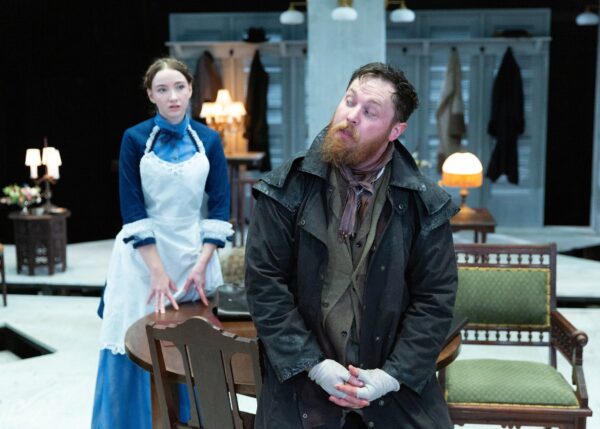
L to R: Jackie Scholl (Regina Engstrand) and Kelby T. Akin (Jacob Engstrand) in the Gamm Theatre production of Ghosts. Photo by Cat Laine
The director has based his adaptation of Ghosts on R. Farquharson Sharp’s 1911 translation, and in his effort to update the language he has pumped in loads of contemporary argot (“take the money and run,” “piece of shit”). That creates some tonal discord, given the period setting, but there is no denying that Estrella’s revamping carves out an energetic path — the action moves along with compelling alacrity. Still, perhaps because of the pacing, the script’s resonances are at times undermined. Sometimes depth of characterization and dramatic impact are lost in the shuffle. For example, the fiery demise of the orphanage comes off as perfunctory — despite the enormity of the destruction and what it means, the characters don’t seem upset or saddened by the loss. Manders is mainly traumatized by the possibility he will be blamed for the conflagration. Kelby T. Akin, as Jacob Engstrand, zestily blackmails the cleric here, relishing his sudden whip hand as an underling. Still, what should be a thunderous debacle wafts by (at least no children were in the building, as they are in the later fire in The Master Builder).
But Estrella’s adaptation takes some effective imaginative liberties with the play’s famous finale. Oswald is usually comatose at this point: vacant, sitting in a chair, staring emptily into space. He is blind to the gleaming morning light flooding the room. (Alex Foley’s lighting is poky in this scene and elsewhere.) Mrs. Alving is immobilized, horror-struck, wondering if she has the will to euthanize her son. Some actresses scream in agony or whimper softly. At the Gamm, this taciturn coup de théâtre receives a quasi-hysterical overhaul: Oswald has collapsed and is stretched across a table, in pain, loudly and repeatedly shouting “The sun!” He is not going into that good night quietly. The words sound like commands as well as cries of madness. (The ghost of Captain Alving?) During Oswald’s distress, the pill case drops to the floor; to retrieve the capsules, Mrs. Alving will have to get down on her knees. Ibsen would no doubt be pleased by the punishing terror of the image — it is an act of humility and reverence, surrender and abnegation, before the dreadful reality she gave birth to.
Bill Marx is the editor-in-chief of The Arts Fuse. For over four decades, he has written about arts and culture for print, broadcast, and online. He has regularly reviewed theater for National Public Radio Station WBUR and The Boston Globe. He created and edited WBUR Online Arts, a cultural webzine that in 2004 won an Online Journalism Award for Specialty Journalism. In 2007 he created The Arts Fuse, an online magazine dedicated to covering arts and culture in Boston and throughout New England.
Tagged: Gamm-Theatre, Ghosts, Henrik Ibsen, Jeanine Kane, Liam Roberts