
Book Review: The Cambridge Five — Stripped of Romance
By Tom Connolly
In Stalin’s Apostles, Antonia Senior dismantles the mythology of the gentleman spy, exposing the murderous loyalties behind the old school tie.
Stalin’s Apostles: The Cambridge Five and the Making of the Soviet Empire by Antonia Senior. PublicAffairs, 480 pages, $35.00
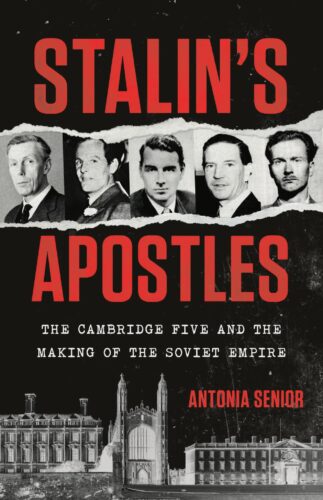 This gripping, clear-eyed account of the infamous Cambridge spy ring begins by focusing on an unassuming meeting between Comintern spymaster Arnold Deutsch and a twenty-two-year-old Harold “Kim” Philby on a London park bench in June 1934—an ideological chinwag that served as one of history’s turning points, a seemingly casual encounter that helped secure Josef Stalin’s geopolitical ambitions. From here on, Antonia Senior proceeds toward her goal: to overcome the romanticized Old Boy mythology of the intellectually conflicted British upper classes. She puts Harold Adrian Russell “Kim” Philby, Guy Francis de Moncy Burgess, Donald Duart Maclean, Anthony Frederick Blunt, and John Peever Cairncross as key elements in the success of the Soviet hegemony.
One of the book’s crucial contributions is to undercut naïve nostalgia, even today, over these “gentlemanly,” “idealistic,” or “misunderstood” bespoke vipers, a mystique reinforced in dramas, films, and books. The most egregious example is the 1981 play Another Country and its 1984 film version, which practically anoint Guy Burgess as a martyr to English homophobic hypocrisy. Alan Bennett’s arresting television drama (and later play) An Englishman Abroad soft-soaps Burgess as well.. Bennett was harsher with Blunt in 1988’s A Question of Attribution, but Blunt was a notorious cold fish who had none of Burgess’s scapegrace appeal.
Worse yet was Graham Greene’s apologia for his friend Kim Philby. The writer went so far as to provide the introduction to Philby’s self-serving memoir, My Silent War, at one point writing:
Like many Catholics who, in the reign of Elizabeth, worked for the victory of Spain, Philby has a chilling certainty in the correctness of his judgment, the logical fanaticism of a man who, having once found a faith, is not going to lose it because of the injustices or cruelties inflicted by erring human instruments. How many a kindly Catholic must have endured the long bad days of the Inquisition with this hope of the future as a riding anchor. Mistakes of policy would have had no effect on his faith, or the evil done by some of his leaders…. If there was a Torquemada now, he would have known in his heart that one day there would be a John XXIII.
Echoing E. M. Forster’s sentiment—“If I had to choose between betraying my country and betraying my friend, I hope I should have the guts to betray my country”—Greene defended Philby directly: “He betrayed his country—yes, perhaps he did, but who among us has not committed treason to something or someone more important than a country?”
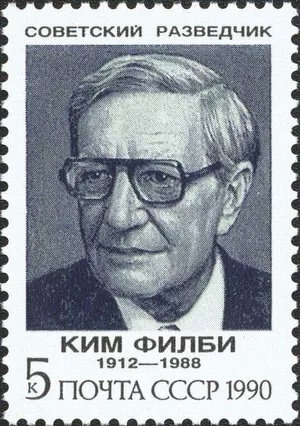
Kim Philby on a Soviet postage-stamp, 1990. Photo: WikiMedia
For decades, popular narratives have focused on the trappings of privilege—old school ties, academic prestige, and the thrill of the double life—effectively fogging over what Senior diagnoses as a profound failure of character, if not sociopathy.
Rather than enlightened anti-fascist rebels, the Cambridge ring operated as the cooperative tools of a murderous totalitarianism, trading civic virtue to support an extremism that destroyed millions to serve Stalinist dogma. These men were not dreamy ideologues; they were callous accomplices—and, in many instances, instigators responsible for the deaths of hundreds, if not thousands, of anti-communist guerrillas, intelligence personnel, and local resistance fighters.
Senior’s treatment of Kim Philby conclusively demonstrates that he was less a cloak-and-dagger desperado than a serial killer. From his post as head of the SIS’s anti-Soviet section, Philby orchestrated the betrayal of anti-communist fighters, delivering them into the hands of torturers and executioners. His crimes went beyond espionage: they systematically destroyed allied intelligence networks and the freedom fighters waging a shared struggle against autocracy. Burgess, for his part, revealed in 1946 the precise location where Albanian rebels would land—knowing they would be exterminated on the spot.
Senior contextualizes the initial appeal of communism to the youth of the 1930s, acknowledging it as a response to oppressive global capitalism and British imperialism. Yet that sympathy curdles into servitude to Stalin: neither the Show Trials, the Purges, nor even the Nazi-Soviet Pact of 1939 could shake their fealty to the Kremlin.
After the war, despite hating the British Empire, the group advanced the subjugation of Eastern Europe. But its members had lost any capacity to recognize the gross injustice of what they had been doing years earlier. As Senior observes:
[Even before the Nazi-Soviet Pact] all the Five’s original links to the regime in Moscow – the men who had recruited them, trained them, nurtured them – were dead, imprisoned, missing or on the run… It was not ignorance that kept them loyal in the face of the Terror; it was an act of revolutionary resolve.
This unyielding defense of a homicidal regime dramatizes the baffling persistence of communist apologists who refuse to face the historical record. Senior cuts through the conventional admiration for that mystification by confronting a fundamental truth: organizations such as the Communist Party USA were never genuine political parties but tentacles operating directly under the control of Russian intelligence and the Comintern.
That cognitive dissonance—ideological devotion overriding reality—finds a present-day parallel in the unshakable loyalty of MAGA zealots, who dismiss any evidence of blatant misconduct or betrayal by their leaders. Like the apologists of the last century — who excused totalitarian purges to keep the promise of a workers’ paradise — today’s loyalists sustain their faith by being willfully blind — a myopia driven by a vision of a brighter, whiter future.
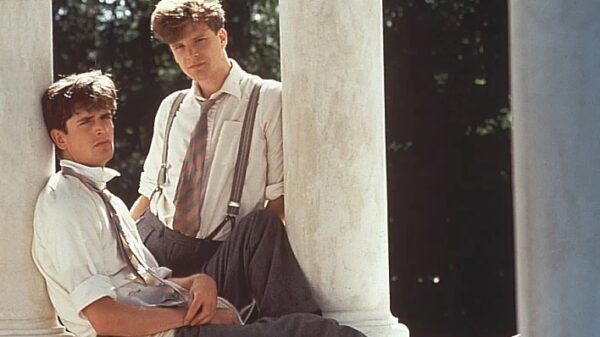
Rupert Everett and Colin Firth in a scene from 1984’s Another Country. Photo: Mubi
Senior uses newly declassified archival files to demonstrate how extraordinarily effective the Cambridge Five were, often bombarding their Soviet controllers with more intelligence than the handlers could process. Bugging Roosevelt’s and Churchill’s rooms at Yalta were almost superfluous acts: the Soviets had copies of the Anglo-American negotiating papers as soon as they were drafted.
That said, some of Senior’s source material is problematic. Historians widely contest the evidence drawn from Vasili Mitrokhin, a Soviet KGB archivist who secretly copied vast quantities of classified KGB material and defected to Britain in 1992. This material can be ambiguous; uncorroborated intelligence fragments should not be treated as certainties. Thus Senior makes a crucial misstep when she identifies Harry Hopkins as a definitive Soviet asset. No reputable historian accepts the disputed, highly contested claims of post-Soviet Russian defectors that Hopkins served the Kremlin. At most, scholarly consensus casts him as an “unwitting dupe”—Roosevelt’s second self, whose excessive confidence in the wartime alliance led to grave errors of judgment. But motive is most often credited to patriotism, not treason.
Despite this overreach, Stalin’s Apostles‘s central strength lies in its exploration of political pathology and moral culpability. In an era buffeted by overarching anxiety and a dissolving diplomatic order, Senior’s work stands as an indictment of a reckless commitment to amoral radicalism—a cautionary fable about a deadly convergence of ideology, privilege, and disloyalty.
Tom Connolly is is Professor Emeritus of Humanities and Social Sciences at Prince Mohammad Bin Fahd University. He recently edited Images from Jewish Life in Döbling Vienna: Tracing History Through Memory (Bohlau Verlag, 2026). He has published three books and numerous journal articles on theater, film, and futuristic studies.
Tagged: Anthony Blunt, Antonia Senior, British intelligence, Cambridge Five, Cold-War, Donald Maclean, Espionage, Guy Burgess, John Cairncross, Kim Philby, Soviet Union, Stalinism, Stalin’s Apostles, book-reviews, history, nonfiction, political ideology
