Film Review: In “The Samurai and the Prisoner” — The Quality of Mercy is Strained
By Peter Keough
Director Kiyoshi Kurosawa trades spectacle for suspense in a period thriller about honor, hostage, and haiku.
The Samurai and the Prisoner. Directed by Kiyoshi Kurosawa, based on Honobu Yonezawa’s novel. At the Coolidge Corner Theatre, starting on August 7.
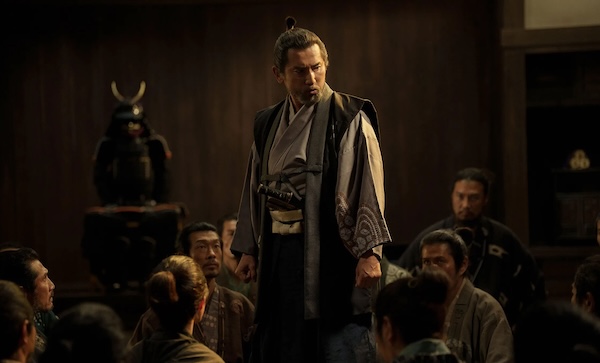
Masahiro Motoki stars as the warlord Murashige Araki, in The Samurai and the Prisoner. Photo: courtesy of Janus Films
Like Christopher Nolan’s revisionist and anachronistic The Odyssey, Kiyoshi Kurosawa’s staid, intricate, and compelling adaptation of Honobu Yonezawa’s period detective novel revolves around a hero renouncing the murderous traditions of his culture. Lord Araki Murashige (a riveting Masahiro Motoki), the real life 16th century general who lived during the bloody and tumultuous civil wars of the Sengoku period, has unexpectedly turned against his liege, the ruthless warlord Nobunaga Oda (Bando Shingo), who is holed up in his formidable Arioka Castle. According to the film’s opening epigraph, the reasons for this switch have never been explained. It is just one of the many puzzles Kurosawa’s slow-moving (nearly 2-1/2 hours long) epic raises, not all of which are resolved.
Consider: who is the samurai and who is the prisoner? The latter could be Kuroda Kanbei (a boyish and sly Masaki Suda), a former friend of Murashige sent by Oda to talk him out of his rebellion. Against the code of conduct, in a seeming act of mercy, Murashige tosses Kanbei into a dungeon but spares his life. But, as Kanbei explains, it’s no favor to him because Oda is holding his 11-year-old son hostage. If he does not return, or if his head is not sent back in a box (lots of heads and boxes in this movie), Oda will assume Kanbei has betrayed him and will likely kill the boy.
Another prisoner is Jinen, also an 11-year-old and the son of one of the followers who betrayed Murashige, thus dooming the boy to execution. But Murashige spares him too – he’s a favorite of his childless wife Chiyoho (Yuriko Yoshitaka), another example of Murashige’s newly adopted policy of mercy. His followers accept this aberrant turn from tradition, unlike the default brutality of other warlords, like Oda. Murashige senses that the times are changing, that nobles and commoners alike are sickened by the ongoing carnage of internecine warfare — the days of ogres such as Oda may be coming to an end.
So, although the impulse might be genuine (a shocking flashback near the end of the film suggests this), it is also calculated. Whatever the motive, Murashige’s attempts to rally other clans to his cause have stalled and the conditions in the castle have deteriorated. Bizarre murders and other strange occurrences — seen by some as acts of divine judgement — have spread confusion and suspicion among his followers. If he’s to resume control of the situation, Murashige must play detective, solve the crimes, and find out who is behind them. To do so, he decides to descend into the dungeon and confer with the wily Kanbei.
As enigmatic as Hannibal Lecter in The Silence of the Lambs (1991), though not as sinister, Kanbei is willing to offer his assistance, but cryptically. There is an odd, unwholesome attraction between the two. When Murashige visits him, it is as if he is descending into the depths of his own subconscious, or consulting with Shakespeare’s Weird Sisters (one wonders if the deceptively bland Chiyoho has the potential of becoming a Lady Macbeth).
Kanbei warns Murashige that his violation of the samurai code, eschewing strategic violence and killing and resorting to compassion instead, will bring bad karma (talk about no good deeds going unpunished). Chained to a post, growing increasingly hirsute, ragged, and grubby, Kanbei offers his sibyl-like solutions to each case — in the form of haiku-like poems that Murashige must decipher. As he gets closer to the answers, the forces of Oda inexorably approach, like the trees of Birnam Wood. It eventually dawns on Murashige that he can trust no one – least of all Kanbei.
The action unfolds over eight months in a series of staid, almost stagey, season-titled chapters set almost entirely within the elegant—even the dungeon—yet claustrophobic confines of the castle. Long, dialogue-heavy set pieces, enveloped in exquisite mise-en-scène, end in abrupt, elliptical cuts that give the narrative a jerky rhythm, evoking intense cogitation punctuated by sudden revelation. Rare forays into the outside world occur when the armies clash, but these scenes are almost bloodless, marked by little balletic swordplay—more like Kiyoshi’s namesake, Akira’s Kagemusha (1980), with its ceremonial, formation-focused battle regalia, than the kinetic, hand-to-hand combat of Seven Samurai (1954). Only at the end are views of the sky and vistas of natural beauty fully revealed, an illusory escape from the intrigue, artifice, and ambition that threaten to crush both the Samurai and the Prisoner.
Peter Keough writes about film and other topics and has contributed to numerous publications. He was the film editor of the Boston Phoenix from 1989 to its demise in 2013 and has edited three books on film, including Kathryn Bigelow: Interviews (University Press of Mississippi, 2013) and For Kids of All Ages: The National Society of Film Critics on Children’s Movies (Rowman & Littlefield, 2019).
Tagged: "The Samurai and the Prisoner", Honobu Yonezawa, Kiyoshi Kurosawa