Film Review: “The Odyssey” — Twilight of the Gods
By Peter Keough
Christopher Nolan’s ambitious and challenging epic is an ode to the end of civilization.
The Odyssey. Directed by Christopher Nolan adapted from the poem by Homer. At the Boston Common, Coolidge Corner, Kendall Square, Drafthouse, and suburbs
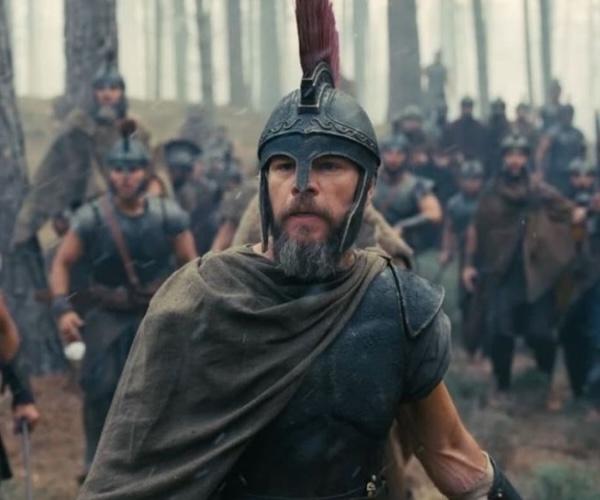
Matt Damon as Odysseus in a scene from The Odyssey. Photo: Melinda Sue Gordon/Universal Pictures
The rage of conservative critics at Christopher Nolan’s ambitious and challenging adaptation of The Odyssey seems misdirected. They have condemned the non-traditional racial and gender casting of some characters and grumbled about the perceived feminist prejudices of the controversial Emily Wilson translation that Nolan is following.
But rather than fuss about any “woke” alterations marring a revered classic, they might worry instead about genuine fidelity to the themes in the original text that challenge their own values and ideology. Consider its repeated allusions to the ancient Greek custom of xenia, or hospitality to all strangers, a policy that those who despise immigrants and refugees might find alien. Or more ominously, the fundamental narrative about the inevitable return of righteous authority to overthrow a regime of corrupt and despoiling usurpers.
So does Nolan’s version do justice to those themes? The proper treatment of strangers, referred to as “Zeus’s law” in the film, plays a crucial role here, and perhaps in ways that the original poem might not have anticipated or intended. But the basic Homeric notion that violating this commandment will result in retribution holds true. Chief violators are the swarm of suitors who infest King Odysseus’s palace during his absence, hoping to win the hand of his wife Penelope (Anne Hathaway, in a powerful and nuanced performance) while in the meantime consuming their absent host’s food and drink, corrupting his servants, taunting Telemachus (Tom Holland) his son and rightful heir, and abusing any beggars who might drop by looking for a handout. Not just bad hosts but bad guests deserve punishment for such impiety.
The greed, duplicity, and cowardice of their leader, Antinous (a reptilian Robert Pattinson) epitomizes this bunch, who are presumably the elite of society. He’s a draft dodger, who in a recurring flashback, is seen finagling another youth, Sinon (Elliot Page), into taking his place when his lottery number comes up for shipment out with the troops for Troy. In a way, however, he is a debased mirror image of Odysseus (Matt Damon, bringing gravitas, a whispery delivery, and a formidable beard to the role) and thus a worthy pretender to the throne. Both are deceptive, tricky, and ruthless in getting what they want. How they differ is a crucial part of the story.
At first, Odysseus, his military prowess and courage excepted, might not seem like such an improvement over his rival. Having helped end the ten-year siege of Troy with his ploy of the giant wooden horse (this might be the only in-depth look at what conditions were like inside that duplicitous offering – not pleasant), he has opted, against the wishes of his men, to separate from the rest of the returning fleet, put off heading back to his wife and his responsibilities as a ruler, and go off on a little adventuring and treasure-hunting of his own. So he sacks the city of Ismarus and, ignoring the warnings of one of the survivors, continues onwards, much to his regret.
As he realizes only later, he has “lost his way.” Adrift from his goal to return home, he encounters such terrors and monstrosities as the cannibalistic Cyclops Polyphemus (Bill Irwin), who, in this rendition inspired by Goya’s painting “Saturn Devouring His Son” (maybe by way of Guillermo del Toro’s Pan’s Labyrinth), combines phallic and vaginal imagery and evokes a pastier version of Grendel in Robert Zemeckis’s Beowulf (2006). Here I must confess that I find Nolan’s f/x less terrifying and awe-inspiring than the stop-motion animation of Ray Harryhausen, though admittedly I first saw Jason and the Argonauts (1963) when I was ten.
Nonetheless, his reprise of Homer’s greatest hits impresses, especially the giant armored Laestrygonians – who look unnervingly like Benny Safdie’s Agamemnon with his Darth Vader headgear and its creepy spinal column attachment. Indeed, the King of Mycenae doesn’t seem like such a good guy, for, as Penelope points out to her husband in an attempt to dissuade him from joining the Troy campaign, he sacrificed his own daughter to the goddess Artemis to ensure favorable winds for his fleet. Also, she claims, the war is being waged not to retrieve his brother Menelaus’s stolen bride Helen, but to seize control of Mediterranean trade routes.
Agamemnon, as it turns out, made it home sooner than Odysseus. His wife Clytemnestra (played by Lupita Nyong’o, who also portrays the similarly perfidious Helen) and her lover cut his throat, a warning to Odysseus and perhaps an indication of the fate in store for all those who rape, pillage, and burn with seeming impunity.

A scene from The Odyssey. Photo: Melinda Sue Gordon/Universal Pictures
Though the original epic begins in medias res and is told in flashback, Nolan, as in previous films, goes even further in deconstructing the narrative structure and undermining the concept of a reliable point of view. In his cubist-like approach, even individual action sequences are chopped up into rapid-fire montages that are disorienting in effect. The story jumps back and forth in time, even within an individual scene, with the point of view ranging from a bard reciting the tale for the suitors at Odysseus’s palace, to the stories told by the shades of the dead whom Odysseus consults in Hades (a precursor perhaps of Dante’s Divine Comedy, if not Akira Kurosawa’s Rashomon).
As for Odysseus’s own recollections, the divine nymph Calypso (Charlize Theron), with whom he has taken refuge after being shipwrecked on her island, has erased them. She has been feeding him the lotus flowers of apathy and forgetfulness (Nolan fusing the poem’s Lotus Eaters and Calypso episodes at the expense of the Nausicaa story and with a nod to the surprisingly good 1954 Ulysses with Kirk Douglas) in order to relieve him of painful memories and, as she falls in love with him, to keep him from leaving. But after seven years of this R & R to cure his PTSD and virtual captivity, she helps him fill in the blank spaces of the past. The horror he can’t shake, it turns out, is not that of the monsters he has faced or the maddening Sirens’ songs or even the condemnation of the sorceress Circe (Samantha Morton), but the “fire, chaos, and suffering” he has helped unleash on Troy.
Like the hero of Nolan’s Oppenheimer (2023) – “the American Prometheus” who famously quotes the Bhagavad Gita line “Now I am become Death, the destroyer of worlds” after testing the first atomic bomb – he has slain countless victims and has defied the gods with his hubris. But the gods are strangely absent in this Nietzschean realm where Odysseus finds himself. Though retribution from the offended deities Poseidon and Helios is referred to, they are never actually seen. Only the accusing Circe, who transforms his men into their primal bestiality, the consoling Calypso, and Athena (Zendaya), his protector, make an appearance, helping him somewhat, but serving mostly as reminders of his values, his mission, and his transgressions.
Unlike in the poem, Athena – a tiny icon of whom Penelope has entrusted to Odysseus and which he holds onto when he has lost everything else – does not advise him as he takes on, alone, the wicked suitors. And alone he triumphs, and the long delayed vengeance and vindication are sweet. But he cannot shake off the realization that the enemy is the one within.
Peter Keough writes about film and other topics and has contributed to numerous publications. He was the film editor of the Boston Phoenix from 1989 to its demise in 2013 and has edited three books on film, including Kathryn Bigelow: Interviews (University Press of Mississippi, 2013) and For Kids of All Ages: The National Society of Film Critics on Children’s Movies (Rowman & Littlefield, 2019).
Tagged: Anne Hathaway, Christopher Nolan, Lupita Nyong’o, Matt Damon, Robert Pattinson, Samantha Morton, The Odyssey