Dance Review: Ilya Vidrin’s “Proxies” — The Opposite of Avatar
By Debra Cash
A sensor-driven dance work probes embodiment, data, and the limits of technological intimacy.
Proxies by Ilya Vidrin at Jacob’s Pillow Doris Duke Theatre, Becket, through July 5.
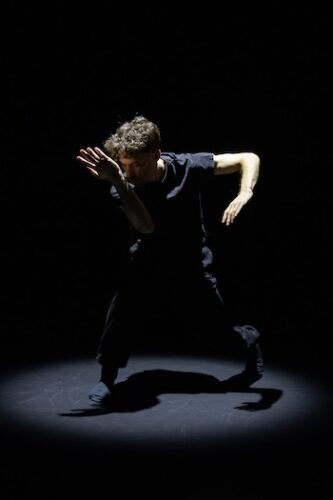
Ilya Vidrin in Proxies at Jacob’s Pillow Dance Festival. Photo: Jamie Kraus
When I learned that Boston-based dancemaker Ilya Vidrin was developing a piece called Proxies, I misheard the title as “Proximities.” You can’t blame me: Vidrin’s work has delved deeply into partnering and tactile connections among people. His work is congruent with an entire body of current dance research and practice known collectively as kinesthetic (or kinetic) empathy, knowledge that asks not just what the human body in motion looks like, but what it feels like. At a time when screen culture has obscured the inescapable ground of human embodiment – and when designers of AI bots and robotics are racing to replace it, as described in a recent New Yorker article by Stephen Witt — thinking hard about how to convey the sometimes baffling, often beautiful experience of multi-sensory physical presence is a project well worth exploring.
Proxies is having its world premier this weekend at Jacob’s Pillow after an eight-year period of development that included residencies at the Pillow before and after COVID. The pandemic experience shed a global light on what it meant to be separated. It exposed questions of trust in the face of dangerous, even deadly contagion, even as it added urgency to the development of remote tools for human connection, such as Zoom. Vidrin is too young to have personally experienced the similar crisis of forbidden touch during the early days of the AIDS crisis, but his beloved grandmother – who had survived the blockade of Leningrad in the early 1940s– was hospitalized during COVID. Vidrin ended up serving as her bedside interpreter.
Yet, as he explained to me over a coffee in Cambridge during a rehearsal break the week before the Pillow opening, the title Proxies is meant to ask questions: What happens when a human life is turned into data? When watches keep track of vital signs and daily steps, when our online attention is repackaged into algorithms? Citing Elizabeth Renieris, he noted that we may be moving towards a juncture where data has more rights than people do.
This weekend was the first time I had experienced the Pillow’s glorious new Doris Duke Theatre set up in the round – or, more precisely, set up with seating on four sides of a square performing arena. Designed expressly to accommodate advanced technology, the Duke’s sound system seemed to be Sensurround, with the two musicians partially visible in the facility’s production balcony. The space was ringed with a series of glowing, vertical tubes and anchored by a small, rotating central platform. The action of Proxies shifts between those two spaces as if they were completely separate rooms: two women (Cassie Wang and Hannah Franz) looking like temple caryatids in flowing white circling serenely on the platform, with the rest of the ensemble (Vidrin with Kelvin Vu, Elizabeth Epsen, and Olivia Moon) inhabiting lines of energy on its outskirts.
Each of the dancers are outfitted with custom-fabricated gloves and insoles with embedded sensors, designed by Vidrin and Steven Geofrey and a multidisciplinary team of collaborators. You can see glints of green lights on their elbows, wrists, knuckles, and ankles, but they are pretty unobtrusive.
What you notice instead is the two figures on the platform regarding each other serenely. When they grasp each other’s forearms and lean away, their weight counterbalanced, the intensity of the lights increases. But, because the sensors are fastened at the dancers’ extremities, distinctive movements like their matched, swaying pelvises are not converted into information that triggers the lights or sound score that Vidrin and his collaborators (musicians Mel Hsu and Eric Seligman) have mosaicked together from the late Romantic shards of Tchaikovsky’s 5th Symphony.
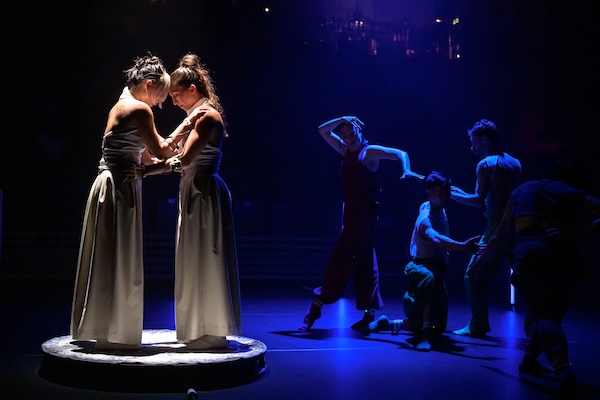
A scene from Proxies at Jacob’s Pillow Dance Festival. Photo: Grace Copeland
Figuring out what gesture will trigger what shift in light and sound – and thus in mood – becomes a kind of game (oh, I see Moon tightening her clasped hands to pull the spotlight in around her like pulling the strings of a sleeping bag closed!) But over time, that becomes less satisfying than just letting the dance stream by. Vidrin has studied many dance genres – he told me his first love was ballet-infused Russian ballroom dance – but the choreographic language in Proxies is constructed of formal, deliberately placed shapes, often with turned-out positions.
Proxies may have grown out of Vidrin’s explorations in partnering, but the most memorable – and legible – episode in Proxies is a pole-dance solo for Moon. The pole descends from the rafters like a streetlight suddenly glimpsed on a darkened street. Moody blue lighting softens her motion. Moon’s pole dance moves – leaning away from it, ascending confidently, curled and suspended around its steady verticality – suggested that the pole was less a prop and more a partner, an instrument for support and decision-making.
It was touching.
Debra Cash is a Founding Contributing Writer at the Arts Fuse and a member of its Board. She has been a Scholar in Residence at Jacob’s Pillow.
Tagged: "Proxies", Elizabeth Epsen, Eric Seligman, Ilya Vidrin, Jacobs-Pillow, Kelvin Vu, Mel Hsu