Tribeca Film Festival — Docs on Dictator Cuisine, TikTok’s Ups and Downs, and The Killer Behind “Cruising”
By David D’Arcy
The Tribeca Film Festival is usually best represented by its outliers. This year, a few films earned that status.
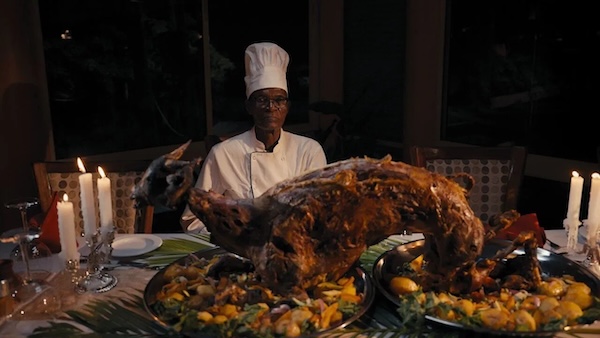
A scene featuring a whole roast goat in How to Feed a Dictator. Photo: Tribeca Film Festival
Among the docs, How to Feed a Dictator led the way. Director Andrew Neel’s adaptation of Witold Szablowski’s 2020 Kitchen Confidential–style book takes you into the kitchens of the cooks who nourished some of the most brutal dictators of our era — Kim Il Sung, Saddam Hussein, Pol Pot, Augusto Pinochet, and Idi Amin.
Welcome to the realm of Beyond Bourdain. If this sounds unappetizing, much of it is, but these stories will hold your attention, although I didn’t notice a site where you can go to find the recipes.
In case you were wondering, Saddam Hussein liked boiled fish in sauce. Dinner was prepared for him every night in each of his many palaces. What would dictatorship be without indulging in shameless waste as the masses suffer?
Pinochet was praised by his former cook, an ardent anti-Communist, as a man of simple origins who savored the food of common people, like a Chilean cassoulet. Kim Jong Il preferred pizza, says the Italian cook who worked for him and dreaded what might happen if the North Korean leader wasn’t pleased. The pizza must have been okay because that cook survived to talk about it.
Idi Amin liked goat — an entire goat, roasted and served as if it were standing upright.
Most of the chefs (but not Coco Pacheco, the anti-Communist Chilean cook) recall being ordered to work for tyrants. They talk about fearing for their lives. Let’s remember that many in the population, who had less food on the table, died in great numbers, often through starvation in places like Cambodia and North Korea. Plenty were simply slaughtered by well-fed tyrants like Saddam Hussein and by Idi Amin, who is said to have eaten not just entire goats, but his political victims.
Neel juxtaposes scenes of abundance and revelry around ornate tables with grim footage of hardship, reminding you that the victims of these regimes were, often, not even given the time to starve to death.
North Korea is the exception. While Kim Jong Il dined on pizza made by a bona fide Italian with ingredients flown in from Italy, citizens and even soldiers in the DPRK (Democratic People’s Republic of Korea) were left to forage for grass. This is no cinematic picnic, but Neel has managed to keep his film watchable. You won’t vomit or turn away. Judging by the coverage of How to Feed a Dictator when it premiered in U.K., there’s an appetite for this kind of exposé. Foodies will not find the dictators any more appetizing.
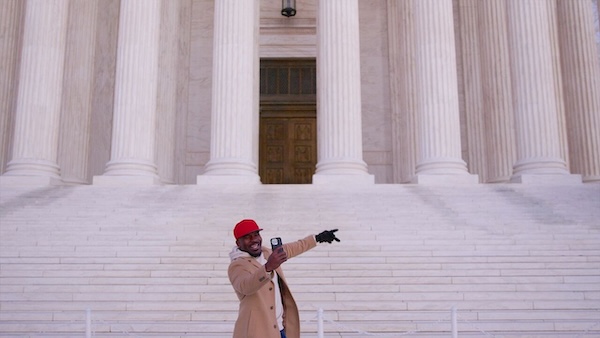
A scene from TikTok Never Dies. Photo: Tribeca Film Festival
TikTok Never Dies, a doc at Tribeca directed by Hao Wu, tracks the phenomenon of the infinitely expanding internet platform, alternatively condemned and praised by U.S. politicians. Neither Meta nor X could duplicate or compete with the platform’s profusion of performances and images made for the short attention span of its creators/consumers. Eventually, a powerful hodgepodge of enemies saw TikTok as a threat, a Trojan Horse branded as Chinese villainy — Republicans, Democrats, and Donald Trump, all of whom said they wanted to ban an alien force.
A ban was imposed briefly, but, almost simultaneously, a Trump billionaire friend acquired a major interest in Bytedance, the Chinese firm that owned TikTok. Then came Trump’s announcement that the platform rallied support for him among young voters, or so he thought. Thus TikTok ceased, at least for Trump, to be a front for espionage. Some might see parallels with his change of attitude toward crypto.
As for TikTok users, they found, to their surprise, that the platform suddenly worked again. We watch the rebirth through clips of news coverage and hear from a chorus of TikTok users who were inspired by the platform and felt betrayed by politicians: home pastry cook Chloe Joy Sexton, Black rapper and Trump admirer Topher Townsend, dapper gay comedian Seven King, and the lawyer son of parents born in the Soviet Union, who sees TikTok as a realm for the exercise of true freedom. It is all evidence of the platform’s amazing adaptability, whether for use or exploitation.
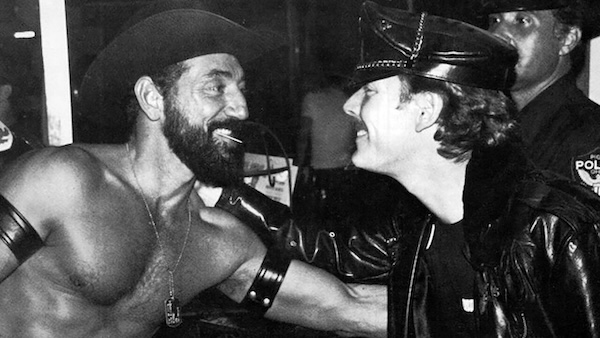
A scene from Mineshaft: The Cruising Murders. Photo: Tribeca Film Festival
If TikTok takes you on a bumpy ride toward the future, Mineshaft: The Cruising Murders takes you back to 1980 and the era of the film Cruising, a horror-thriller melodrama set in a sadomasochistic gay Greenwich Village. It was directed by William Friedkin, who had earlier helmed The Boys in the Band (1970), an adaptation of the stage play whose casting called for an ensemble of witty and frustrated middle-aged gay men. Friedkin also made hits like The French Connection (1971) and The Exorcist (1973).
The doc, directed by Jeffrey Schwarz, looks at one inspiration for Cruising, a series of murders of gay men in the West Village in the mid-’70s. Body parts washed up on the nearby riverbanks. The 1980 film was also based on a novel by the NY Times reporter Gerald Walker that was based on those homicides.
The leather bars in the Meatpacking District on the edge of the Village drew a rough crowd. Friedkin tried to give the film a lurid tactility, a look drenched in bodily fluids. It was a visual approach that gay critics in the doc, who knew that milieu and opposed the project, called silly and overdramatized. Audiences who see the film today are likely to feel the same.
Friedkin also drew, partly, on the murder of Addison Verrill, a journalist for Variety who liked the rough trade. He ended up dead — smashed in the head and stabbed in the chest by a man he’d met in a leather bar. We hear from Verrill’s boyfriend, a lawyer who never watched Cruising, and from his sister, who didn’t know he was gay.
The killer turned out to be Paul Bateson, a radiologic technologist who had a small part in The Exorcist playing the same role, assisting a neurosurgeon. When the openly-gay Village Voice journalist Arthur Bell wrote about Verrill’s killing, Bateson, a gonzo alcoholic, wrote to him to clarify some details. Police tracked Bateson down. He confessed that he had wanted a more lasting relationship with his victim. Convicted of murder, Bateson served more than 23 years in prison.
Bateson was also a suspect in the “bag murders” of six men whose remains washed up in plastic bags along the Hudson from 1975 to 1977. He was never charged. No one was ever convicted for the killings, although evidence implicating Bateson was found.
Mineshaft reopens old wounds, partly because it treats Friedkin as if he were a villain for making Cruising. Shooting sites in 1979 became places of protest, where activists accused Friedkin and his crew of taking over their neighborhood to tell a violent story stigmatizing its characters.
I had a personal connection to the filming of Cruising. Driven out of parts of the Village by protesters, Friedkin and the film crew moved uptown to the northernmost reaches of Riverside Park, which sloped abruptly into an empty intersection under a bridge at 125th Street. (I lived in a building across the street). Only the homeless and a few local dog walkers knew how to enter the park at the site. The area’s high stone walls — appropriately cinematic — meant that scenes could be shot discreetly. Without protesters, much of the end of Cruising was shot in that location.
Al Pacino, who starred in Cruising as a cop going undercover in gay clubs, was faulted by gay groups for playing that role. Eventually, he acknowledged the gay community’s grievances against the film. (He did no publicity or interviews for Cruising.) Friedkin, who himself went undercover in leather clubs researching his script, was unapologetic. Reviewers trashed the film when they weren’t snickering at its serious moments. Gay film critics at the time (some of whom are interviewed in Mineshaft) mocked the director’s efforts to enter their world, which included hiring gay porn stars to infuse club scenes with “authentic” drama. Cruising sank at the box office.
Mineshaft is framed by larger events. HIV spread through the West Village in the years after the film opened, closing the sex clubs as it ravaged a generation. Gentrification transformed the area’s shadowy, malodorous streets (then lined with wholesale butcher shops) into a bland tourist mall of chic restaurants and sleek boutiques. Looking back, an actor who gravitated to the neighborhood recalled that “it was funky, and slummy….and fabulous.” For those who knew (and admired) the New York of those days, watching Mineshaft will be a mournful experience. But it will also be nostalgic, even elegiac. Cruising can be viewed for free on YouTube.
David D’Arcy lives in New York. For years, he was a programmer for the Haifa International Film Festival in Israel. He writes about art for many publications, including the Art Newspaper. He produced and co-wrote the documentary Portrait of Wally (2012), about the fight over a Nazi-looted painting found at the Museum of Modern Art in Manhattan.
Tagged: "Cruising", "How to Feed a Dictator", "Mineshaft: The Cruising Murders", "TikTok Never Dies", Andrew Neel, Hao Wu, Jeffrey Schwarz