Theater Review: Arlekin’s “Delirium” Reimagines Ionesco with Visual Flair and Urgency
By Bill Marx
Arlekin’s high-energy adaptation underscores absurdism’s resonance in an age of conflict.
Delirium, Igor Golyak’s adaptation of Eugène Ionesco’s Frenzy for Two. Staged by Arlekin Players Theatre at the Calderwood Pavilion at the Boston Center for the Arts, Boston, through July 2.
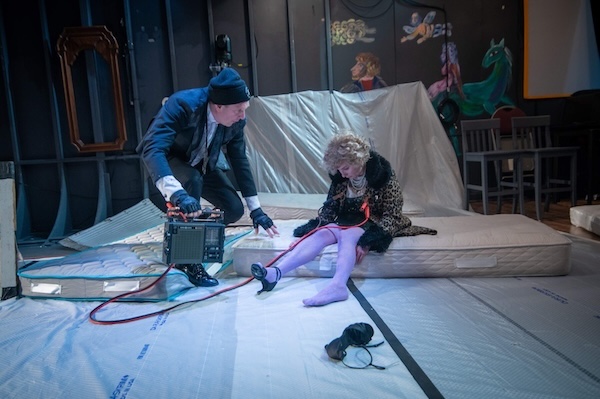
Andrey Burkovskiy (Him) and Chulpan Khamatova (Her) in the Arlekin! production of Delirium. Photo: Olga Maturana
In his Fragments of a Journal, Eugène Ionesco blurts out that “I live like a dead man,” and then admits that he bursts out laughing when he says these words. This existential paradox—humanity’s consciousness of the inevitability of death—lies at the root of the dramatist’s absurd mortality plays. One of the brilliant decisions in director Igor Golyak’s expansive adaptation of 1962’s Frenzy for Two (Ionesco’s masterpiece Exit the King was produced the same year) is the way he chooses to highlight this predicament. He has placed a large aquarium onstage. A big fish swims about in the tank as a couple, Him and Her, hysterically move about while they role-play, bicker, and fantasize in their increasingly deconstructed apartment, badgered by sudden explosions, a blinking red alarm light, and the sounds of sirens as a war wages (what war? take your pick). The frenzied couple does what it can, hilariously at times, to escape its awareness of doom by preserving (often grotesquely) past rituals and memories. These antics are juxtaposed against the mounting mayhem and the unperturbed fish. Ionesco is not lampooning domestic relationships here; rather, he makes us watch, with horrified amusement, two people trapped in a tumbrel inching toward the guillotine. Nature has no sense of its own extinction—we do, and we suffer farcically for it.
The splendid theatricality of the fish tank stands as a hallmark of Golyak’s playful approach to Ionesco, whose vision of people passing the time before extinction more often hinges on linguistic inanity—a possible symptom of repressed desperation—than on overt physical comedy. There are, of course, marvelous exceptions: the ever-expanding corpse that crowds out the living in Amédée, or How to Get Rid of It, and the grotesque metamorphosis at the anti-fascist core of Rhinoceros (soon to appear in a new production at the American Repertory Theater). Delirium does ample justice to the script’s verbal jousting, especially in the wrangling between Him and Her over whether the snail and the turtle are the same animal—they both have shells, after all. For Ionesco, playgoers (and critics) must relinquish their cherished longing for rationality; life, like the human psyche, resists such coherence. What Golyak and his performers do, to their credit, is push that insight a step further. The stage becomes a whirligig of frenzied irrationality, packed with pratfalls and sight gags worthy of first-rate silent comedy, all executed with astonishing precision by the seemingly inexhaustible, perpetual-motion performers Chulpan Khamatova and Andrey Burkovskiy. Burkovskiy is a lanky Gumby with a booming voice; Khamatova, a marvelously modulated spitfire.
Delirium‘s comedy feeds off a joyous dissolution of boundaries. Him and Her’s space is nothing if not chaotic: the pair spin doors and windows as if they were tops, determining what is up and what is down, what is in and what is out. Grenades pop in, cueing macabre games of catch; wigs and hats are dunked in the aquarium and then exchanged; the radio becomes a source of unpredictable sounds. Who dominates—Him or Her—and who is submissive shifts from moment to moment. The scaffolding in Jan Pappelbaum’s ingeniously minimal set holds boxes suspended above the playing area that occasionally (with a bang) dump material (costumes, debris, corpses) into the action. It recalled, to me, a giant Skinner box, a kind of conditioning chamber, though, as you can see in the photo below, there are boxes within boxes, cages within cages.
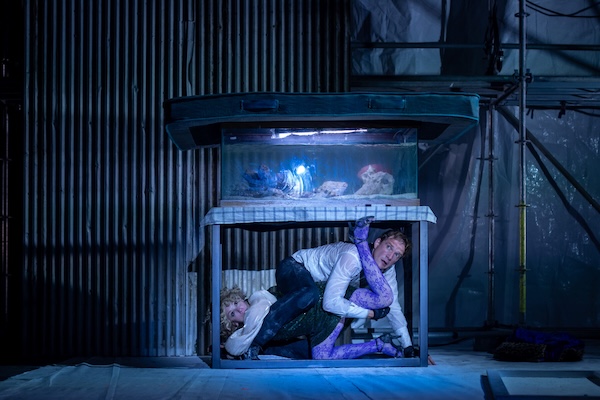
Andrey Burkovskiy (Him) and Chulpan Khamatova (Her) in the Arlekin Players Theatre production of Delirium. Photo: Olga Maturana
Also, Golyak has wisely imported additional material from Ionesco, including short stories that reveal his flip side: a dreamy, childlike response to his fear of extinction. There is a charming scene in which Him and Her engage with audience members as they hunt for the sun and the moon, with spotlights projected onto the theater walls. The fantastic here is not mere escapism but an exercise in innocent, imaginative strength—an impish vision that alleviates, if only momentarily, the threatening meaninglessness in which the characters find themselves. (Ionesco’s farce A Stroll in the Air was also written in 1962.) Golyak brings in light, but he also underscores the play’s darkness; acts of brutality that Ionesco only suggests in the script are rendered concrete onstage. It is also worth noting that Him and Her are civilians, fodder for the destructive forces of war and “justice.” Ionesco wrote this piece about annihilation during the Cold War, with two world wars and Hiroshima in mind. What gives the play added political resonance now, amid conflicts in the Middle East and the Ukraine-Russia war, is the extent to which noncombatants—women and children—have become targets. The impulse to wish that reality away has itself become a distinctly modern anxiety.
Delirium not only testifies to the superb skills of Golyak, his production team, and its cast, but also to the resonant power of the theater of the absurd as we (hopefully) move through the age of polycrisis. Ionesco, unlike some of his fellow travelers, Samuel Beckett among them, paired his terror of pointlessness and human savagery with a sustaining sense of wonder. For him, existence’s senselessness is complicated by a humanist belief that art must probe the deeper vérité hidden beneath surface réalité. In that way, Ionesco may be a valuable guide to the strange new world that’s taking shape. A salient comment along these lines, that could have inspired this staging, appears in his prose collection Notes and Counter Notes: Writings on the Theatre: “If the usefulness of the useless, the uselessness of the useful, is not understood, art is not understood. And a country where art is not understood is a country of slaves or robots, a country of unhappy people, of people who do not laugh or smile—a country without spirit. Where there is no humor, where there is no laughter, there is anger and hatred.”
Bill Marx is the editor-in-chief of The Arts Fuse. For over four decades, he has written about arts and culture for print, broadcast, and online. He has regularly reviewed theater for National Public Radio Station WBUR and The Boston Globe. He created and edited WBUR Online Arts, a cultural webzine that in 2004 won an Online Journalism Award for Specialty Journalism. In 2007 he created The Arts Fuse, an online magazine dedicated to covering arts and culture in Boston and throughout New England.
Tagged: "Delirium", Andrey Burkovskiy, Arlekin, Chulpan Khamatova, Eugène Ionesco