
Visual Arts Review: What Do Trees Know?
By Lisa Reindorf
Artists confront climate change by probing the intelligence, fragility, and resilience of trees.
Learning with Trees: Artists and Ecologies of Connection, at HallSpace, 950 Dorchester Avenue, Dorchester and City Hall Boston, Scollay Square Gallery, 1 City Hall Square, Boston, through August 14.
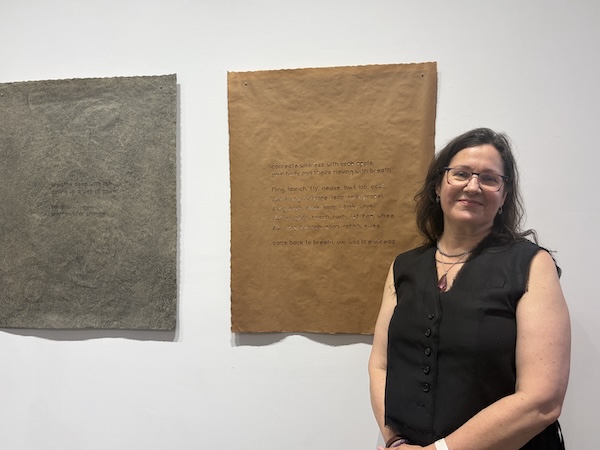
Artist Jane Marsching with two of her works in the exhibit Learning With Trees. Dyed mulberry paper, with short texts written by the artist using tree inks. Photo: Lisa Reindorf
Organized in collaboration with Speak for the Trees, whose mission is to expand and protect Boston’s urban forest—especially in underserved, under-canopied neighborhoods—this exhibition, curated with Martina Tanga, unfolds across HallSpace in Dorchester and a satellite presentation at Boston City Hall. It directly reflects the organization’s commitment to planting, preservation, education, and advocacy in environmentally marginalized communities
“Trees are the lungs of our planet—living beings fundamental to human well-being, Earth’s stability, and essential to countering climate change,” Tanga notes. The artists extend this premise, presenting trees as communicators, collaborators, teachers, and witnesses to environmental transformation. The title signals reciprocity: we are learning with, not simply about, trees. Across painting, sculpture, textiles, photography, installation, and works on paper, the exhibition maps the complex life of trees—their underground mycorrhizal networks, responsiveness to human intervention, and simultaneous endurance and change.
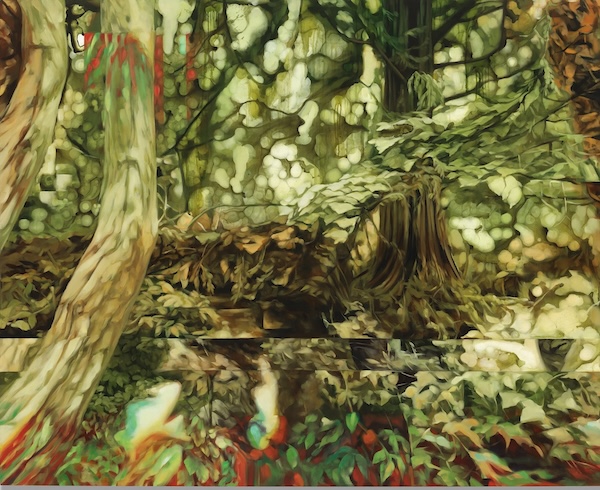
Christi Rinklin, Thicket, 2025. Oil and acrylic on aluminum. Photo: Lisa Reindorf
Cristi Rinklin’s paintings, drawn from photographs made during walks and travels, evoke landscapes shaped by instability. Wildfires, floods, and extreme weather—once rare—now recur with unsettling frequency. Her works balance observation and invention: in Thicket, a dense woodland appears natural at first glance, but subtle distortions ripple across its surface. Soft, unfocused light orbs (bokeh) disrupt the image, raising questions of memory, simulation, and perception. Nature here is not fixed, but in flux.
For Sarah Slavick, trees operate as both subject and system—at once figure, metaphor, and map. Her series Elegy to the Underground turns below the surface, tracing the hidden networks of roots and fungi that sustain forest ecosystems. Long drawn to the unseen, Slavick treats mycorrhizal systems as sites of speculation as much as study. As she explains, these invisible worlds offer “a rich territory…to invent and create with wonder, reverence, and urgency.”
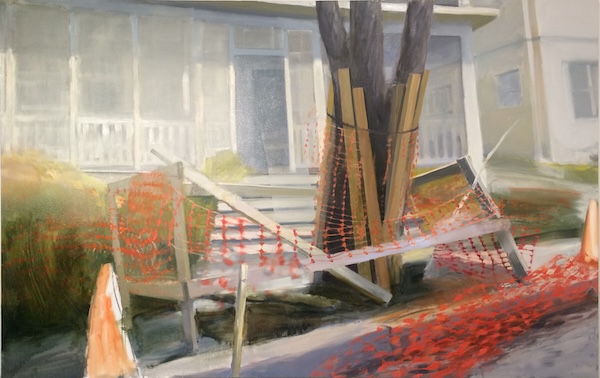
Joel Janowitz, Screened, 2016. Oil on linen. Photo: Joel Janowitz
If trees model interdependence, they also expose vulnerability. Joel Janowitz’s Protected Tree series examines the temporary enclosures built around street trees during sewer upgrades—lumber frames wrapped in bright orange plastic fencing. The images register both care and contradiction: living trees shielded by dead wood and petroleum-based materials. Through restrained compositions that balance geometry and organic form, Janowitz renders these scenes quietly disquieting.
Jane D. Marsching’s interdisciplinary practice addresses climate change and environmental justice through participatory forms. Her works here—dyed mulberry paper, laser-cut and inscribed with texts in inks derived from bark, berries, nuts, and leaves—function as poetic prompts. Inviting viewers to breathe, move, and observe, they encourage a somatic, imaginative alignment with nonhuman systems.
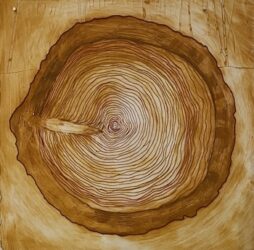
Diana Arcadipone, Tree Ring, VE6_25. Drypoint, embroidery, beading. Photo: Diana Arcadipone
Diana Arcadipone’s Two Tree Rings and a Wild Basket reflects her close engagement with the forests of Maine. Combining monotype printmaking with embroidery and beadwork, the works translate direct observation into tactile form. The two tree-ring pieces are monotype prints enhanced with hand embroidery and beadwork. Surrounded daily by woodland landscapes, Arcadipone draws inspiration from their beauty, fragility, and resilience. Tree rings become records of growth and stress, encoding time, weather, and the visible impact of climate change.
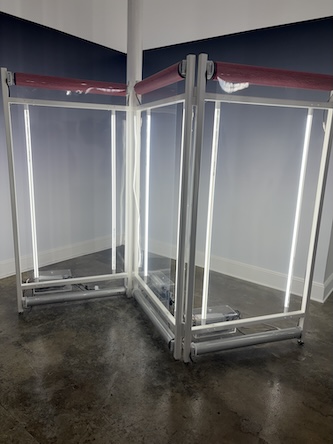
Clint Baclawski, Clear Cut, 2026. Powder-coated steel frame, scrolling lightbox kits, electronic ballasts, Latex prints, LED bulbs. Photo: Lisa Reindorf
Boston-based artist Clint Baclawski’s Clear Cut transforms analog photographs of the Scottish Highlands into a kinetic installation. Presented as a motorized, scrolling image within a folding screen, the work resists stillness: colors shift from natural tones to saturated reds and blues before the image disappears altogether. The effect mirrors the cycles of harvesting and regrowth, while foregrounding the instability of perception and memory.
Across these works, trees emerge not as passive symbols but as active agents—recording, communicating, and adapting within fragile ecosystems. At a moment of escalating environmental precarity, Learning with Trees proposes a shift in perspective: toward interdependence, attentiveness, and the possibility of coexistence.
Lisa Reindorf is an architect and artist whose work deals with climate change. She lectures frequently at art and environmental conferences, and is also an arts writer for such publications as Hyperallergic and Miami New Times.
Tagged: "Learning with Trees", Clint Baclawski, Cristi Rinklin, Diana Arcadipone, Jane D. Marsching, Martina Tanga, Sarah Slavick
1 Comment
Leave a Comment

Thanks to Lisa for writing this review and covering the show! Learning with Trees, curated by Martina Tanga, is a tru gem not to be missed this summer if you are in the Boston area. Check out Hallspace!