Film Review: Eric André Is at His Best When He’s Unhinged. “Little Brother” Isn’t.
By Sarah Osman
Netflix’s raunchy comedy gives the comedian some room to flail, but there’s not enough weirdness to fully unleash his chaotic brilliance.
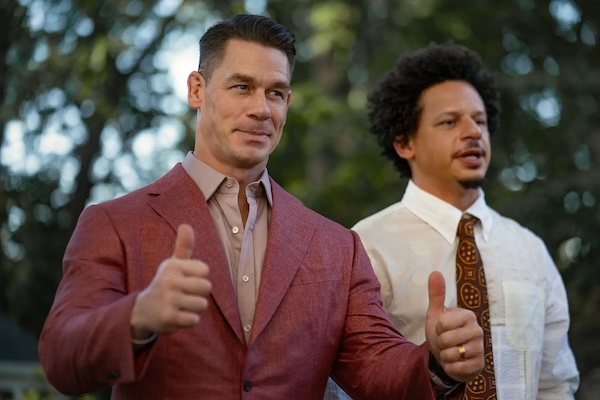
John Cena as Rudd, Eric André as Marcus in Little Brother. Photo: Clifton Prescod/Netflix
Comedian Eric André gives his best performances when he’s playing at being completely unhinged. He is at his strongest when he has no parameters to respect, à la The Eric André Show and Bad Trip. He also excels in scripted series as well, when they are gloriously deranged, like The Righteous Gemstones and Don’t Trust the B—- in Apartment 23 (RIP James Van Der Beek, who played a maniacal version of himself on the short-lived sitcom).
André’s performance as the titular little brother in Netflix’s new comedy, Little Brother fits into that wild mold. The problem is that the film isn’t demented enough to take advantage of his specialized talents. André’s hijinks, whether you admire them or not, are anything but boring or stale. Unfortunately, Little Brother feels like a rehash of raunchy 2000s comedies. It’s all been done before.
Little Brother follows Rudd Lancy (John Cena), an uptight real estate agent who’s tired of living in the shadow of his richer, Jeff Bezos-esque brother, Josh (Christopher Meloni). To Rudd’s surprise, he receives a phone call from Marcus (Eric André), the former “little brother” he mentored through the Big/Little Brother program in high school. Marcus believes that Rudd wants to see him based on a series of emails he’s been exchanging with him. But spoiler alert: the emails aren’t from Rudd. They’re from Rudd’s assistant, Mia (Sherry Cola), who’s interested in Marcus. After Marcus gets into a terrible car accident and has nowhere else to go, Rudd’s kind-hearted wife, Deirdre (Michelle Monaghan), invites the guy to stay with them. Marcus then proceeds to wreak havoc on Rudd’s life — chaos ensues.
Little Brother has its amusements. I laughed at André’s physical contortions; there’s something inherently funny about watching him get hurt and flail about. Because of its focus on this kind of farce, the first half of the film is much funnier than the second. The laughs can be crude: André has a catheter removed. They can be absurd, such as when Rudd tries to carry Marcus up the stairs in a wheelchair slathered with gasoline. Marcus and Deirdre form a sweet bond; he genuinely attempts to help her with her struggling marriage (a particularly good sex tip does the trick). More comic are complications added: Rudd wants to land a spot on a Bravo-esque reality show about realtors, and the producers decide to include Marcus in the cast. A rival realtor, Kieran (Ben Ahlers), comes off as a sharp parody of the personalities on these kind of shows. He insists that Marcus has to go because he’s the Bethenny Frankel to Rudd’s Jill Zarin.
Eventually, the film loses steam by indulging in tasteless retreading. Some of these jokes have not only been done before, but they are dated in a troubling way. A subplot about Marcus and a psych ward approaches the offensive. The character clearly had a traumatized childhood — playing it for laughs isn’t very funny. Nor is the Little Brother’s mockery of the other patients in the psych ward. Poking fun at mental health institutions (and those in them) is as exhausted as the horror-movie mental hospital trope, and it needs to end. André can’t do much with this moldy material; worse, it all leads to a predictable, cheesy payoff.
There is genuine comedic chemistry between Cena and André, but neither is given the chance to shine as they have in the past. That shortfall lies less with the actors than with the film’s middling writing and direction. The latter is especially surprising: Little Brother is directed by Matt Spicer, whose Ingrid Goes West offered a sharp, thoughtful meditation on mental health and social media. Here, writers Jarrad Paul and Andrew Mogel deliver only intermittent flashes of inventive farce. What ultimately holds the film back is its strained attempt to replicate the raunch-comedy formula of the 2000s. The real challenge is finding what feels funny about life in 2026—and, given the current climate, that is no easy task, which helps explain, in part, the current comedy drought.
Sarah Mina Osman is based in Los Angeles. In addition to The Arts Fuse, her writing can be found in The Huffington Post, Success Magazine, Matador Network, HelloGiggles, Business Insider, and WatchMojo. She has an MFA in Creative Writing from the University of North Carolina Wilmington and is working on her first novel. She has a deep appreciation for sloths and tacos. You can keep up with her on Instagram @SarahMinaOsman and at Bluesky @sarahminaosman.bsky.social.