
Book Review: Power, Progress, and Loss in Erdoğan’s Istanbul
By Jeffrey Kahrs
Suzy Hansen’s “From Life Itself” traces the human cost of modernization and authoritarianism in a changing city.
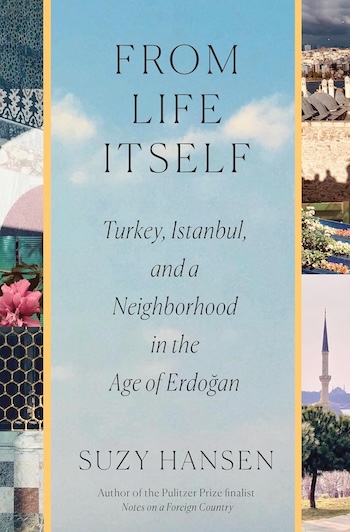
From Life Itself: Turkey, Istanbul, and a Neighborhood in the Age of Erdogan by Suzy Hansen. Farrar, Straus and Giroux, 368 pages, $30.
The infrastructure that Recep Tayyip Erdoğan built in Istanbul is impressive. When I first arrived in September of 1993, the only evidence of a subway was the open pit of the future Şişli station. Within a few years, when Erdoğan was mayor of Istanbul, one of my students wore a t-shirt contrasting the 13 subway lines and 186 stations of the Tokyo Subway with Istanbul’s one line and five stops.
Istanbul now has 11 primary lines and 152 stations. It’s a relatively simple task to get from one part of the city to another. Modernization, the Turkish dream that began in the 19th Century, has become Erdoğan’s and Ak Party’s greatest achievement: Now Turkey has the largest airport in Europe, the largest court. New bridges span the Sea of Marmara and the Dardanelles. But a price must be paid. After a reevaluation in January 2005, the Turkish lira stood at 1.65 to the dollar. The economy, based on growing foreign and domestic debt, supercharged inflation. Forty-six lira to the dollar is the current rate. Decorative metal cladding in the Taksim Metro Station, the first built and still one of the most important, has been stripped off, leaving its rusting, pitted, and bent underbelly exposed. The runway of the airport in Hatay, built on a drained lakebed in 2007, split in two during the terrible earthquake of 2024. It was six days before rescue services could fly in. As Suzy Hansen points out, with her customarily sharp assessment, the rush to modernize—propelled by corruption—has its downsides.
From Life Itself is an impressive achievement, critical if one wants to understand modern Turkey. Hansen never fails to mention the historical events that drive the engine that has led to autocracy, but she also, to her credit, continually gives her book a personal, emotional touch.
A female, Western journalist, she gains the trust of her neighborhood of Karagümrük. Once home to “a wonderland of notable elites,” [it] “has become a dusty, impoverished backwater.” She enters places like its kahve (a tea garden) or a barbershop, very male, macho institutions in these working-class areas. But it would be unfair to underestimate the kindness the people of this mahalle (neighborhood). As I recently discovered staying in Balat, another working-class neighborhood in the old city, if the people there like and trust you—and you speak a little Turkish—you’re in. Hansen became the female equivalent of an eniste, the word for uncle, which also means a friend of the Turks.
Hansen develops a compelling dramatis personae, and she looks at their lives beyond the political perspective. She examines how their personalities and internecine conflicts reflect the contradictions of living in Karagümrük. The muhtar Ismail, the primary political figure in the neighborhood for many years, was raised there. He remembers the golden age when Rum—the name for Greeks from Asia Minor—lived in the area, the gardens and the beautiful wooden houses. But, like everyone else, Ismail sold his wooden house with a garden so an apartment building can be built. Hüseyin is a defender of the Syrians and a fervent supporter of Erdoğan’s Ak Party throughout most of the book. Yet, by the end, “he was no longer the boisterous, proud Erdoğan evangelist”. He is the father of three bright, ambitious daughters who, though they went to a religious Imam Hatip school, don’t wear headscarves. Hüseyin despairs because they can’t find work. Ebru is the local real estate agent and holds three master’s degrees. She is the best educated person in the mahalle and a friend to the local Roma. She runs for muhtar, expounding smart ideas about how to improve the mahalle. Burhan Bey, the Ak Party candidate, has his hands on the party’s cash and power but, once again, Ismail the political independent wins. Hansen has carefully selected people who illustrate the ongoing battle between the old-timers in the mahalle and newbies, many from the country, who have recently moved to the neighborhood.
Erdoğan’s policies inevitably change Karagümrük. The legendary Roma neighborhood, Sulukule, is torn down and replaced with cheap but expensive-looking housing from TOKI, the national housing authority. Eventually, wealthy Syrians end up living there and their businesses become going concerns on the high street of the neighborhood. Predictably, the tension between the Turks and the Syrians grows.
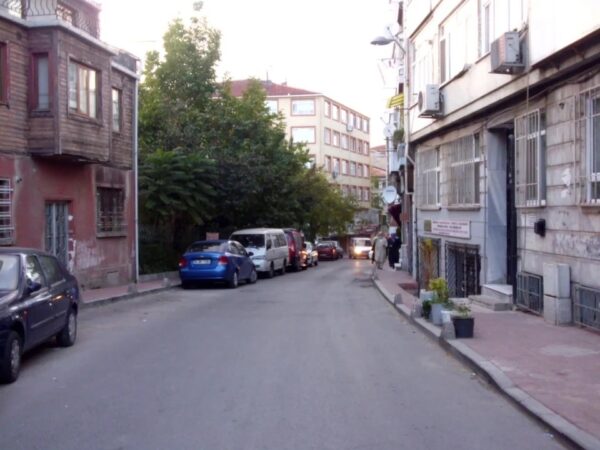
A look at a street in the Karagümrük neighborhood of Turkey. Photo: Wikimedia
After the Gezi Park Protests in 2013, the Ak Party began to hit back hard at any attempt to change the status quo, which led to the arrest, on trumped-up charges, of liberals such as Osman Kavala, who is serving a life sentence. The Gülen religious movement, once part of Erdoğan’s coalition, attempted a coup in 2016 and failed. Around 113,000 people were arrested, and 150,000 public servants of all sorts lost their jobs in this police action, including six thousand academics. After the Kurdish Peoples Democratic Party wins enough of the popular vote to join the parliament, Selahattin Demirtas, its head, is detained. In 2024, 10 years after the Kobani riots he was accused of fomenting, he is found guilty of several charges and sentenced to 42 years in jail. More recently, Ekrem Imamoglu, the very popular mayor of Istanbul, has been put in pre-trial detention. Just to ensure that his Republican Peoples Party (CHP) doesn’t get any ambitions, a judge appointed by the Ak Party recently suspended the newly elected leader of CHP, replacing him with Kemal Kıllıcdaroğlu, who had already lost some 13 elections before losing his position as head of the party in 2023.
Near the end From Life Itself, Hansen points out that Erdoğan’s ideological foundation comes from Ottoman ideology, Turkish nationalism, and American imperialism. True enough, but I feel Hansen also should take a look back at the history of Asia Minor itself. It was a cradle for empires, from the Hittites to the Ottomans: Erdoğan had only to admire the repression demanded for this glorious imperial past to inspire his desire for an imperial future.
As for the book’s relevance to the autocratic happenings in America today, my instinct is to temper making snap judgments. Erdoğan is a smart politician who has been in power for 23 years. Trump does not come off as all that clever. Turkey’s centralized government and the decentralized political structure of the United States are quite different—for example, Turkish governors are appointed while we in the U.S. elect them. But if you want to understand how a country grows more authoritarian, this is an indispensable read. Hansen’s chronicle of how political power is being used to oppress academic freedoms in Turkish universities is a sad reminder of recent lawsuits brought by the Trump administration.
Hansen’s first book, Notes on a Foreign Country, while written with verve, was an expatriate starter kit. Reading it, I found myself reliving my misunderstandings of Turkish culture during the years I initially lived there. What’s more, its analysis was scattered across a number of countries and centuries. From Life Itself is the work of an experienced hand. I’ve never read a book about Turkey that so completely gets at the complexity of the political dilemma generated by the election of a cunning autocrat who not only knows how to say haddini bil—know your place—but how to teach a lesson—ders vermek.
Jeffrey Kahrs recently published a book of poems called The Far Shore in a bilingual edition of Turkish and English. He’s also published a chapbook from Gold Wake Press and won the Nazim Hikmet Poetry Prize in 2012. His poems, fiction, and nonfiction have appeared in numerous journals. Working with translation partner Mete Özel, their renderings of Turkish poetry into English were nominated for a Pushcart Prize in translation in 2025. Mr. Kahrs lived in Istanbul for 18 years.