Book Review: Stop Romanticizing the Starving Artist
By Debra Cash
Making Art and Making a Living assembles colorful tales of ingenuity while skirting the economic inequities that make them necessary.
Making Art and Making a Living: Adventures in Funding a Creative Life by Mason Currey. Celadon Books/Macmillan, 227 pp, $30.
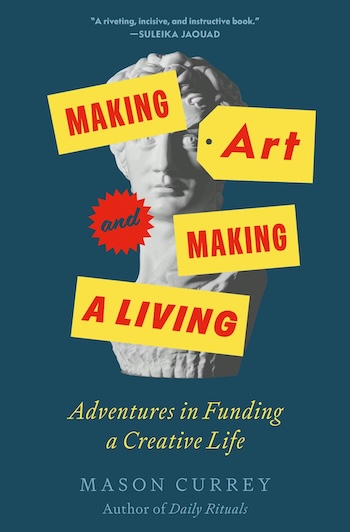
Mason Currey’s new Making Art and Making a Living: Adventures in Funding a Creative Life is a compendium “of patrons, day jobs, side hustles, strategic marriages, petty theft, palace intrigue and other adventures in funding a creative life.” Young artists won’t learn how to beat the odds by following Currey’s historical examples—and I feel sorry for the folks who are misled by the title and think it will—but they may learn that their predecessors often pulled off being artists by the skin of their teeth.
The volume is full of factoids you can throw into a cultivated chat at a soirée. Did you know that if he hadn’t been an idiosyncratic composer, Charles Ives might be remembered as a pioneer of the life insurance industry? That Louisa May Alcott wrote Little Women to support her family (including her Transcendentalist father, who was feckless) and resented it as an example of “moral pap for the young”? That Thornton Wilder suggested that an ideal job for an aspiring writer was to run a gas station in the New Mexican desert? That painter Romare Bearden tried to write hit songs to fund a return to the Paris he had enjoyed on the GI Bill? That avant-garde composer and theorist John Cage and painter Larry Rivers both made big bucks appearing on early television game shows?
Currey parses out a series of biographical vignettes that describe various strategies that young artists may have seen recommended by Carol Lloyd, Bill Burnett, and Dave Evans, or heard from a counselor at a conservatory or university Career Center. These include the time-tested suggestion that artists take side gigs related to their passions (a painter working in a framing shop, a writer in a bookstore). That they find paid employment doing something completely unrelated—ideally in a job with flexible or protected hours—to keep their heads clear for making their art. That they find a steady, good-paying job that underwrites an art practice pursued outside work hours—teaching or even, if you’re Jeff Koons, selling commodities on Wall Street.
Alternatively, a young artist can find a patron: parents, a dying aunt, a gainfully employed spouse, a prince, the Pope, or Peggy Guggenheim. Or turn to stripping and sex work (Kathy Acker) or theft (Godard, Genet).
Poverty didn’t ennoble the artists whose trajectories Currey traces—depending on who they were, it made them cranky, clingy, obsequious, or suicidal—but in most cases, it did spur ingenuity. Was figuring out how to come up with the rent and the price of their materials a detour from focusing on their “real” artistic work? Sometimes. But at other times, it was a step that not only got them fed, it also created the conditions for further work. While their financial needs and art-making practices may have been individual, the best solutions tended to be communal and systemic. As just one example, when Frank O’Hara worked at the Museum of Modern Art’s ticket counter, he not only found the time (and inspiration!) to write poems on his lunch break, but the job also brought him into the creative circle (and occasionally mutual aid) of the mid-century painters, poets, and composers who congregated at the Cedar Street Tavern.
Money matters. Keeping a roof over your head and being able to eat—even if it’s a ceaseless diet of ramen—is never beside the point. When Currey discusses the WPA Federal Art Project (which commissioned, among other works, the murals in the Wilbur J. Cohen Federal Building in Washington, D.C., created under WPA auspices by Ben Shahn, Philip Guston, Seymour Fogel and slated for demolition by the current philistine administration), the government salary for artists was $23.86 a week, on par with the average starting salary for an American automotive worker. The subsidy catalyzed a remarkable creative flourishing. At the same time, special pleading for artists is, at best, unseemly. If we are going to fight for guaranteed basic income for artists who choose to pursue their relatively unalienated labor, we need to be fighting for it for the low-wage, often immigrant hamburger flippers, rideshare drivers, and aides to seniors, too. Let’s not forget that pandemic relief under Biden “spurred the largest one-year drop in child poverty on record, driving child poverty down to an all-time low of 5.2 percent.” Surprise! A great solution to poverty is giving people money, especially when that money comes with no strings attached.
Today’s discourse about “cultural entrepreneurship” positions artists on the same plane as people building apps. It’s not that artists are not entrepreneurial—they often are—but in financial terms, the analogy is misguided. Developers building apps are looking for customers. The artists discussed in Currey’s book follow their own star, come what may. Maybe their effort will pay off, in income or reputation. Maybe it won’t. Even if it does, we may only be able to tell in retrospect what it truly cost, and what the culture they contributed to gained on that investment.
As I was reading, I was reminded of a brief, cheerfully aggrieved song that I hadn’t thought of in years. In three and a half minutes, songwriter Hugh Blumenfeld distills what it took Mason Currey extensive research and over 200 pages to say. I looked up Blumenfeld’s website. He went back to med school, became a doctor, and says he still plays gigs from time to time.
“Mozart’s Money” is worth meditating on before all of Mozart’s, and everyone else’s, work has been pirated by AI, and the derivative words, images, film, and music it spits out will beggar us all.
Debra Cash is a Founding Contributing Writer to the Arts Fuse and member of its Board. She has always held down more than one job.