Book Review: Literature vs. McCarthyism — A Battle Marjorie Garber Only Thinks She’s Winning
By Tom Connolly
Marjorie Garber’s case for poetry as resistance proves more fanciful than persuasive.
A Treacherous Secret Agent: How Literature Spoke Truth to Power During the Red Scare by Marjorie Garber. Yale University Press, 264 pp, $30.
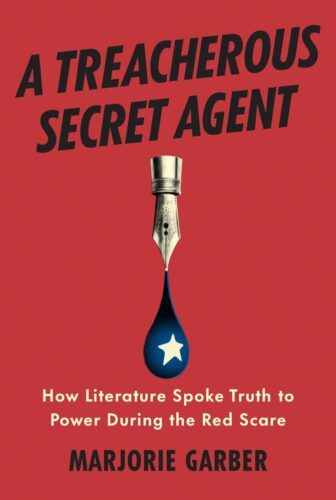
Dorothy Parker is mistakenly credited with the quip: “This is not a book to be tossed aside lightly. It should be thrown with great force.” Cultural critic Marjorie Garber’s A Treacherous Secret Agent deserves this violent fate. Garber’s writing career has been about flitting from one pet project to the next. When she discovered sexuality, she ordained orgasms for the whole world. She bought a house and wrote a book about how everyone must be obsessed with real estate. The latest nectar sipped by this pedantic hummingbird is the Red Scare. Ten years ago, Garber co-edited an anthology about the Rosenbergs. In her opening essay, she reduced their electrocution to a discussion of Jell-O. Now she has come up with a volume to remind us, eight times, that HUAC Congressman Joe Starnes suspected that Christopher Marlowe was a Communist.
Garber’s argument boils down to the assumption that Red-baiters were illiterate. On the other team, Robert Oppenheimer loved T.S. Eliot and John Donne, and Paul Robeson played Othello. Humanists have the last laugh on the barbaric boneheads. A passage from George Steiner’s Language and Silence makes the counterargument: “’We know that a man can read Goethe or Rilke in the evening, that he can play Bach and Schubert, and go to his day’s work at Auschwitz in the morning.” Or how about this Nazi appreciation of the arts: “When I hear ‘culture’…I unlock my Browning!.” (“Wenn ich Kultur höre…entsichere ich meinen Browning!” [ellipsis in the original]). This statement was made by Hanns Johst, German playwright and an SS officer, who, by the way, who survived the war and died in bed.
The book’s subtitle, “How Literature Spoke Truth to Power During the Red Scare,” promises an inspiring excursion among the heroes who faced down HUAC and McCarthy. But it is lazy; the narrative is essentially a series of vignettes sprinkled with Garber’s favored literary allusions and quotations. “And thus the whirligig of time brings in his revenges” is trotted out more than once. She states that her “subject is poetic revenge,” which she describes as “a phenomenon more tangential or subliminal: the voices of poets and playwrights from earlier times that echo and reecho at key moments in an uncanny counter-testimony, offering challenges to the committee that its members do not hear, or do not catch.” Garber is pushing the lawnmower in Virginia Woolf’s Mrs. Dalloway, which made the sound “clever, clever, clever” and “went on and on.”
Curiously, Garber neglects the one indisputably great author who testified before HUAC, Bertolt Brecht. She establishes connections between Oppenheimer and the titular hero of Brecht’s play Galileo, but the playwright is only a tangent for her. Garber can’t examine his role in the Red Scare because it would undercut her thesis. Brecht’s testimony, widely available in full, shows the poet outfoxing the committee with elaborate verbal obfuscations. Brecht had no faith that words would shield him from HUAC’s outrageous slings and arrows. He fled the country a few hours after he testified. The chapter on Paul Robeson is a paean to the man’s greatness, but the fact that he performed Othello three times — his 1943 staging still holds the record for the longest-running Shakespeare production on Broadway — did not stop the State Department from revoking his passport or the C.I.A.’s alleged attempts to “neutralize” him.
Midway through A Treacherous Secret Agent, Garber inserts a chapter on the Pledge of Allegiance, examining how “under God” was placed into it. She offers a close reading of Francis Bellamy’s original text and treats readers to a reminiscence of her childhood insights into scansion and literary style. This is representative of the book’s superficiality: How can literature “speak truth to power” if power is deaf to it? HUAC neither “heard” nor “caught” the literary echoes Garber insists reverberate so mightily to her today. Hers is more of an excursion into personal fantasy than concrete political analysis. Of course, intellectual opposition to authoritarianism has succeeded — there was Thomas Mann’s very public campaign (with U.S. government support) to preserve German culture in the face of Nazi depredations. Recall John Paul II’s response to Stalin’s jibe: “How many divisions does the Pope have?” It wasn’t sermons that brought down the Polish Communists — it was the Pope’s support for Solidarność.
The final chapter focuses on Joe Papp, who defended Shakespeare against charges of propaganda, the definition of which Garber parses for two pages (it’s “from the Latin”). But it wasn’t the Bard who got Papp his job back at CBS after he had been blacklisted — it was his union. The book’s “coda” trots out the inevitable, now exhausted, reference to Shelley’s belief in poets as “unacknowledged legislators,” with Garber issuing the stern warning that “those who aspire or pretend to power today will learn the lesson that eluded their predecessors.” Trump and his authoritarian-minded minions have little to fear from the lessons in this book.
Tom Connolly is Professor Emeritus of Humanities and Social Sciences at Prince Mohammad Bin Fahd University. He recently edited a historical study (in English) of the 19th- and 20th-century Jewish community of Döbling for the Österreichischen Akademie der Wissenschaften, Institut für Kulturwissenschaften. His book Goodbye, Good Ol’ USA: What America Lost in World War II: The Movies, The Home Front and Postwar Culture is forthcoming from Houghton Mifflin/PMU Press.
Tagged: "A Treacherous Secret Agent", HUAC, Marjorie Garber, McCarthyism