
Film Review: I’m an Actor, Not a Victim” — Ian Charleson’s Final Hamlet
By Tim Jackson
Elsinore, with Andrew Scott and Olivia Colman, dramatizes the final months an actor who gave the performance of his life while hiding his AIDS diagnosis.
Elsinore, directed by Simon Stone. Screening at Coolidge Corner Theatre, Brookline and AMC Boston Common. At the Alamo Drafthouse Seaport, beginning on Dec. 10.
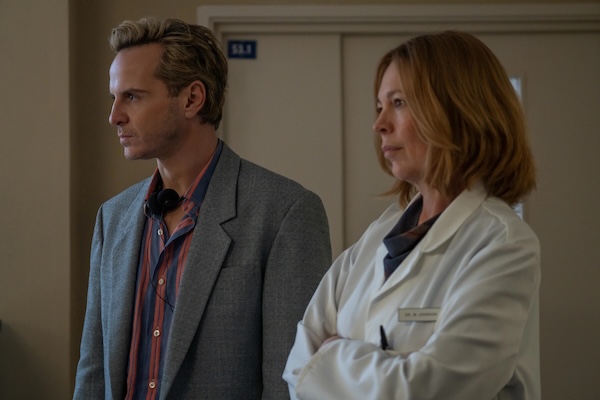
Andrew Scott and Olivia Coleman in Elsinore. Photo: Focus Features
In September 1989, Daniel Day-Lewis walked offstage in the middle of a performance of Hamlet at London’s National Theatre. Ian Charleson, seriously ill with AIDS, stepped in to a role he had played once, well over a decade earlier. The actor went on to give a performance many consider the finest of his career. (Some critics called his Hamlet among the greatest interpretations of the role.)
Charleson’s final performance at the National Theatre took place on November 13, 1989. The public did not learn of his illness until after his death on January 6, 1990, at age 40. Cast, crew, and audiences had been told he was recovering from a sinus operation. Director Simon Stone’s Elsinore chronicles Charleson’s final months onstage.
Andrew Scott, who plays Charleson in Elsinore, performed the role of Hamlet in Robert Icke’s modern-dress production at the Almeida and Harold Pinter Theatres in 2017. The Observer wrote, “He is a brilliant communicator and ensures that Shakespeare’s language never sounds archaic.” Scott has since appeared as the priest in Fleabag, in the title role of Ripley, in a one-person adaptation of Uncle Vanya, and, most recently in New York, in Simon Stephens’s Sea Wall, which was filmed for an upcoming feature. For this project, the ubiquitous actor faced the challenge of imagining Charleson’s Hamlet as distinct from his own.
The film opens on Charleson as a working actor frustrated at being remembered mainly as Scottish runner Eric Liddell in Chariots of Fire (1981). “All they remember is the music,” he complains, referring to Vangelis’s Oscar-winning score. In one scene, a cab driver recognizes him and sings the famous theme. A friend teases him about the role, calling it “the first in a long line of heterosexual masquerades.” Playing Hamlet is both a vindication and a rare chance to prove his worth as an actor.
Singer and actor Johnny Flynn plays stage director Richard Eyre, a role far removed from his diabolical villain Frankie Cooper in MobLand. Eyre knows about Charleson’s HIV diagnosis and offers him the part anyway. Their easy rapport is amusingly dramatized in this exchange about the actor taking on the part. “It’s not a risk for me, but it is for you,” Eyre says. “Are you speaking with your heart or your brain?” asks Charleson. “My heart,” replies Eyre. “Well, you never had much of a brain,” Charleson shoots back.
In Elsinore, Charleson later faces off against director Derek Jarman, played in an explosive cameo by David Dawson (My Policeman). Jarman, whose films The Tempest (1979) and Caravaggio (1986) reimagine historical and literary subjects through a queer sensibility, insists that Charleson publicly acknowledge his sexuality and illness and become a “soldier for the cause.” Charleson has other priorities. He wants to explore his own depths through Hamlet, not turn his private life into a public declaration. “If they see me and not the character, I’ve failed,” he tells Jarman. “I’m an actor, not a victim.” Then, in an oddly anachronistic reference, Jarman tells him, “Well, you’re no Matt Damon.” Charleson’s reply is more on the money: “And you’re no Visconti.” Of his illness, he adds, “And they will know soon enough.”
The greatest challenge, however, is meeting the physical demands of the role night after night. Olivia Colman plays Dr. Margaret Johnson, a physician and HIV specialist, with bracing directness. Sensibly, she urges Charleson to turn down the role, since rehearsals, memorizing lines, and the strain of performing will consume every waking minute, leaving little time for rest. He looks straight at her and says, “I’m dying.” An awkward silence follows. “That’s a question,” he adds emphatically. “Yes. Possibly,” she responds. “Will you come to a performance?” he asks. Disarmed, she says nothing.
Discarding her warnings, he takes the role. Sustained by pills and chemotherapy, Charleson gives powerful performances, though nausea and weakness sometimes bring him close to collapse. Looking back on the Hamlet he played over a decade earlier, he is dismissive: “I was too young to play Hamlet. You have to have the world inside of you.” Now, with death approaching, he brings an intimate knowledge of mortality to the part, an understanding reinforced by scenes that cross-cut between his treatment and performances in the theater. Asked what he hopes to achieve, Charleson answers, “To be.” Hamlet’s own speech on death near the end of the tragedy declares, “Readiness is all.” There is no need to underline the parallels.
And that brings me to the production’s major flaw—its tendency to overscore emotion. A fine cast, led by Scott’s charm and intensity, carries the narrative easily, so importing cinematic and musical clichés is unnecessary. Stone, whose background is primarily in theater, should have trusted Stephen Beresford’s script more. The swelling score, especially in the final moments, comes off as redundant and needlessly manipulative. Still, that excess is a small price for a moving story of artistic resolve in the face of mortality, anchored by one of the year’s best performances.
Tim Jackson was an assistant professor of Digital Film and Video for 20 years. His music career in Boston began in the 1970s and includes some 20 groups, recordings, national and international tours, and contributions to film soundtracks. He studied theater and English as an undergraduate, and has also worked helter-skelter as an actor and member of SAG and AFTRA since the 1980s. He has directed four feature documentaries: Chaos and Order: Making American Theater, which is about the American Repertory Theater; Radical Jesters, which profiles the practices of 11 interventionist artists and agit-prop performance groups; When Things Go Wrong: The Robin Lane Story, and Marblehead Morning: Daring & Stahl: 50 Years in Harmony. He has made two short films as well: Joan Walsh Anglund: Life in Story and Poem and The American Gurner. He is a member of the Boston Society of Film Critics. You can read more of his work on his substack.
Tagged: AIDS history, Andrew Scott, Biopic, Chariots of Fire, Daniel Day-Lewis, David Dawson, Derek Jarman, Elsinore, Elsinore film review, HIV, Hamlet, Ian Charleson, Johnny Flynn, National-Theatre, Olivia Colman, Queer Cinema, Richard Eyre, Shakespeare, Simon Stone, Stephen Beresford, film review