
Visual Arts Review: When Artists Took Their Sketchbooks Outside
By Lauren Kaufmann
At Harvard Art Museums, ten trails inspired by philosopher Jean-Jacques Rousseau trace how artists stepped outside the studio and found new ways to see the natural world.
On Location: Drawing the Outdoors, at the Harvard Art Museums, Cambridge. On view through January 17, 2027.
The natural world offers an endless variety of subject matter for visual artists. From the romantic visions of Thomas Cole to the dappled light of Monet and the solid abstractions of Cézanne, landscapes have long been an enduring theme. It seems that artists have always ventured outside to capture the changing colors and light of waterways, mountains, open fields, and forests.
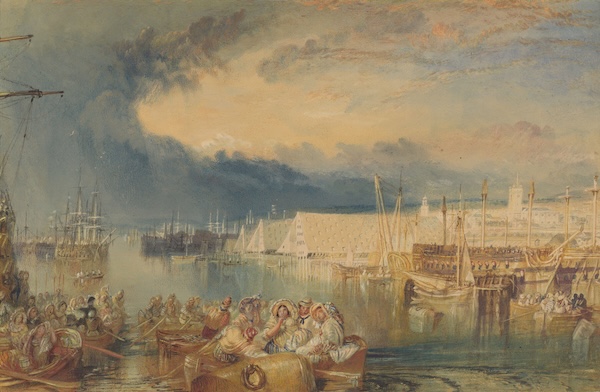
Joseph Mallord William Turner, Devonport and Dockyard, Devonshire, c. 1825-29. Photo: copyright President and Fellows of Harvard College; courtesy Harvard Art Museums.
On Location: Drawing the Outdoors reveals that it wasn’t until the late 1700s that European artists turned their focus to the natural world. And it must have been a wonderful relief after years spent depicting religious, allegorical, and historical subjects and painting portraits of wealthy patrons and powerful men.
For a long time, classically trained artists were confined to the studio, where they took inspiration from live or plaster models, still-life arrangements, and biblical and historical stories. Once they ventured outside, artists experimented with a variety of tools, techniques, and styles to express the beauty of the great outdoors.
The rise of urban industrialization in the 1700s played a role in the quest to explore nature, as people sought fresh air, open space, and uplifting views. The exhibition displays several works depicting places where city dwellers went to escape, including parks, racetracks, and nearby woods.
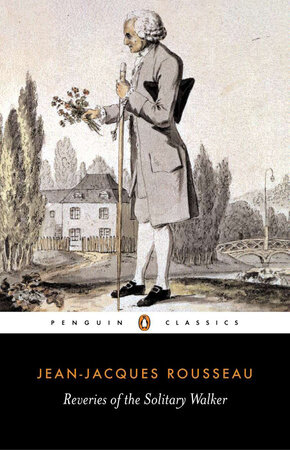 The exhibition features about 140 sketches, watercolors, and pastels dating from the 1780s to the early 1900s. It is organized into ten “trails” inspired by the writings of Swiss philosopher Jean-Jacques Rousseau (1712–1778). His book Reveries of the Solitary Walker, published posthumously in 1782, is organized into ten walks. For Rousseau, being in nature offered both joy and a refuge from society. Given the hardship and strife he experienced in his life and career, it’s not surprising that he turned to the natural world for solace.
Although each of the ten trails has a particular focus, the categories overlap, and some works could easily fit into more than one trail. For the most part, though, the groupings work well: the similarities among the pieces give each trail a distinct focus.
Trail 1: Solitary Walks focuses on Rousseau and his influence on how people viewed the natural world. A glass case displays a handwritten copy of The Confessions of J. J. Rousseau alongside Reveries of the Solitary Walker. There’s also a book of botanical prints by the French artist Pierre-Joseph Redouté. Rousseau collected plants on his walks, and his specimens were the basis for the prints. The books on display come from Harvard’s Houghton Library, while most of the art in the exhibition was supplied from the collections of the Harvard Art Museums. The museums have valued landscapes since the founding of the Fogg Museum, whose early curators acquired some outstanding examples.
Some labels include QR codes that lead to additional information about the works. Some link to the Arnold Arboretum, a Harvard-affiliated botanical research institute and public park. A QR code beside Swiss artist Adrian Zingg’s magnificent ink drawing Bank with Sweet Coltsfoot, Blossoming Reed-Grass, and Other Plants links to information identifying the plants in the drawing.
Trail 1 also includes British artist J. M. W. Turner’s watercolor Devonport and Dockyard, Devonshire (c. 1825–29). This depiction of the naval base in Plymouth, England, celebrates England’s victory over Napoleonic France. Naval ships sit in dry dock as sunlight breaks through dark clouds. The painting’s inclusion in Solitary Walks is puzzling, since the trail emphasizes close observation of nature. Nevertheless, the picture shows off Turner’s mastery of dramatic skies. Known for his dazzling seascapes, Turner had a talent for rendering filtered sunlight, and this painting is a fine example.
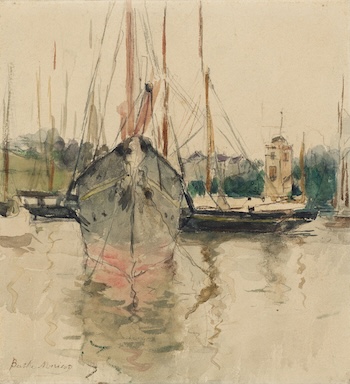
Berthe Morisot, Boats (Entry of the Midina to the Isle of Wight), 1875. Photo: copyright President and Fellows of Harvard College; courtesy Harvard Art Museums.
Trail 2: Materiality and Process explores the materials and techniques of landscape drawing. Before setting off for the woods, artists might pack ink, ink wash, watercolor, chalk, charcoal, graphite, and pastels, along with brushes and water containers. By the 1800s, portable drawing and watercolor kits made it easier to work outdoors.
Sky Study with a Tree (1826), by Élisabeth Louise Vigée-LeBrun, is a lovely pastel sketch by an artist better known for her portraits. Vigée-LeBrun was well paid for the latter — she made nature studies for her own enjoyment.
Some pieces in this section are quick sketches that served as the basis for finished works completed in the studio. Others are exquisitely detailed, finished drawings. In Wooded Landscape, François-Louis Français drew on charcoal, charcoal wash, opaque watercolor, and black ink. He traced the edges of the leaves in ink and applied opaque white watercolor to convey filtered light. The drawing is remarkable for its detail and inventive use of materials.
Trail 3: An Artist’s Education addresses the lack of formal training in landscape art. Although art academy professors encouraged artists to work en plein air, or outdoors, they did not teach students how to draw or paint landscapes. Some French artists traveled to Italy in the summer; others sketched in forests outside Paris or along the coasts of Normandy and Brittany. Artists struck up friendships as they worked outdoors together, sharing tools and techniques.
Eugène Delacroix (1798–1863), regarded as the leader of the French Romantic school, was well known for his large-scale historical paintings. Yet he made time for landscapes. Curator Joachim Homann says that Delacroix’s Forest Clearing (c. 1854) shows “a new way of painting based on looking and thinking about nature, perception, and art in correspondence.”
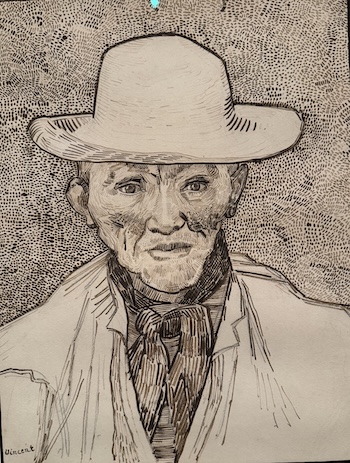
Vincent van Gogh, Peasant of the Camargue, 1888. Photo: courtesy of Lauren Kaufmann.
In Fragment of the Alps (c. 1854–56), British painter John Ruskin studies Alpine plants and rock formations at close range. In this watercolor, subtle shifts of light and shadow give the rocks weight and volume, while a distant cobalt-blue sky sets off the finely observed foreground.
Trail 4: Nature, Identity and Notions of Liberty focuses on Swiss artists who found inspiration in the landscape of their home country.
Trail 5: Home and Away considers both artists who depicted their home regions and those who traveled to study unfamiliar landscapes. A group of northern European artists spent their summers in Rome, hiking through the surrounding hills and sketching the Italian landscape.
Trail 6: Observation and Optical Devices looks at how landscape artists used lenses, mirrors, and other devices to depict what they saw as accurately as possible. British artists used a variety of tools and techniques to render the natural world faithfully. One such tool was the camera lucida, an optical device that made the scene appear superimposed on the paper as the artist drew.
In Trail 7: Landscape of the Mind, artists use imaginary scenes to take viewers to new places. William Blake’s watercolor War (1805) depicts grieving figures on a battlefield at dawn. A woman, a child, and an elderly man huddle beside the body of a fallen war hero. The watercolor part of a series of imaginative landscapes Blake produced.
Depictions of agricultural workers fill Trail 8: Labor and Land. In the mid- to late 1800s, industrialization and urbanization encroached on rural life, turning peasants into wage laborers with no guarantee of food or shelter. While some artists romanticized rural life, others detailed the hardships farmworkers faced. In Peasant of the Camargue (1888), Vincent van Gogh portrays a former cowherd who became a gardener. It’s a powerful portrait that conveys van Gogh’s empathy for working people.
Trail 9: Works in Escapism and Leisure depict city dwellers who sought a break from urban life and a chance to enjoy the natural world. Berthe Morisot’s 1875 watercolor Boats (Entry of the Midina to the Isle of Wight) is a loosely rendered picture that combines a thin wash of paint with wavy brushstrokes to suggest ripples on the water. It’s a marvel of simplicity.
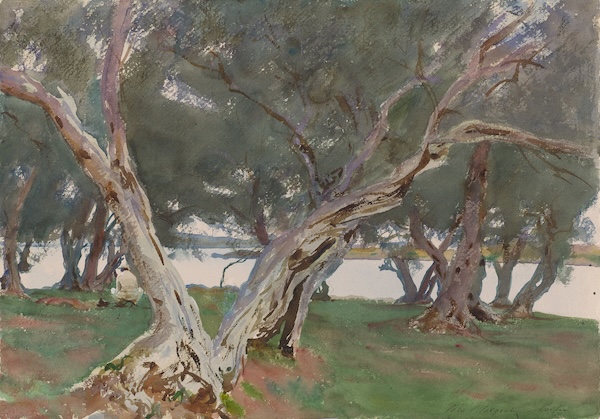
John Singer Sargent, Olive Trees, Corfu, 1909. Photo: copyright President and Fellows of Harvard College; courtesy Harvard Art Museums.
Trail 10: Landscape and Environment brings together works that pair close observation with feeling, showing how small details can evoke a landscape as a whole. John Singer Sargent’s Olive Trees, Corfu (1909) also points to the limits of that approach. As the label puts it, “an artist’s intuition and creativity are but a minor part of the complex natural forces that surround us—of an environment that can only be suggested but not comprehended with a brush.”
The range in this show is breathtaking: finely detailed plant studies, luminous watercolors of woods, and shimmering views of water. Many of the artists had no formal training in landscape art and were better known for other work, yet they found subjects outdoors that rewarded close attention. Seen together, their works make a strong case for the restorative pleasure of looking closely at the natural world.
Lauren Kaufmann has worked in the museum field for the past 14 years and has curated a number of exhibitions.
Tagged: Berthe Morisot, Botanical Art, Cambridge Massachusetts, Eugène Delacroix, Harvard-Art-Museums, Jean-Jacques Rousseau, John Singer Sargent, Landscape Art, On Location: Drawing the Outdoors, Pastels, Plein Air Drawing, Vincent van Gogh, art exhibitions, j.M.W. Turner