Book Review: The Enduring Mysteries of “The Last Words of Jack Ruby”
By Bob Katz
Joshua Corey has skillfully imagined his way into the convoluted, atmospheric mysteries of Dallas through the force of his prose and the diligence of his research.
The Last Words of Jack Ruby by Joshua Corey. Tortoise Books. 388 pages, $22.99.
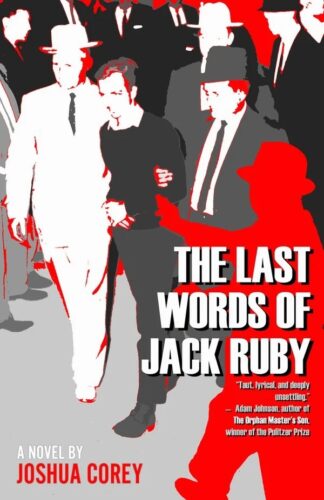
“Oswald’s November,” wrote poet Anne Sexton in evoking that season of gloom and dread. But she could just as aptly have named it “Ruby’s November,” as Joshua Corey makes clear in his brooding, lyrical, noirish novel, The Last Words of Jack Ruby.
We are, of course, speaking of November 1963 and its still-smoldering aftermath.
Last Words takes place four years later, in 1967. The Warren Commission has completed its investigation into the assassination of President Kennedy, yet its conclusion that Lee Harvey Oswald acted alone and unaided has hardly settled the matter. In the public mind, vital questions remain unanswered, questions that might have been addressed had Oswald lived to stand trial.
Jack Ruby put an end to that.
But why? Why did this anxious, humorless Dallas strip club owner with no history of political allegiances do it?
FBI Director J. Edgar Hoover (fictionalized here, all too real in real life), annoyed by the festering controversies and impatient for closure, summons Special Agent Jonathan Bergman (fictional) for a critical assignment. Jack Ruby is dying of cancer at Parkland Hospital, with only a few days to live. “Go there and see if you can get anything out of him. See if you can learn what the hell he was up to.”
“Americans can accept one lone gunman,” Hoover explains. “They cannot accept two.”
Why Bergman, a strait-laced desk jockey G-man whose career has languished unhappily in the unglamorous fraud division? Count that among the mysteries Bergman will soon find himself wrestling with.
He heads off to Dallas, pulls up a chair at Ruby’s hospital bedside, finds the convicted killer of the alleged assassin to be surprisingly congenial, yet learns nothing of obvious relevance. This won’t be quick or easy.
Bergman checks into a downtown hotel and is introduced by a wily bellhop to a foxy lady who’d previously worked at Ruby’s Carousel Club and is now a prostitute schooled in Russian literary classics and adept at mimicking a Russian accent. Infatuated, Bergman enjoys calling her Marina, the name of Oswald’s Russian-born wife. Between late-night scenes of lustful role-playing (“What was he like in bed?” “Who?” “Your husband.”), Bergman remembers he has a job to do. Back to Parkland.
Ruby is happy to talk. The problem—unless it’s not actually a problem but rather the undiagnosed subconscious clue to what makes Ruby run—is the particular topic he persists in obsessively jabbering about. Barney Ross. Barney Ross. Barney Ross.
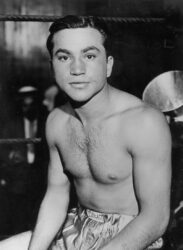
Boxer Barney Ross in 1934. Photo: Wikimedia
The action-packed exploits of Ross, Ruby’s Chicago boyhood chum, world champion boxer in three separate weight divisions, and World War II military hero much decorated for Guadalcanal heroics, sprawl across long sections of the novel, often hogging center stage.
I suppose Corey lets Ross take up so much space because Ruby idolized him. Ross made good in all the ways Ruby floundered, and he embodied the “tough Jew” Ruby aspired to be. That helps explain one theory: Ruby shot Oswald to prove he was tough, too. Still, this reader could have used less of it.
That said, Corey’s descriptions of Ross’s extraordinary life and times are among the novel’s most vivid writing.
“Newsreel cameras cranked at the neutral corners; smoke from cigars and cigarettes wound its way upward into the bright May evening into which a full moon was creeping. Sixty thousand fans, Jack among them, cheered deliriously as Barney danced into the ring in the old striped bathrobe he always wore.”
Back to Bergman. Marina has dashed off to New Orleans in a frantic attempt to reclaim her toddler son, held captive by her controlling white-trash ex. Hopelessly smitten, Bergman doggedly follows.
Not what J. Edgar had in mind. Agent gone rogue. Things begin to spiral. Downward.
Shacked up with Marina in a sleazy Big Easy motel, Bergman hunts down the dirtbag ex at a bayou boat launch, pistol-whips the wrong guy in a crowded nightclub on New Year’s Eve, bloodies his own hand on the sharp edge of a beer can pull-tab, dripping blood everywhere as he chases down leads that lead, or maybe they don’t, to Broussard’s, an upscale French Quarter restaurant where, in the shadows of a corner table, District Attorney Jim Garrison, the Jolly Green Giant, sits amiably lunching with, well, it’s hard to know exactly who that is, since the lighting is dim and the swarthy man swirling his drink with a swizzle stick has his back turned, and, frankly, the roster of sources and suspects is long and getting longer.
Like the stupefied private eye in the final scene of the movie Chinatown, Special Agent Bergman has stumbled into a murky netherworld he never set out to probe and can’t possibly hope to understand.
Because nobody can.
And so we arrive at that fateful final Sunday morning. Corey, drawing on Warren Commission findings and other sources, deftly executes a step-by-step countdown of Ruby’s actions on the morning of November 24, starting with him climbing into the Oldsmobile beside Sheba, his beloved dachshund, and culminating, as we know it must, when he extracts the handgun from his suit coat pocket and “fires once into a storm of flashbulbs.”
I’ll note that Corey makes no mention of the evidence the House Select Committee on Assassinations (HSCA) presented in its final report. The committee concluded that Ruby’s act “was not a spontaneous act” and suggested that he may have been tipped off about the timing of Oswald’s transfer—from the city jail to the more secure county jail—and may have had help getting into the police basement where the murder occurred.
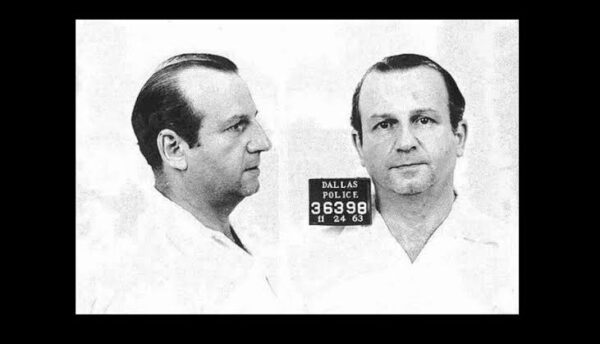
Mugshot of Jack Ruby taken November 24, 1963. Photo: Wikimedia
I don’t really fault Corey for this. It can be too much to deal with.
Even as fiction.
Full disclosure. I was intensely involved in the campaign to establish a congressional reinvestigation of the JFK case, and I came to this novel braced to be at least mildly irked by slick distortions of the known facts for the purpose of cheap-thrill plot development and potboiler effect.
That’s not what I encountered here. Instead, Corey has skillfully imagined his way into the convoluted atmospheric mysteries of Dallas and, through the force of his prose and the diligence of his research, earned the prerogative to bring readers along.
Ruby, Corey writes, “wasn’t on the grassy knoll or at the book depository, wasn’t part of the crowd lining Commerce Street . . . did not witness the penetration of the void at the center of the President’s smile, splashing bits of bone and brain on the pink suit of the President’s wife. The blood was general, it rained on Dealey Plaza and across downtown, fell into the river and coated the blighted hills, soaking into the soil, spreading across Texas and the former Confederacy, infiltrating the secret streams running north to Chicago and New York, west to California, every vein American.”
The novel is also a trove of trivial-pursuit proper names, many of them deserving of their own true-crime, pulp-fiction treatment.
Lynn Bennett, a.k.a. Little Lynn, Carousel Club stripper on whose behalf Ruby went to the Western Union office on the morning of November 24 to wire her $25 before heading to the police station, defense witness at Ruby’s murder trial, arrested for bringing a gun into the courtroom.
George Senator, Ruby’s roommate in a two-bedroom Dallas apartment that rented for $125 a month, native of Gloversville, NY, traveling clothing salesman, part-time Carousel Club employee, testified that he woke Ruby up on the morning of November 24 and they ate breakfast together while watching TV news.
Santo Trafficante Jr., high school dropout, head of organized crime in Florida and pre-Castro Cuba, closely linked to Sam Giancana, Carlos Marcello, and other Mafia figures suspected of colluding with the CIA in nefarious anti-Castro activities, including assassination attempts on Fidel.
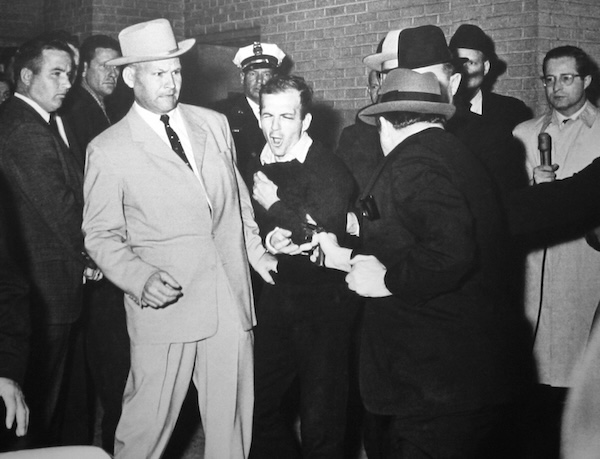
Pulitzer Prize-winning photo of Jack Ruby shooting killing Lee Harvey Oswald, taken on November 24, 1963. Photo: Wikimedia
On the day Trafficante was brought to Washington to testify before the HSCA, I was present in the Cannon House Office Building hearing room.
The morning’s first witness went overtime, and Trafficante was bumped to the afternoon session. During the lunch break, I went down to the cafeteria and found myself waiting in line behind a dour old man wearing black-framed eyeglasses and a dull gray suit. It was him.
Did I ask—hey, just asking—if he had anything to do with the JFK assassination? I did not.
We did, however, briefly discuss which sandwich to order.
Do I recall which sandwich Trafficante chose? I do not.
I could, of course, make it up, invent a detail to help the story along. But that would be fiction.
Bob Katz is the author of six books, including the novels Waiting for Al Gore and Third and Long, winner of the 2011 Independent Book Publishers Association fiction award, and the nonfiction titles Elaine’s Circle and The Whistleblower. He was a founder of the Assassination Information Bureau, a nonprofit group that organized support for a reinvestigation of the JFK and MLK murders. BobKatz.info
Tagged: Barney Ross, Bob Katz, J. Edgar Hoover, JFK Assassination, Jack Ruby, John F Kennedy, Joshua Corey, Lee Harvey Oswald, The Last Words of Jack Ruby, Tortoise Books, book-reviews, historical fiction, noir fiction