Theater Review: “Tell Me, Mother” — Powerful Stories in Search of Cohesion
By Helen Epstein
At Arlekin Theater, Yana Gladkikh’s accounts of mothers traumatized by war make for an intriguing but unfinished whole.
Tell Me, Mother. Devised and Directed by Yana Gladkikh. Choreography by Suli Holum. Soundscape by Bryce Somerville & Victor McSurely. Scenic Consultant, Peter Rule. Performed in Russian, Armenian and Hebrew by Arlekin’s resident company with English supertitles. At Arlekin Theater, Needham, 368 Hillside Ave., through December 20. (75 minutes)
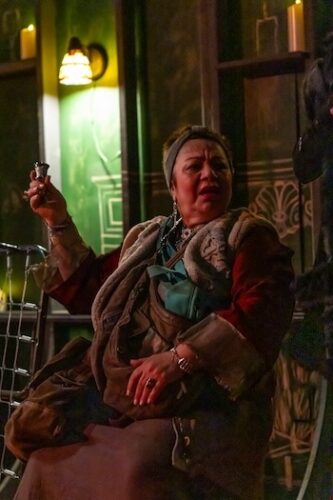
Nana Petetsky-Ghukasyan in Arlekin! Company’s Tell Me, Mother. Photo by Olga Maturana
Sitting in the 35-seat theater of the nondescript commercial building in Needham that has served as the Arlekin! Company’s home for over a decade, I kept thinking of New York’s Public Theater of the 1970s. Back then, producer Joseph Papp ran a laboratory for theater in new forms, created by a variety of nontraditional theater artists, including women like Elizabeth Swados, Adrienne Kennedy, and Ntozake Shange, whose choreographed recital of twenty interconnected poetic monologues by Black women became the Broadway hit For Colored Girls Who Have Considered Suicide. Another project to come out of the Public Theater was A Chorus Line, the hit musical about Broadway dancers that Michael Bennett created from audiotaped autobiographical narratives. While Tell Me, Mother has little dancing or singing — it focuses on the grim narratives of women trapped and traumatized by war — the script shares with those earlier works the power of true personal stories and reflects the long process of shaping them into a coherent piece of theater.
It differs, however, in key ingredients. Tell Me, Mother features an all-immigrant cast, producer, and director and is performed mostly in Russian (with some Hebrew and Armenian bits), translated into English that I read on two small screens containing supertitles. It was conceived and directed by Yana Gladkikh, the actor who performed the role of Leah in Arlekin’s critically-acclaimed production of The Dybbuk, staged at Boston’s Vilna Shul. She also directed the company’s 2026 local production of Beethoven. A graduate of the Moscow Art Theatre School and, for a decade, an actress at the Chekhov Moscow Arts Theatre, Gladkikh directed features and series for Russian television before moving to Los Angeles in 2024 to attend the American Film Institute. She is part of Arlekin Company’s loose association of Russian immigrant artists, assembled by its founder Igor Golyak, who immigrated from the Soviet Union (Kyiv) to Brookline as a child. In 2004, instead of attending college in the U.S., Golyak made the startling decision to study theater in Moscow. He returned to Boston in 2009 and, after failing to find work as an actor or director, began teaching and then founded his own theater in Needham.
Initially, his off-off-off Broadway venue was known only by Boston’s large, tight, theater-loving Russian community. Then, in the spring of 2020, COVID hit and Golyak utilized his time in quarantine to launch the Zero Gravity (Zero-G) Lab with an interactive virtual show State vs. Natasha Banina, which attracted international fans including, eventually, collaborators such as Mikhail Baryshnikov and Jessica Hecht, whom he later recruited for a hybrid production of The Cherry Orchard. That production reached viewers in 55 countries and garnered an impressive on-line following. Arlekin’s 2024 production of The Dybbuk, presented at Boston’s historic Vilna Shul, won an Elliot Norton Award for Outstanding Production. The troupe subsequently staged Our Class in 2025. An adaptation of Ionesco’s Frenzy for Two followed in 2026.
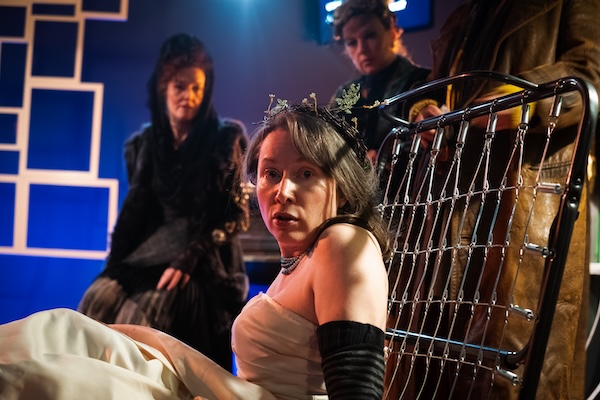
Polina Dubovikova, Anna Furman, and Julia Shikh in Arlekin’s Tell Me, Mother. Photo: Fima Furman
Tell Me, Mother takes place in a café “at the end of the world,” in a set with broken, mismatched props and patched-up costumes that evoke chaos and shipwrecks of civilization. The thematic frame focuses on mothers’ experiences of war and the psychological toll those experiences take. Seven ragtag matriarchs of various ages and nationalities come and go, delivering testimonies of survival from Armenia, Ukraine, the Second World War, 9/11 in New York, 10/7 in Israel, and the 1991 Soviet coup against Michael Gorbachev in Moscow. There are accounts of marriage, childbirth, rape, escape, of holding onto life against all odds.
Right now, Tell Me, Mother plays like a work-in-progress rather than a finished piece of work. Everything about the production—the ensemble of actors, the sets, soundscape, and the direction—is dramatic and intriguing. As a non-Russian speaker, I cannot fully assess the original texts or their delivery. English translations appeared as supertitles on two small screens suspended from the ceiling of the room, and I found it difficult to follow the translations while watching the actors. I noticed that translations from the Hebrew were belated, sometimes inadequate, and suspected that the same was true of the Russian. The performances of the cast are uneven, too. The challenge of delivering emotionally super-charged, devastating monologues in a space as intimate as a living room sometimes overwhelms both actors and audience.
I left feeling that Tell Me, Mother was an important piece of theater, featuring new, interesting, unusual characters in search of an author. A cafe at the end of the world does not provide a sufficient dramatic situation or even an effective frame. This project needs far more cohesion. I hope that the director and company will develop it further. And I look forward to returning to Arlekin.
Helen Epstein (www.helenepstein.com) is an arts reporter and author of a dozen books of non-fiction. She has worked for the ArtsFuse since its inception.
Tagged: Anna Furman, Arlekin Theater, Boston-theater, Helen Epstein, Igor Golyak, Irina Knyazhitskaya, Jenya Brodskaia, Julia Shikh, Nana Petetsky-Ghukasyan, Needham, Polina Dubovikova, Polina Vaserman, Russian-language theater, Tell Me Mother, immigrant theater, theater review, women and war