
Film Appreciation: “Raise the Red Lantern” at 35 — The Aesthetics of Confinement
By Noah Goldstein
Restored in 4K and screening at the Brattle Theatre, Zhang Yimou’s sumptuous, suffocating masterpiece turns household rituals into instruments of control.
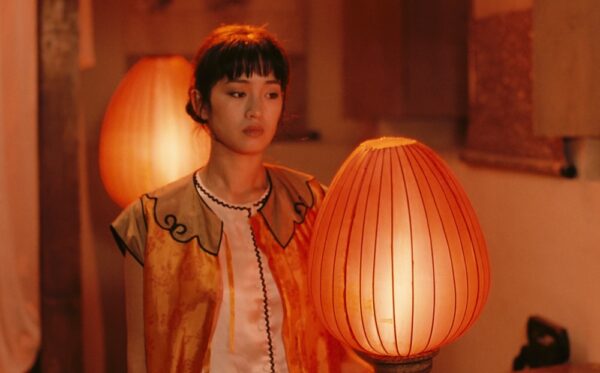
Gong Li in Raise the Red Lantern. Photo: courtesy of Film Movement
Confinement, whether physical or emotional, is so deeply woven into cinema that the two can seem inseparable. From the locked-basement horror film to the story of a wide-eyed dreamer whose ambitions give way to a dreary, bill-paying job, the loss of autonomy drives the tension in countless films. Often, the thrill lies in the escape: the captive breaks free, the idealist takes a chance. These are the moments that bring us to our feet, cheering them on.
Rarely does such a film deny us that reassuring moment of liberation; rarer still does it make confinement so palpable that the audience feels trapped within it. But Zhang Yimou’s Raise the Red Lantern, singular in so many respects, achieves the latter precisely by refusing the former.
Gloriously restored in 4K in honor of its 35th anniversary and playing now through Sunday, November 22, at the Brattle, Zhang’s film is best characterized by its asceticism, adamantly denying its audience the usual cinematic pleasures so that we may more deeply connect with the suffering felt by its characters.
Much of that torment falls to Songlian, played with superb restraint by Gong Li. Zhang and Gong had previously collaborated on three films, including Red Sorghum and Ju Dou, which, together with Raise the Red Lantern, form the loose “Red Trilogy”. Their offscreen romance, meanwhile, had drawn intense media scrutiny.
Yet whatever the offscreen turmoil, Zhang’s framing of Gong as Songlian is rigorously formal. From the opening shot, she sits isolated at the center of the frame, answering her stepmother’s questions about her marriage prospects. What Songlian already understands—and what we will soon learn—is that the women of this vision of 1920s China are confined not merely by the frame but by the claustrophobic social order it reflects. That radical confinement also invites a broader reading: of life in Zhang’s own country after Tiananmen. When Songlian chooses to become a concubine, resigning herself to “a woman’s fate,” the illusion of choice only reveals how little freedom she has.
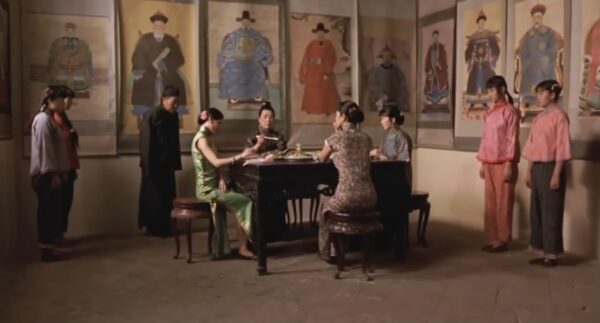
A scene in Raise the Red Lantern. Photo: courtesy of Film Movement
The facade of decision-making is rare in Zhang’s film. It depicts a rigid hierarchy: authority over those below must be as absolute as submission to those above. Once Songlian enters the compound of her soon-to-be husband—a man known only as “the Master,” whom the camera keeps distant or indistinct—even her name gives way to a rank: “Fourth Mistress.”
Her three predecessors may know the Master’s peculiarities better, but novelty initially secures Songlian his favor. Red lanterns are lit outside her quarters, announcing that he will spend the night with her — she receives the coveted privilege of a foot massage. The ritual signifies his sexual dominion, even as coitus itself remains offscreen. The massage also invites an association with footbinding, or chánzú, a centuries-old practice that linked female status and desirability to bodily constraint. The image deftly embodies the film’s dovetailing of privilege and submission.
Status, of course, is everything, and the prospect of bearing a son offers Songlian a means of securing hers. In a household where reproductive potential determines a woman’s value, her arrival threatens Meishan, the Third Mistress, who has a young son, while encouraging an uneasy alliance with Zhuoyun, the Second Mistress, whose daughter confers no comparable standing. The system makes rivals of the women, directing their resentment toward one another rather than toward the authority that confines them. Each initially appears antagonistic; only as the tragedy unfolds does it become clear that all are adapting, in different ways, to the same cage.
Working with cinematographer Zhao Fei, Zhang gives that cage architectural form. Compositions recur until they become devastatingly familiar, above all the elevated, almost surveillant view of the compound’s central courtyard. With each return, the world beyond its walls seems less imaginable.
This formal rigidity recalls the work of Taiwanese filmmaker Hou Hsiao-hsien, credited here as a producer. Sound extends the enclosure beyond the image: the servants’ calls to light the lanterns and the drifting notes of a flute reverberate through the estate. Even what lies outside the frame remains within earshot. Viewers find themselves as captive as the characters.
The conventional escape narrative promises a world beyond confinement, but the rituals here assume a historical inevitability. The horror does not lie simply in what happens within the compound but in how readily its structure and its practices maintain themselves — resumptions follow interruptions. Raise the Red Lantern’s extraordinary power lies in how precisely and beautifully it conveys the emotional degradation of confinement.
Noah Goldstein is a student at Tufts University pursuing a dual degree in Film and Media Studies and Cognitive Brain Sciences. He covers the film and music beats for the Tufts Daily and occasionally writes on sports.
Tagged: 4K restoration, Brattle Theatre, Chinese Cinema, Cinematography, Gong Li, Power and Control, Raise the Red Lantern, film review, patriarchy, world cinema