
Concert Review: Haydn’s “Creation” Shimmers with the Boston Symphony Orchestra
Philippe Jordan leads an exuberant, dramatically charged performance, with radiant soloists and a fervent Tanglewood Festival Chorus.
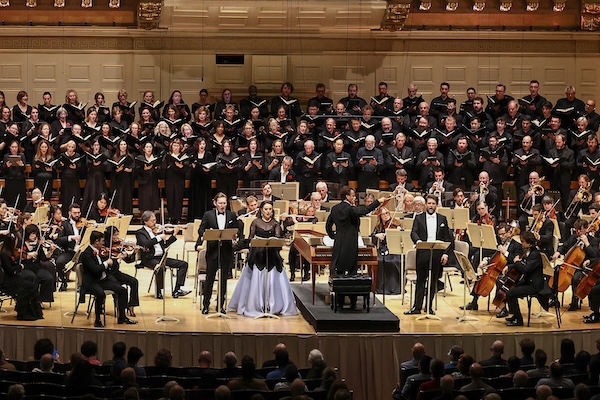
Boston Symphony Orchestra at Symphony Hall performing The Creation with Philippe Jordan, conductor, Louise Alder, soprano, Bogdan Volkov, tenor, David Steffens, bass-baritone, Tanglewood Festival Chorus, and Jean-Sébastien Vallée, conductor and BSO Director of Choruses. Photo: Winslow Townson
By 1791, Franz Joseph Haydn was already celebrated across Europe. His prolific output and reputation preceded him when he visited London for two extended stays during that decade, where he was feted as one of Europe’s foremost composers. But Haydn also honored the greats of the past. He felt a special affinity for the work of George Frideric Handel, whose oratorios were performed on a grand scale at the 1791 Handel Commemoration in Westminster Abbey.
By most accounts, Haydn attended the event and was seated close to the royal box. The large musical forces were assembled for the occasion to stage some of Handel’s oratorios. Haydn had never before encountered these works in person, and was moved to tears. Allegedly he cryed out, in reference to Handel, “He is the master of us all!”
Melodramatic effusions aside, Haydn found in Handel an energetic voice he felt he had been lacking in the music around him. To him, the “Hallelujah” chorus from Messiah rushed forth with exhilarating fervor. The limpid rhythms and witty vitality of passages from Israel in Egypt conveyed the plagues of locusts and frogs in a way that fused the serious and playful. An inspired Haydn then sought to do the same in what he considered his best score: The Creation. By turns mysterious and reverent, Haydn’s familiar oratorio, composed late in his career, reflects a faith that is both personal and world-embracing. Performed by the Boston Symphony Orchestra under the baton of guest conductor Philippe Jordan this past weekend at Symphony Hall to open the two-week Creation Festival, the music was familiar yet freshly reassuring — an inspiring Sunday sermon– light, hopeful, and full of abiding joy.
But even when it aims for spiritual renewal, The Creation blazes with operatic drama and intensity. The libretto draws from both the Bible and John Milton’s Paradise Lost, relaying the archetypal story through the eyes of three angels—Gabriel, Uriel, and Raphael—each portrayed a vocalist.
Jordan, serving as both conductor and fortepianist for the secco recitatives, kept the music moving swiftly. Strings and winds struck an ideal balance, deftly collaborating with the soloists and the Tanglewood Festival Chorus. But when the music called for it, Jordan unleashed the full power of his forces.
The overture, representing the chaos of the cosmos at the beginning of all things, sought urgently for any sense of resolution. That solace arrived with the choral declamation of “Let there be light,” with the chord blaring forth like the sun through the harmonic mist.
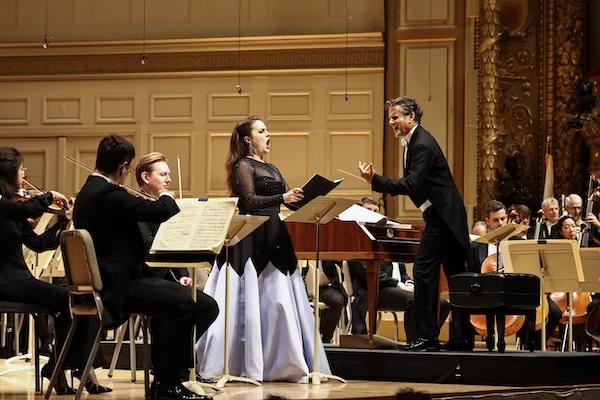
Soprano Louise Alder performs aria in Haydn’s The Creation with Philippe Jordan conducting BSO. Photo: Winslow Townson
The Tanglewood Festival Chorus, prepared by Jean-Sébastien Vallée, sang with fervent vitality. The singers conveyed the righteous rage of “Verzweiflung, Wut und Schrecken” and the vibrant conviction of “Der Herr ist groß in seiner Macht.” The closing chorus of Part 1, “Vollendet ist das große Werk,” echoed with triumphal valediction.
As the three angels, soprano Louise Alder, tenor Bogdan Volkov, and bass-baritone David Steffens evoked awe and wonder as creation unfolded. Alder’s burbling melismas and beaming tone traced the nimble flight of birds. She brought clarion grace to “Nun beut die Flur das frische Grün.”
Volkov’s bell-toned tenor rang with conviction in “Und Gott sah das Licht.” In “In vollem Glanze steiget jetzt die Sonne strahlend auf,” he heralded the first sunrise, his clear voice emerging through string harmonies that hovered like haze.
Steffens summoned the heavenly splendors of “Nun scheint in vollem Glanze der Himmel” with the assurance of a country preacher, fiery one moment and soothing the next.
In Part 3, Steffens and Alder became a sensitive Adam and Eve, their “Holde Gattin, dir zur Seite” unfolding with unforced tenderness. As Uriel, Volkov warned of the perils of reaching beyond the knowledge God permits. Chorus and soloists joined in a final hymn of thanksgiving, but beneath the rejoicing lingered a warning: Eden is yours—so long as you can keep it.
Aaron Keebaugh has been a classical music critic in Boston since 2012. His work has been featured in the Musical Times, Corymbus, Boston Classical Review, Early Music America, and BBC Radio 3. A musicologist, he teaches at North Shore Community College in both Danvers and Lynn.
Tagged: Bogdan Volkov, Boston Symphony Orchestra, Choral Music, Classical Music, Creation Festival, David Steffens, Jean-Sébastien Vallée, Joseph Haydn, Louise Alder, Philippe Jordan, Symphony Hall, Tanglewood Festival Chorus, concert review, oratorio