
Theater Review: Chadwick Stokes’s “1972” Finds Its Voice in a Powerful Cry for Women’s Empowerment
By Paul Robicheau
Gracie McGraw anchors an exhilarating world-premiere rock opera, despite uneven handling of its darker themes.
1972: A Rock Opera Music and lyrics by Chadwick Stokes. Book by Chadwick Stokes and Jessie Nelson. Directed by Jessie Nelson. Presented by the American Repertory Theater at the Farkas Theatre, 12 Holyoke St., through December 6.
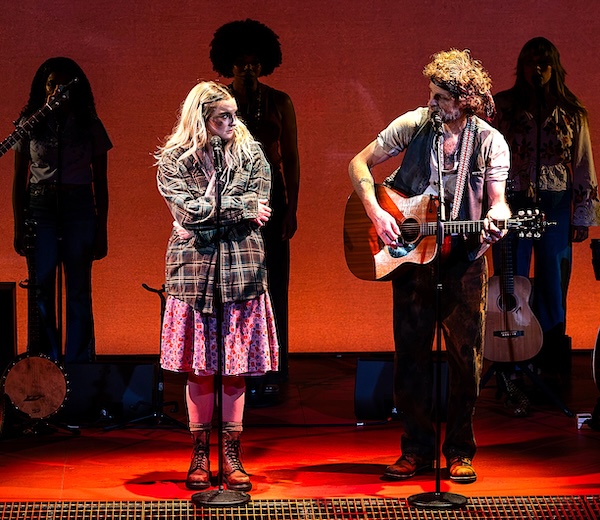
Gracie McGraw (Hannah) and Chadwick Stokes (Depot) in 1972 at the A.R.T. Photo: Hawver and Hall
It’s a long way from headlining TD Garden with his band Dispatch to performing in a musical on an intimate Harvard soundstage under the auspices of the American Repertory Theater. But for years, Chadwick Stokes workshopped songs that form the backbone of his rock opera 1972, now in an invigorating world-premiere run at Harvard’s Farkas Theatre, with Stokes playing a prominent role in the cast.
An ambitious tale of a pregnant young woman fleeing an abusive relationship in search of an abortion in the titular year before Roe v. Wade, 1972 provides a still-timely storyline, even if it struggles somewhat to convey the right tone for such a serious, graphic subject within the confines of a rock musical.
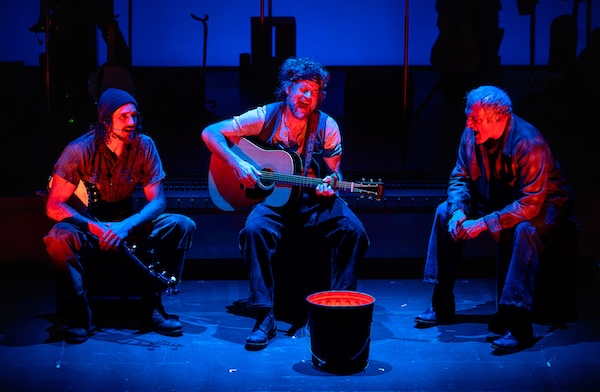
Will Urmston (Pinto), Chadwick Stokes (Depot) and Darren Buck (Eddy) in 1972 at the A.R.T. Photo: Hawver and Hall
Nonetheless, at Wednesday’s press night, 1972 proved not only ultimately triumphant in its cry for women’s empowerment but also practically seamless in its crisp, exhilarating interchange of instrumentalists, singers, and actors—a dozen-strong cast that shared those parts with punch, precision, and clarity. They made 1972’s 80-minute running time (without intermission) fly by. It was a testament to the talents of performers from different backgrounds, as well as to the direction of Jessie Nelson (who co-wrote the sung-through script with Stokes and did similar work with Sara Bareilles for Waitress) and the ebb-and-flow choreography of Jill Johnson. There was also no doubt that the positive energy throughout the room on Wednesday had something to do with the previous night’s election results.
Befitting a production that operates much like a concert, the show begins with an 11-piece band walking out behind a transparent scrim depicting railroad tracks, a nod to the train-hopping adventures of Stokes and his musician brother Will Urmston in their younger years. The dynamic band also features bassist Tommy Ng and drummer Jr King from Stokes’ latest group, the Pintos, as well as other singers and horn players (some on double duty). The tracks also reflect the stage design: a realistic boxcar frame with open sides that allow the players to jump off the train onto the lower stage.
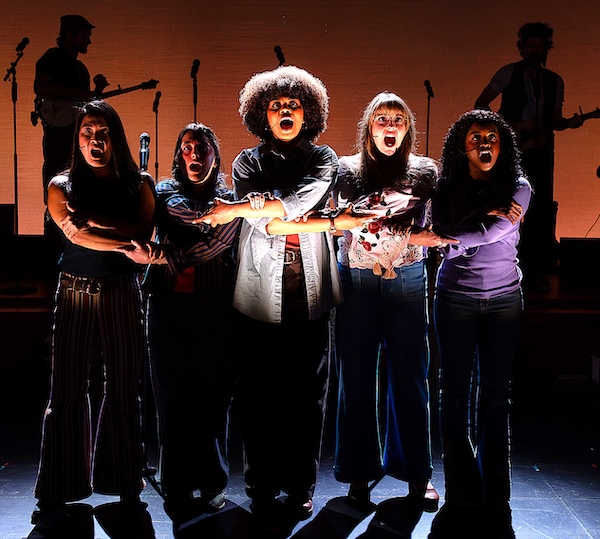
Brit King, Hannah Foxman, Khaila Wilcoxon, Darby Patterson and Jackera Davis as the Janes in 1972 at the A.R.T. Photo: Hawver and Hall
A moving wall reveals Hannah in a faded print dress and work boots, singing of a plight accented by the bruise on her cheek and a punch mark in the wallpaper. Gracie McGraw, daughter of country stars Tim McGraw and Faith Hill, underplays that role in a way that fits Hannah’s sad uncertainty. “There’s a better world that I can find,” McGraw sings. “Just give me a moment to get my courage up.” When Hannah finds Depot (guitarist Stokes), Pinto (a banjo-toting Urmston) and Eddy (a harmonica-flashing Darren Buck) camped around a fire bucket, the glow flickers in her nervous eyes (although the audience in the upper rows likely couldn’t appreciate her subtle facial reactions). Eddy doesn’t support Hannah’s plans to terminate her pregnancy, but Depot urges her to hop a train with their crew and pursue her intentions.
Buck also plays a bigger nemesis than Eddy: a rogue abortion doctor who bleeds Hannah and fellow victim Louisa (Jackera Davis) of both their cash and their well-being. The role gives Buck room to take his more theatrical style over the top—an uncomfortable distraction from the hovering tragedy of the procedure, implied through light and shadow.
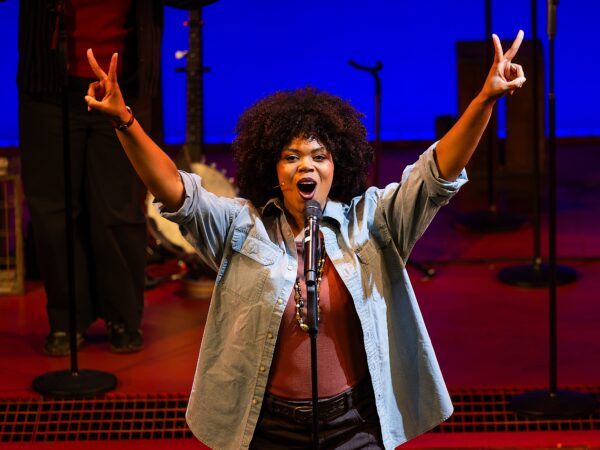
Khaila Wilcoxon in 1972 at the A.R.T. Photo: Hawver and Hall
But once Hannah escapes and finds her way to the Janes, a revolutionary group of women in Chicago who offered safe, free abortions to women in the 1960s and early ’70s, the tone of 1972 (along with the year itself) completely changes. The Janes (particularly Khaila Wilcoxon as Harlan, their big-voiced leader in an Afro) convey compassion and conviction, even as they face down the legal system after a bust. They bring Hannah aboard as a new member. And McGraw shifts from portraying Hannah’s vulnerability to boldly projecting her brighter side, bringing the audience to its feet in an all-out finale of the song “Cry Out,” in which the company sings of being “all the way free.” In the wake of the midterm election, the sentiment seemed appropriate.
Paul Robicheau served more than 20 years as contributing editor for music at the Improper Bostonian, in addition to writing and photography for The Boston Globe, Rolling Stone, and many other publications. He was also the founding arts editor of Boston Metro.
Tagged: 1972", American Repertory Theater, Cambridge, Chadwick Stokes, Darren Buck, Dispatch, Farkas Theatre, Gracie McGraw, Jackera Davis, Jessie Nelson, Jill Johnson, Khaila Wilcoxon, Reproductive Rights, Will Urmston, musical theater, rock opera, the Pintos, theater review