Theater Review: “Songs from Bark of Millions” — Too Much, and Still Not Enough
By Robert Israel
Taylor Mac and Matt Ray’s bawdy, bighearted romp raised the Paramount’s roof, but its sprawling celebration of queer history cries out for a firmer editorial hand.
Taylor Mac and Matt Ray: Songs from Bark of Millions. Produced by Pomegranate Arts and Nature’s Darling (NYC), in association with ArtsEmerson and the Huntington Theatre Company (Boston). Lyrics, concept, and direction by Taylor Mac. Music by Matt Ray. Staged at the Robert J. Orchard Stage, Emerson Paramount Center, 559 Washington St., Boston, through Oct. 18. Closed.
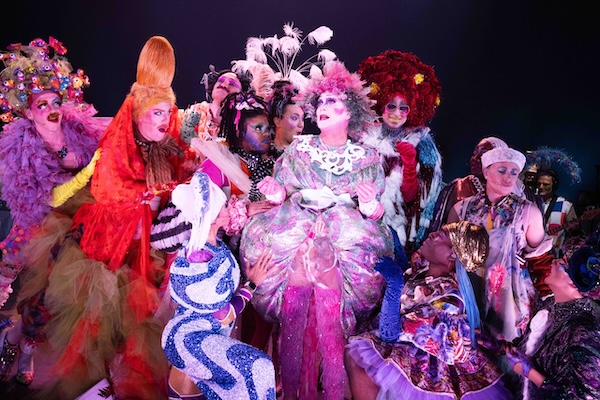
Taylor Mac and cast in a scene from Taylor Mac and Matt Ray: Songs from Bark of Millions. Photo: Julieta Cervantes
Something dreadful appeared to have happened to Taylor Mac’s troupe, either on the way to Boston or while they were in town. Everyone was talking about it in the lobby when I arrived at the Paramount Center on Friday, Oct. 16, but no explanations were supplied. All we knew was that our performance had been canceled. (The production was scheduled to run from October 15 through 18.) When we asked questions, we were told at the theater that no further information would be forthcoming. Attendees feared something dire — perhaps a death — but no one would confirm that. Several of us in the press opted to attend another performance; I returned for the matinee on October 18. Again, no explanation was offered for what had happened. Mac, who uses the pronoun ‘judy,’ alluded to the cancellation onstage no fewer than three times, apologizing to audience members who had been inconvenienced and thanking those who had returned. But judy offered no details.
Mac and co-creator Matt Ray chose to push on, taking their cue, it seemed, from the Bugs Bunny theme song: “On with the show, this is it!” The cartoon reference fits: the costumes by the über-imaginative Machine Dazzle are so Technicolor-flamboyant and comical that they might have sprung from the imaginations of the Looney Tunes animators. “And oh what heights we’ll hit!” goes the song. Mac and company did indeed hit those heights. In fact, they blasted through the Paramount’s roof.
Boston is richer for it: the show was a bawdy, insouciant romp. The 17-member company, with four onstage rock musicians, gave its all, no holds barred. Over the top and cheeky — literally and figuratively — the show felt freshly squeezed, not from concentrate. The cast wiggled, giggled, played peekaboo, flashed a moon or three, sang their hearts out, and worked the audience with their high-camp shtick, leaving everyone drenched in their sweaty enthusiasm.
That said, not every number worked. Some performers upstaged others. Some lyrics were indecipherable. Some singing was flat; elsewhere, the falsetto wore thin. The musicians sometimes played too loudly, sometimes too softly. A shower curtain — not the first time I’ve seen that prop — hid them during several numbers. Why not cut out some of the peek-a-boo so we could keep their wild playing in view as well as in our ears? At times, the show resembled a Fellini casting session: Who could out-freak whom? Choose me! each seemed to be saying. I’m the wackiest of the bunch!
But in the end, the show stayed true to its heart — all four chambers of it.
I had encountered Mac’s work in Boston in 2023, when the Huntington Theatre Company presented judy’s drama Joy & Pandemic. It didn’t work for me: the playwright’s verbosity weighed it down. The same problem dogs this show. Don’t expect otherwise, Mac told the audience, giving us permission to get up, leave, and return, warning us that most of judy’s productions run long.
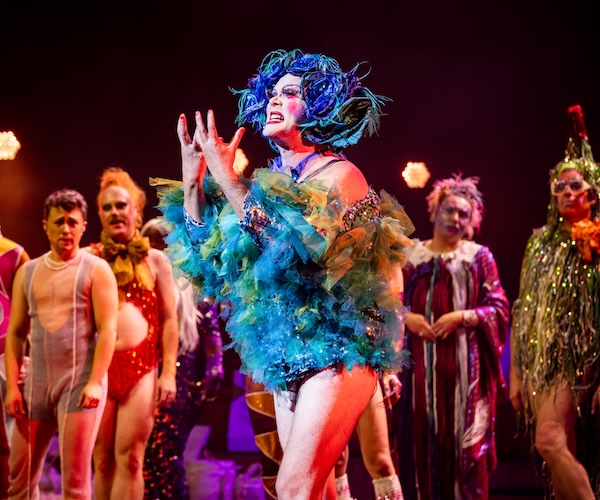
Taylor Mac and cast in a scene from Taylor Mac and Matt Ray: Songs from Bark of Millions. Photo: Daniel Boud
Mac needs a director to channel judy’s tsunami of ideas. This MacArthur Fellow’s talent is generous, effusive, and awe-inspiring, and the cast clearly idolizes judy. But if judy wants this show to travel well, judy needs more than a few dozen cans of whoop-ass. Mac needs a director who can hold judy’s feet to the fire — and put the sprawling evening into modulated shape.
Mac told the audience there was enough material to keep the production going for five hours or more. This is, after all, the creator of A 24-Decade History of Popular Music, a project judy also took to Australia. Mac wants to capture, as judy puts it, “queer history,” and here judy succeeds. How to shape that abundance into something manageable remains an open question.
With so many over-the-top performers singing so many songs, it is hard to single out a few as representative of Mac’s vision. The evening ranges across the creation of a queer library, confrontations with hatred, and triumphs over adversity. There is a number sung in Spanish, a segment about the mistreatment of gay people in Nigeria, a look back at the Stonewall uprising in New York City, and Mac’s monologue about judy’s upbringing, which touches on judy’s mother’s inability to say the word “homosexual.”
Total immersion is what Mac and Ray are aiming for. We enter their world willingly; we sign up for the journey. The experience can be jolting. It may take weeks or months for memories of the songs, sounds, and outlandish cartoon costumes to work their way past our defenses. Beneath all that excess lies a simple but powerful message: we need to be embraced by others and learn to embrace them in return.
Mac invites us in. Judy wants company on a journey whose destination, at least at this point in the entertainment’s evolution, may not yet be clear. We just have to jump aboard. And that seems to be the point.
Robert Israel, an Arts Fuse contributing writer since 2013, can be reached at [email protected].
Tagged: ArtsEmerson, Bark of Millions, Boston-theater, Emerson Paramount Center, Huntington-Theatre-Company, LGBTQ+ arts, Machine Dazzle, Matt Ray, Pomegranate Arts, Robert Israel, Songs from Bark of Millions, Taylor Mac, costume design, musical theater, queer history, queer theater