
Visual Arts Review: At the Goethe-Institut, a Landscape Bears Witness
By Mary Sherman
In her haunting installation Cemetery of the Nameless, Pınar Öğrenci contemplates displacement, anonymous deaths, and the cruelties that recur across borders and centuries.
Cemetery of the Nameless at the Goethe-Institut Boston through October 25.
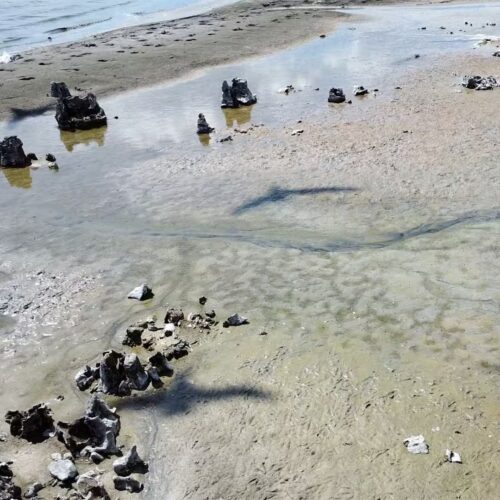
A scene from Pınar Öğrenci’s installation, Cemetery of the Nameless. Photo: Goethe-Institut Boston
The current exhibition at the Goethe-Institut Boston is fleeting: it opened October 15 and closes October 25. Perhaps the short run is fitting. The installation meditates on life’s brevity and the cruelty humanity persists in inflicting on one another, century after century. Humans seem to have found no better response to fear than to attack those unlike ourselves, blind to the diversity that sustains the natural world to which we all belong
The power of Pınar Öğrenci’s installation, Cemetery of the Nameless, lies in its psychological restraint. No one is shown being shot, dragged, handcuffed, or crammed into a squalid prison cell. Yet these unseen brutalities haunt the work.
The installation centers on a full-screen video of the landscape around Van, Turkey, Öğrenci’s birthplace. Shot from above, the drone footage moves so slowly and stealthily that the terrain sometimes dissolves into abstraction. Lake Van lies along escape routes through eastern Turkey used by people fleeing Iran and Afghanistan. The site is a border crossroads between Iran and Turkey, traveled by Turks, Afghans and Iranians alike. It is the location of countless losses: the Armenian genocide of 1915–1916, massacres of Kurds, and displacement of Afghans by decades of war. And still, it remains an escape route for those fleeing to better lives.
The landscape, however, is treacherous. Winter freezes the high mountains; many attempting the crossing succumb to the cold or are killed along the way. Viewed amid the Goethe-Institut’s 19th-century grandeur, these journeys recall the perilous crossings of those resisting or fleeing the Nazis during World War II.
Mirrored images of vast expanses marked by footsteps hang over the salon’s framed decorations. These echoes of history are deliberate, as Öğrenci explained at the opening. The area around Van was not immune to imperial ambitions – neither to the Reich’s expansionist desires, nor the Allies’ post-World War I divisions of the Ottoman Empire. Nor, a Turkish woman living in Berlin, is Öğrenci is a stranger to displacement.
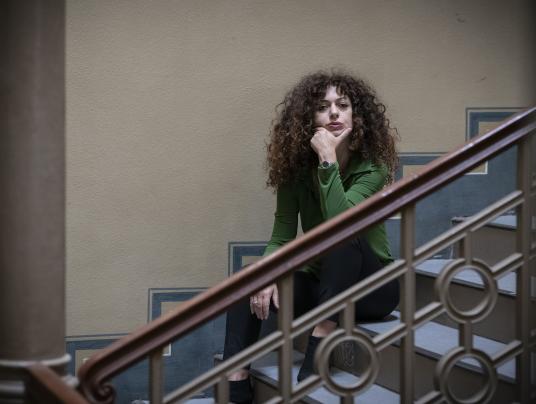
Pınar Öğrenci. Photo: Kerem Uzel.
In her homeland, the bodies of those who perish during winter crossings—or are killed and left unclaimed—become trapped in mountain ice. The spring runoff sweeps them into the lake. Some are recovered and buried in nameless graves; others remain in its depths.
Again, Öğrenci sidesteps melodrama and platitude, treating the dead with dignity. Their deaths go unseen. Brief voice-overs recount the facts in a compassionate but restrained voice, leaving us to imagine the lives behind them. Her words and images draw us close; the lost become part of us.
Like the lake, visitors to the exhibition bear silent witness to what has happened in the region—and to the persecution unfolding today in immigration roundups across America’s neighborhoods, in the Gaza Strip, in Ukraine, in Sudan, and beyond. Again and again, people whose only “crime” is trying to save themselves and their families are hounded by those who want them dead simply for being different. Insecurity, greed, and fear masquerade as superiority, displacing the collective intelligence and common purpose we need to confront our shared problems.
These are people like us, struggling with brutalities imposed by others. None of us is immune. As the climate crisis dries up Lake Van, strange stalagmite formations emerge from its receding waters. The film ends with a close-up pan across them. “Has the calcium that dissolved from their bones [of those who ended up in the lake] mingled into the microbialites?” it asks. In this apocalyptic moment, we come face to face with our own demise.
For two decades Mary Sherman wrote about the arts, beginning as a freelancer for the Chicago Reader, followed by being the art critic for the Chicago Sun-Times and, later, as a regular contributor to The Boston Globe, Boston Herald, and ARTnews, among many other national andinternational publications. In addition to writing, she is a widely exhibited artist and founding director of TransCultural Exchange. Currently, Mary is at work on her first book, A Legacy of Deceit. It is part memoir, part Cold War investigative journalism, prompted by the many unexplained encounters she had with her late father, not the least of which was his once showing up at an airport, a briefcase handcuffed to his wrist.
Tagged: Boston art exhibitions, Cemetery of the Nameless, Climate Change, Goethe Institut-Boston, Human-Rights, Lake Van, Pınar Öğrenci, Refugees, Turkish art, contemporary art, displacement, installation art, migration
