
Film Appreciation: “The Devils” – The Devils in Me
By Ed Symkus
The provocative 1971 study of politics, religion, and sex in medieval France is back on the big screen—with its long-censored footage reinstated.
The Devils, written and directed by Ken Russell, is playing at the Coolidge Corner Theatre and Somerville Theatre for one week, starting on October 16.
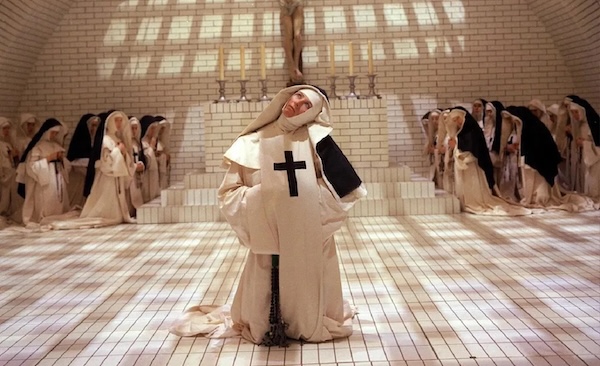
Vanessa Redgrave in a scene from The Devils. Photo: Warner Bros
It’s been 55 years since I first experienced British director Ken Russell’s The Devils. It was on a warm summer night at the Nickelodeon Cinemas in Boston. I hadn’t yet seen Russell’s earlier films Women in Love or The Music Lovers, so I had no idea what to expect, but there was a buzz in the air over this one. I went, on a first date, with a woman who told me she loved movies—all movies—but wasn’t familiar with this director.
It opens with blood-red words on a black background: “This film is based upon historical fact. The principal characters lived, and the major events depicted in the film actually took place.”
That’s followed by a vibrant and colorful musical number featuring a nearly naked, high-heels-wearing King Louis XIII flamboyantly emerging on a stage from a half shell in a portrayal of Botticelli’s The Birth of Venus, danced to the music of Michael Praetorius (“Courante” and “La Bourrée”).
A conversation follows between the weak and witless king and his advisor, the malevolent and domineering Cardinal Richelieu, regarding the “religious wars” between Catholics and Protestants. It’s Richelieu who closes his eyes, crosses himself, then quietly utters, “And may the Protestant be driven from the land.”
Before I could form a thought about what I might be in for, there’s a hard cut to a close-up of a skull teeming with maggots, followed by a vigorous political speech from Father Grandier inside the white-tiled walls of the provincial French village of Loudun, and an appalling look at piles of dead bodies in the streets—victims of the rampaging bubonic plague. Soon there are stories of forbidden love, illusory demonic possession in a convent, physical torture, and a tremendous battle between church and state, all taking place in 1634.
I didn’t know at the time that the censors had already gotten hold of the film. The damage — from what I can discern from viewing the just released director-approved restoration — amounted to only a few raucous minutes of excessive nudity (along with some “blasphemy”) and two rather subtle scenes of implied masturbation. The film was a hit in England in the early ’70s, but, because of negative reviews, didn’t fare well in the U.S. It never went beyond cult status here, even though a small segment of critics and members of the public labeled it a masterpiece.
The reason this little-seen, decades-old film is currently getting a lot of press is that, because of the determination of a cadre of supporters, the deleted footage has been reinstated—we are now treated to the full “rape of Christ” sequence. It has also been given an audio and a 4K video restoration, drawn from the original camera negative.
The fabulous state-of-the-art enhancement of sights and sounds (both were already terrific when the film was originally released), and the long-awaited replacement of those notorious segments, will be appreciated by completists who have seen the film before. But these improvements take a back seat to the opportunity of seeing pretty much any version of this spectacular, one-of-a-kind film on a big screen.
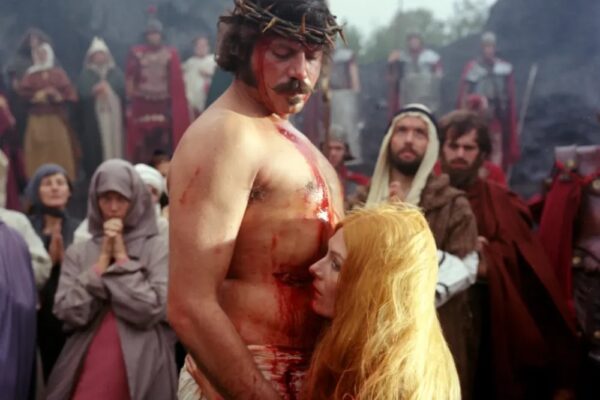
Oliver Reed and Vanessa Redgrave in a scene from The Devils. Photo: Warner Bros
Who am I to make such a grandiose statement? Well, I was caught up in and blown away by the restored version. But it was my 18th viewing of The Devils since that long-ago summer night. I’ve watched it in repertory houses, at festivals, and on bootleg DVDs whenever possible. My farthest-flung screening was in Florence, Italy, three years after its release, in a packed cinema. I’ve read the scholarly 1952 Aldous Huxley book The Devils of Loudun and the 1961 John Whiting play The Devils.
What initially drew me in? Happenstance. Luck of the draw. It was just another movie to slake my filmgoing habit. What’s caused me to keep returning? I’d never seen anything like it. And that still holds. Yes, it tackles religion and politics—two topics that hold little interest for me—but Russell, who wrote the screenplay as well as directed, tackles everything with such fervor—and no pulling of punches—that the film clutches you by the throat and refuses to let you turn from the screen, no matter the intensity of its unflinching emotional and physical violence.
But it also stands tall as a work of art, most notably in the contributions of cinematographer David Watkin (Help!, Chariots of Fire; Oscar winner for Out of Africa), production designer Derek Jarman (whose massive, white-tiled Loudun boggles the mind), and composer Peter Maxwell Davies (let’s just call his music uncategorizable, but “cacophonous” will suffice).
As far as the art of acting, the performances range from controlled over-the-top to laid-back, sympathy-inducing. In the lead roles, Oliver Reed is lusty, proud, angry, and tender as the politically targeted, rampant sinner—but good soul—Father Grandier, a man trying to save his village from destruction by political forces. Vanessa Redgrave is tragic, perplexed, feverish, and frightening as the hunchbacked, Grandier-obsessed, and supposedly possessed Mother Superior, Sister Jeanne. Superb supporting work comes from Dudley Sutton as Richelieu’s formidable henchman Baron De Laubardemont, Murray Melvin’s meek Father Mignon, Gemma Jones’ radiant, lovelorn Madeleine, and Michael Gothard as the fierce, sadistic, long-haired rock star of an exorcist, Father Barre, who adds a dark strain of humor and campiness to the goings-on.
What have others thought of The Devils?
It took the Best Foreign Film award at the 1971 Venice Film Festival, and Russell was named 1971 Best Director by the National Board of Review.
Vincent Canby, in The New York Times, wrote, “Although I rather liked Russell’s adaptation of Women in Love, I was appalled by The Music Lovers, and thus I can’t explain why I should have been surprised to find his approach to The Devils to be that of a hobbyist determined to reproduce The Last Supper in bottle tops” (whatever that means).
But Roger Ebert, in The Chicago Sun-Times, offered: “A burning at the stake, an afternoon in the rack, headscrews, a douche with boiling water, nails into hands, induced vomiting, ripped tongues, dead babies, human target practice, possession by devils, rape, transvestism, nude orgies in the nunnery. Put them all together and they spell Committed Art.”
The Devils still makes me cringe and, for a few moments, laugh. It fearlessly combines ruthless ideological critique with both religious and sexual hysteria. It’s not for everyone—certainly not the squeamish.
As for that first date all those years ago, there wasn’t a second one.
Ed Symkus is a Boston native and Emerson College graduate. He went to Woodstock, edited the books Russ Meyer: Interviews and Guy Ritchie: Interviews, has interviewed Woody Allen, Danny Boyle, David Fincher, and Kathryn Bigelow, and has visited the Outer Hebrides, the Lofoten Islands, Anglesey, Mykonos, Nantucket, the Azores, Catalina, Kangaroo Island, Capri, and the Isle of Wight with his wife, Lisa. And, full transparency, he has seen The Music Lovers 32 times.
Tagged: 1971 films, 4K restoration, Aldous Huxley, Boston movies, British cinema, Coolidge Corner Theatre, Ed Symkus, Ken Russell, Ken Russell films, Oliver Reed, Somerville Theatre, The Devils, The Devils of Loudun, The Devils restoration, censored films, cult films, film censorship, film history, religious horror, restored film
