Book Review: “Tender Is the Night” — F. Scott Fitzgerald’s Novel of Compassion and Sacrifice
An appreciation of F. Scott Fitzgerald’s most personal novel, in which a marriage’s collapse becomes a searching exploration of love, ambition, and the courage to begin again.
Tender Is the Night by F. Scott Fitzgerald. Charles Scribner’s Sons, 1934, 349 pages.
I have spent the summer reading. On the occasion of this beloved country’s 250th anniversary, I decided that instead of watching more discouraging news, I would read my way through American literature, starting with Melville and ending with Tim O’Brien’s The Things They Carried (1990), which has always, it seems to me, marked the end of an era. And, I am happy to report, the news is good. For more than two hundred years, this country has produced novels and stories that are not merely first-rate but amazing and magnificent. And, best of all, their diversity reflects our wonderfully varied population and the different landscapes in which we live.
The Man Behind the Myth
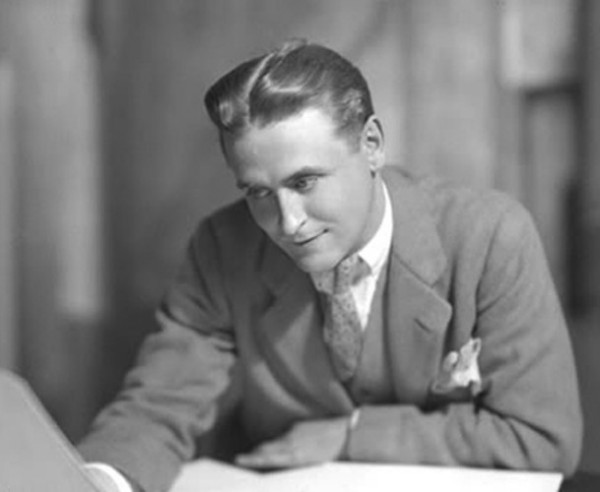
Writer F. Scott Fitzgerald — it is easy to lose sight of the man himself. Photo: Wikimedia
Before getting to Tender Is the Night, I will simply mention some favorite writers and novels in the hope that some of you may find as much pleasure as I did in either reading them for the first time or rereading them. What’s so interesting is that so many of our American writers wrote not only novels but also short stories, and, to my great surprise, the stories are as good as, and sometimes even better than, the novels. Examples include Herman Melville, Henry James, Nathaniel Hawthorne, Stephen Crane, Willa Cather, Edith Wharton, Ernest Hemingway, F. Scott Fitzgerald, William Faulkner, Saul Bellow, John Cheever, Don Barthelme, James Baldwin, Bernard Malamud, Philip Roth, and I. B. Singer.
Then there were those who mixed fiction and history, like John Dos Passos, Upton Sinclair, and John Hersey; those who wrote mostly stories with an occasional novel sprinkled in between, such as Sherwood Anderson, Eudora Welty, Flannery O’Connor, Grace Paley, and J. D. Salinger; and those whose books I have held close since my youth, like The Grass Harp (Truman Capote), The Bridge of San Luis Rey (Thornton Wilder), Little Women (Louisa May Alcott), the Penrod series (Booth Tarkington), The Member of the Wedding (Carson McCullers), Their Eyes Were Watching God (Zora Neale Hurston), A Tree Grows in Brooklyn (Betty Smith), An American Tragedy (Theodore Dreiser), East of Eden (John Steinbeck), Tales of the South Pacific (James Michener), All the King’s Men (Robert Penn Warren), and Arrowsmith (Sinclair Lewis). And then there were those who nourished me as a young mother: Catch-22 and Something Happened (Joseph Heller), Sophie’s Choice (William Styron), Song of Solomon (Toni Morrison), The Centaur (John Updike), American Pastoral (Philip Roth), Ceremony (Leslie Marmon Silko), The Woman Warrior (Maxine Hong Kingston), The Keepers of the House (Shirley Ann Grau), and Beyond the Bedroom Wall (Larry Woiwode), as well as the works of Kurt Vonnegut, Nathanael West, Raymond Carver, Wallace Stegner, William Maxwell, Sue Miller, and Vladimir Nabokov.
Among 19th-century novels, Moby-Dick is still unique, and anyone who gives it a real chance (probably reading it aloud is best) knows that the cadences of its biblical prose are indescribably mesmerizing. (For more about that splendid novel, see Gerald Peary’s essay on rereading it here in The Arts Fuse.) But its lack of female characters is a problem for me; therefore, Henry James emerges as my favorite author from that time. In the 20th century, the standout is William Faulkner; his books about the Compson family — The Sound and the Fury (1929) and Absalom, Absalom! (1936) — are remarkable, unforgettable works, as good as Ulysses or To the Lighthouse. His fictional Yoknapatawpha County is as vivid as George Eliot’s Middlemarch or Thomas Hardy’s Dorset or the England of Dickens and Trollope or the Russia of Chekhov and Tolstoy.
So how, you may ask, while reading through our American treasures, did you land on Fitzgerald’s great and underrated fourth novel, Tender Is the Night?
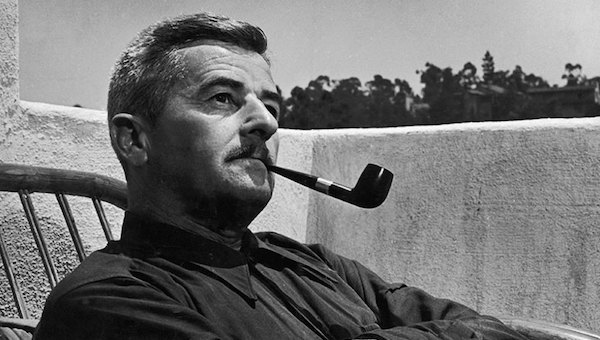
William Faulkner. Photo: WikiMedia
The answer came to me after I read Faulkner’s 1950 Nobel Prize speech. There he reminds us that the work of any writer is “to create out of the materials of the human spirit something which did not exist before.” Then he goes on to discuss the dangers of life during the Cold War and the constant threat of a nuclear bomb. But at the end he says:
I believe that man will not merely endure; he will prevail. He is immortal, not because he alone among creatures has an inexhaustible voice, but because he has a soul, a spirit capable of compassion and sacrifice and endurance. The poet’s, the writer’s, duty is to write about these things. It is his privilege to help man endure by lifting his heart, by reminding him of the courage and honor and hope and pride and compassion and pity and sacrifice which have been the glory of his past. The poet’s voice need not merely be the record of man, it can be one of the props, the pillars to help him endure and prevail.
That last paragraph reminded me that Tender has a special place in our American canon. For Fitzgerald had that rare “soul” and “a spirit capable of compassion and sacrifice and endurance.” Those are actually the themes of Tender Is the Night, as it explores love, marriage, ambition, mental illness, incest, alcoholism, the lure of money, and the fundamental question of what makes a rich and interesting life.
However, before I get to the book, we need to know about the man. He was born in 1896 to a middle-class Irish Catholic family in St. Paul, Minnesota, was brought up in upstate New York, where his father was a salesman, and attended Princeton University, where he wrote stories and plays for the literary magazines and befriended Edmund Wilson and John Peale Bishop, who became friends for life. On break during his sophomore year, he met a wealthy Chicago debutante named Ginevra King. They fell in love and courted, but King’s father had no use for him, insisting that “poor boys shouldn’t think of marrying rich girls.”
When Ginevra threw him over, Fitzgerald decided to leave Princeton and enlisted in the army. While stationed in Montgomery, Alabama, he met eighteen-year-old Zelda Sayre and fell in love again. Like Ginevra, Zelda was very pretty and loved parties and clothes and “fun”; moreover, she could keep up with Scott’s drinking. She was not as well educated or as curious as her future husband, but Scott was smitten. He was also determined to write fiction, maybe, as he once told his Princeton classmates, “to become one of the greatest writers in the world.” After some ups and downs with Zelda — her Protestant family was wary of his Catholicism and his drinking — and an unsuccessful stint in advertising in New York City, Scott went home to St. Paul, holed up in the attic of the family home, and wrote This Side of Paradise. It was published to great acclaim in the spring of 1920. He was also beginning to publish stories in The Saturday Evening Post.
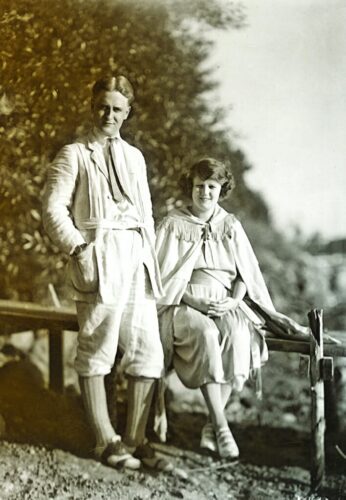
F. Scott Fitzgerald and Zelda in Saint Paul in 1922 before they left for New York. Photo: Wikimedia
A month after his debut novel came out, he and Zelda were married. A year later, they had a little girl known as Scottie. The next five years were filled with incredible success, not only for that novel but also for The Beautiful and Damned (1922) and the many short stories about the Jazz Age and the Lost Generation. During that time, he and Zelda became known for their wild escapades, their love of risk, and, sadly, their endless drinking; Scott also became known for his friendship with Ernest Hemingway. The Great Gatsby was published in 1925, and although it was not as successful as the earlier novels and story collections, it established him in the forefront of American writers.
That same year, Scott and Zelda met Sara and Gerald Murphy, well-off American expatriates who had settled in the south of France. But it was also around that time that it became clear that Zelda was mentally ill, and by the time Tender was published in 1934, she had been diagnosed with schizophrenia and was in and out of institutions. Thus, her mental illness became the major theme of Tender Is the Night: how it can wreck a marriage and even the friendships that surround it.
In 1934, America was hardly the country Fitzgerald had so skillfully evoked in the 1920s. Now plunged into the Great Depression, unnerved by the rise of fascism in Europe, and dealing with the terrible effects of the Dust Bowl, it had no time for a story about expatriate Americans living on the French Riviera or the story of a failed marriage between a physician and his very rich patient. The novel was a critical and commercial failure.
When Fitzgerald died in 1940, at the age of 44, he was convinced that his work had sunk into oblivion. Proof of that is a poignant scene at the end of Nancy Milford’s biography of Zelda Fitzgerald, when a young man interested in Fitzgerald’s work visits Zelda in the spring of 1947, a year before she died. He reported: “Zelda was amazed and touched, I think, by my interest. She several times said to me, ‘Oh, how flattered Scott would be to think that people still remember him . . .’” And in Beloved Infidel, the memoir by Sheilah Graham, with whom he fell in love in his last years, she describes embarrassing scenes of him approaching strangers and wanting to know if they knew who he was or the titles of any of his books.
The years after Tender was published were difficult. He had enormous medical bills to keep Zelda in a decent sanatorium; he also had school expenses for Scottie — first boarding school and then Vassar. Moreover, he was plagued by the failure of Tender to capture the public’s imagination. He considered it his most serious and finest book. So he fiddled with it, trying to figure out where he went wrong. The result is that there are two editions of the novel: the original, which came out in 1934, and one edited from his notes by Malcolm Cowley, which came out in 1951, with the timeline of the narrative changed. I much prefer the original, which begins on the French Riviera; that is the text I am using for this appreciation.
During his last years, he was mostly in Hollywood, where he was trying to make it as a screenwriter. That didn’t work out so well, but it was not lost time. Based on his observations, he wrote a good part of The Last Tycoon in 1939 and 1940, when he had finally become sober and was living quietly with Graham. From his voluminous notes and about six finished chapters, his old friend Edmund Wilson was able to edit and publish it as an unfinished novel in 1941. In the following years, Fitzgerald became better known through a quirk of fate. During World War II, the Council on Books in Wartime, formed to select books for soldiers on the front to help with morale, sent 150,000 copies of The Great Gatsby overseas. That and the publication of Arthur Mizener’s biography The Far Side of Paradise in 1951 helped restore his reputation.
Because so much of the biographical information about Scott Fitzgerald is buried beneath the sordid tales of his marriage to Zelda, it is easy to lose sight of the man himself. Yes, he could be volatile, insecure, indeed childish. But he was also highly intelligent, in love with the English Romantic poets, remarkably well read, and prepared to make the sacrifices needed to write good fiction. This is apparent in the strange book published in 1945, after his death, and also edited by Edmund Wilson, The Crack-Up. It is a marvelous compendium of Fitzgerald’s essays, letters, reminiscences, and random thoughts; these reveal a man far more sensitive, thoughtful, and appealing — a man of substance, far more self-aware and loyal than the Fitzgerald Hemingway wrote about in A Moveable Feast. That portrait of Fitzgerald has loomed large in the public’s imagination — partly because it contains some of Hemingway’s best writing — but it is skewed, shaped by the perspective of a very young and impossibly ambitious peer who was jealous of Fitzgerald’s enormous talent. Yet Hemingway admitted to their mutual editor, Maxwell Perkins, in one of his saner moments, “that Tender Is the Night gets better and better.”
A Marriage Beneath the Riviera Glitter
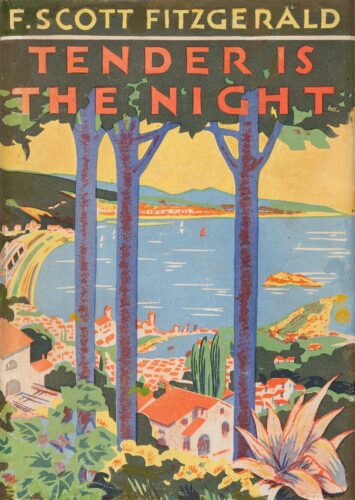
One of the most memorable observations Fitzgerald makes in The Crack-Up is: “All good writing is swimming under water and holding your breath.” In Tender, the stakes are very high, and even more personal than they were in Gatsby. For this is a story of a marriage in which there are many parallels to his own. In the prologue to her wonderful book about the Murphys, Everybody Was So Young, Amanda Vaill describes it best: “In the novel, the woman with the pearls is recovering from a psychotic break brought on by incest, and the man with the rake ends up losing his wife, his position, everything he cares about.” And although Nicole Warren has certain characteristics of Sara Murphy and Zelda Fitzgerald, she is a fictional character in her own right: a fully rounded (as Forster meant it) person who starts out very damaged and grows into a sturdy woman who can live on her own.
Rounded, too, is her fictional husband, Dick Diver — a man from a very ordinary background who has great promise, who went to Yale, who got his medical degree at Johns Hopkins, and who was a Rhodes Scholar at Oxford. He is a man with high standards, who is good, even noble; an ambitious man whose work means a great deal to him, who has come back from fighting in World War I with big plans to write about the intricacies of the human mind. He is a brilliant American who has come to Europe to study with the best minds in the world. But after he has settled in as the protégé of a well-known psychiatrist in Switzerland, he muses, “. . . he used to think he wanted to be good, he wanted to be kind, he wanted to be brave and wise, but it was all pretty difficult. He wanted to be loved, too, if he could fit it in.” It is this last desire that proves his nemesis.
The book has three parts. Book 1 begins when an eighteen-year-old movie star, Rosemary Hoyt, now famous for her debut movie Daddy’s Girl, finds herself on the French Riviera. There she and her mother are enthralled by a couple who seem to own the little stretch of beach connected to the small hotel where they are staying. They are Nicole and Dick Diver; they have been married for ten years and have two children and several very loyal friends. From Rosemary’s perspective, Fitzgerald paints a divinely gorgeous picture of what seems to be a divinely gorgeous existence in which Nicole and Dick are known for their exquisite Villa Diana, their elegant style, their fabulous parties, and the ease with which they go through their days. This is the part of the novel the critics found most vividly written and praised for its dazzling portrait of wealthy expats living in southern France during the 1920s. But Rosemary’s arrival and her starry-eyed adoration of Dick start a sequence of events that reveal that all is not well in paradise. It is an old, tried-and-true narrative: the stranger arrives, and what seems like serenity dissolves into chaos. Thus, Fitzgerald sets up a tantalizing mystery: What is really going on?
Book 2 gives us the backstory, at first concentrating on Dick. After serving in World War I, he came to study with a famous psychiatrist in Zurich. There he fell in love with Nicole Warren, who was a patient at the sanatorium because she had been subjected to incest by her father in her early teens, after her mother died. Although Dick and Nicole are smart enough to realize the dangers involved in a marriage between patient and doctor, they take the plunge, helped by Nicole’s sister, Baby Warren, whose great resources have allowed her to “buy a doctor who will take care of Nicole for the rest of her life.” So about halfway through this novel, we are left with the question: Has Dick married for love, made a Faustian bargain, or simply fulfilled his role as doctor to a difficult patient? Probably all three.
After tea with Baby, when plans have been solidified, the reader expects details of how they married and set up a home and had two children. Instead, there is a remarkable passage from Nicole’s point of view that is some of the best writing Fitzgerald has ever done. It begins:
How do you do, lawyer. We’re going to Como tomorrow for a week and then back to Zurich. That’s why I wanted you and sister to settle this, because it doesn’t matter to us how much I am allowed. We’re going to live very quietly in Zurich for two years and Dick has enough to take care of us. No, Baby, I’m more practical than you think—it’s only for clothes and things I’ll need it . . . Why that’s more than—can the estate really afford to give me all that? I know I’ll never manage to spend it. Do you have that much? Why do you have more—is it because I’m supposed to be incompetent? All right, let my share pile up then . . . No, Dick refuses to have anything whatever to do with it. . . .
Isn’t it funny and lonely being together, Dick. No place to go except close. Shall we just love and love? Ah, but I love the most, and I can tell when you’re away from me, even a little. I think it’s wonderful to be just like everyone else, to reach out and find you all warm beside me in the bed.
As the section loops through her thoughts, we realize that Nicole is more intelligent, more self-aware, and less stable than she appears. Then, suddenly, we are back on the beach, where her unsettling soliloquy ends with: “I am here on this tranquil beach with my husband and two children. Everything is all right—if I can finish translating this damn recipe for chicken a la Maryland into French. My toes feel warm in the sand.”
Nicole is still recovering, subject to episodes of madness and behaving strangely enough that her precarious situation is more than obvious to their good friends. It was one of those episodes that Mrs. McKisco witnessed in Book 1 that prompted Tommy Barban to say, “It’s inadvisable to comment on what goes on in this house.” Nicole’s fragile mental state keeps everyone on edge; to complicate matters further, her seductive beauty has caused a few of the men to fall madly in love with her.
The crux of the matter, though, is the tension between her dependence on Dick and his constant need to be on guard while he protects her. Contrary to what outsiders like Rosemary think, their life is not only less than perfect; it is becoming hard to endure. Living the high life in Europe is not what Dick aspires to, even though he is so good at it. He is unhappy that he is not working and is wasting precious time; he becomes increasingly aware that there is no way he can realize his dreams in this environment. We sense his longing to go back to America, which runs like an undertow throughout this book. By the time Rosemary arrives, he is also drinking too much.
This second book is difficult to read because it reveals, in a series of scenes, how disordered and how dangerous the Divers’ life has become. After restoring Villa Diana, they return to the sanatorium in Zurich for a few years, but that proves disastrous. Back in France, there are also wild coincidences and risky incidents that are based on real events — weird fights and shootings and time in jail. All terribly exciting and sometimes amusing, but amounting to what? Nothing that resembles a substantial, useful life.
Dick’s frustration at not being able to work and write his magnum opus mirrors Fitzgerald’s yearning to get back to the serious books and his resentment at having to write the more lucrative short stories to pay Zelda’s medical bills. Indeed, somewhere in Book 2, Nicole and Dick have come to resemble the Murphys less and the Fitzgeralds more. But a strange thing has happened. As Zelda spirals more and more into insanity, Nicole Diver becomes stronger. What he could not do in real life, Fitzgerald does in this novel. And to cure Nicole and give her a future, he must free both Dick and Nicole from what has become a ruinous marriage.
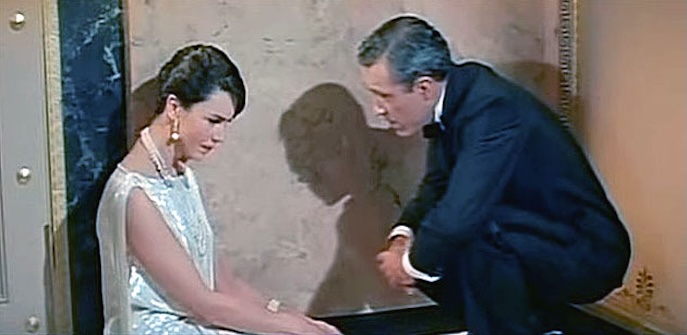
The Divers (Jennifer Jones, Jason Robards) in the 1962 film version of Tender Is the Night.
Book 3 is the shortest section and describes its painful dissolution. But there is clearly something more going on than Dick’s drinking or his dalliance with Rosemary or his yearning to get back to his work. Here is their exchange toward the end of the book:
“We can’t go on like this,” Nicole suggested. “Or can we?—what do you think?” Startled that for the moment Dick did not deny it, she continued, “Some of the time I think it’s my fault—I’ve ruined you.”
“So I’m ruined, am I?” he inquired pleasantly.
“I didn’t mean that. But you used to want to create things—now you seem to want to smash them up.”
She trembled at criticizing him in these broad terms—but his enlarging silence frightened her even more. She guessed that something else was developing behind the silence, behind the hard blue eyes, the almost unnatural interest in the children. Uncharacteristic bursts of temper surprised her—he would suddenly unroll a long scroll of contempt for some person, race, class, way of life, way of thinking. It was as though an incalculable story was telling itself inside him, about which she could only guess at in the moments when it broke through the surface.
“After all, what do you get out of this?” she demanded.
“Knowing you’re stronger every day. Knowing that your illness follows the law of diminishing returns.”
And a little further on, Fitzgerald shows us Nicole acknowledging that she must strike out on her own:
. . . Nicole relaxed and felt new and happy; her thoughts were as clear as good bells—she had a sense of being cured and in a new way. Her ego began blooming like a great rich rose as she scrambled back along the labyrinths in which she had wandered for years. She hated the beach, resented the places where she had played planet to Dick’s sun.
“Why I’m almost complete,” she thought. “I’m practically standing alone, without him.” And like a happy child, wanting the completion as soon as possible, and knowing vaguely that Dick had planned for her to have it, she lay on her bed as soon as she got home and wrote Tommy Barban in Nice a short provocative letter.
In the end, this novel, which poses so many difficult questions, becomes a story about more than a failed marriage; it is really a story about two people trying to save themselves. And although Nicole is triumphant and it looks as if Dick has lost everything, as if he is the “failure,” the “coward” that Nicole and Baby and the others think he is, it may be that he is the bravest of all. For very near the end, when he and Nicole have had their last bitter conversation, Fitzgerald writes: “Then he leaned his head forward on the parapet. The case was finished. Doctor Diver was at liberty.”
The Courage to Begin Again
In the last sad chapter, which describes Dick going back to practice medicine in upstate New York, we might assume that he is finished, and it is true that it was Fitzgerald who said, “There are no second acts in American lives.” But no one has died, and Dick is still in early middle age. At the very end, a door seems to open when Nicole thinks, musing about his last letter: “Perhaps … his career was biding its time, again like Grant’s in Galena . . .” Perhaps what we have been reading is a book about a man whose story needed to be told, whose bravery needed to be witnessed, who has made enormous sacrifices to save someone he loved — but also a man who may have a future.
Fitzgerald was in his late thirties when Tender was published. My firm belief is that, like the most complicated character he had created thus far, Fitzgerald thought he had a future. And after he met Sheilah Graham and became sober, he began working again; the writing in The Last Tycoon is as good as that in Tender. Who knows what he might have written had he lived even to a normal threescore and ten?
Still, how lucky we are to have the five novels and all those stories. In describing The Great Gatsby, the great American critic Alfred Kazin talked about “the inexpressible poignance” of that book. I think it is even more present in Tender Is the Night. This is a novel whose creator shows the compassion that Faulkner praised so highly in his Nobel Prize speech and has the generosity of spirit and the determination to tell it all — the love and physical attraction as well as the danger and violence that are present not only in relationships but also in our culture. At this time, when we are facing some of the very things that Fitzgerald addresses — the temptations of power and money and too much leisure; the cheapening of the connections between people, like marriage and friendship; the deleterious effects of alcohol and drugs; the narcissism; the reluctance to embrace time-honored ideals — we can turn to Tender not only as a cautionary tale but also as a lesson in empathy. It is something we dearly need right now, something that may require more than one reading but is well worth the effort.
Here, in fewer than 350 pages, is a novel of great beauty: a peculiar twist on that very American story in which the poor, bright boy meets a very rich girl; an escape from “the weariness, the fever, and the fret,” as described by his beloved Keats in the poem that gives this novel its title. In Dick Diver, we have a real hero who made hard choices but who understood the connections that make us human. Proof, I submit, that Fitzgerald’s stubborn genius — required to put down the words, sentence by sentence, chapter by chapter, over the course of almost a decade — led him to create a great American work, one that glows with a special radiance, one that can deepen our understanding of what it takes to live a meaningful life.
Roberta Silman is the author of five novels, two short story collections, and two children’s books. Her second collection of stories, called Heart-work, was just published. Her most recent novels, Secrets and Shadows and Summer Lightning, are available on Amazon in paperback and ebook and as audio books from Alison Larkin Presents. Secrets and Shadows (Arts Fuse review) is in its second printing and was chosen as one of the best Indie Books of 2018 by Kirkus. A recipient of fellowships from the Guggenheim Foundation and the National Endowment for the Arts, she has reviewed for The New York Times and Boston Globe, and writes regularly for The Arts Fuse. More about her can be found at robertasilman.com, and she can also be reached at [email protected].
Tagged: American literature, American novels, F Scott Fitzgerald, Jazz Age, Literary criticism, Lost Generation, Tender Is the Night, book-reviews, literary expatriates, marriage in literature, mental illness in literature