
Visual Arts Review: The Art Bastard Returns — With Trump and Company in Hell
By David D’Arcy
At New York’s Art Students League, Robert Cenedella’s grotesque group portrait turns the MAGA elite into a gathering of horned grotesques.
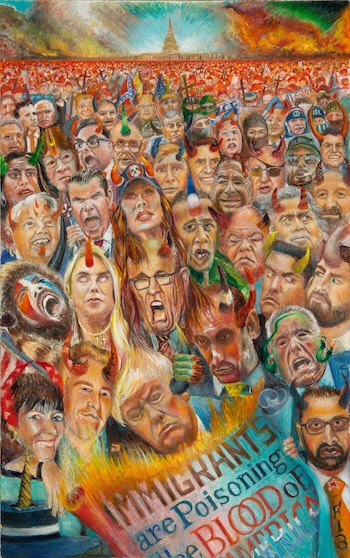
Robert Cenedella, Immigrants Are Poisoning the Blood of America. Photo: courtesy of the artist
Deep in a corner of an unadorned gallery in a once-imposing building on 57th Street, spitting distance from Carnegie Hall, amid some of New York’s most expensive real estate, Robert Cenedella is exhibiting a work of grotesquery. How could it be anything else? The painting, Immigrants Are Poisoning the Blood of America, is a group portrait of Donald Trump and his team.
This picture is at the Art Students League, where students of all ages have learned to paint since 1875, the same year the Met opened. Those students have included everyone from Man Ray to Georgia O’Keeffe to Jules Feiffer to Morley Safer. The show displays work by the League’s teachers.
There are some forty discernible figures in Immigrants, from the orange-skinned president to a smug Jeffrey Epstein and a grinning Ghislaine Maxwell alongside Trump, to the disgraced Homeland Security chief Kristi Noem, to the self-described Secretary of War Pete Hegseth. The group portrait can be viewed as a lampoon of the communion of saints as depicted in European religious paintings, or seen as Cenedella’s take on a view of hell, complete with a distant US Capitol, inspired by Hieronymus Bosch.
Cenedella doesn’t show most of his subjects smiling. Unlike Epstein and Ghislaine, the MAGA elite appear as comfortable as rats stuffed into a cage that extends into the horizon.
A satirist since the 1950s, Cenedella, 85, gave up on the art market in 1965, when Pop Art emerged as the dominant new style and Warhol’s Brillo boxes and soup cans were in vogue.
His life in and out of art is chronicled in the film Art Bastard, directed by Victor Kanevsky. Still rentable, it came and went in 2016. The title isn’t just a nickname: Cenedella grew up unaware that the man who raised him was not his biological father. “I was a bastard before I was an artist,” he likes to say.
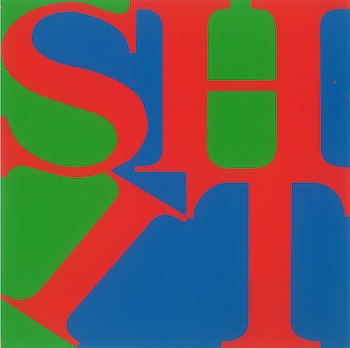
Robert Cenedella, Shit, 1965. Photo: courtesy of the artist
1965 was a key year for him. It was then that he made a poster adapting pop artist Robert Indiana’s famously cloying square Christmas card design, LOVE, substituting letters that spelled SHIT. Indiana sued him. Cenedella responded that he did nothing more than what Andy Warhol did with a Campbell’s soup can, and won the case.
He went into advertising and created, among other things, the Hostility Dartboard, a novelty item that let users mount an image and pelt it with darts. Cenedella’s target of choice was Richard Nixon, with Lyndon Johnson and Spiro Agnew close behind. It sold everywhere, even at Macy’s. (An unsuspecting Nixon sent him a letter congratulating him on the launch. Cenedella framed it; it remains dart-free.)
Cenedella returned to painting in the 1980s, when he began teaching at the Art Students League. He also developed a specialty: the group portrait. His most famous depicted a hundred customers at Le Cirque, the watering hole for New York’s boldfaced names in the Tom Wolfe era — from Ivana Trump to Woody Allen to Richard Nixon, along with bejeweled patrons whose fame didn’t outlive them. (But not Donald Trump, whom Cenedella refused to include.) The painting hung in the restaurant for decades, leaving viewers to decide whether it was history or satire.
Cenedella himself studied at the Art Students League with one of the twentieth century’s notorious satirists, George Grosz (1893–1959), who depicted World War I invalids, prostitutes, ragged derelicts, and pompous officials in Germany until he fled Berlin in 1933.
Grosz the refugee became Cenedella’s teacher. The contempt for authority rubbed off. Grosz advised the younger man to go into television, because “art is dead.”
Not dead enough for Cenedella, though close. The younger man painted a prophetic work: Fin del Mundo (“The End of the World”), a 2016 triptych imagining a cataclysmic Trump presidency. It combined elaborate Boschian decay with the lurid over-saturation of Eugène Delacroix’s 1827 Death of Sardanapalus, now at the Louvre.
Cenedella says Fin del Mundo put him at odds with the Art Students League administration. He turned up the heat in 2017 with The Presence of Man, which depicts a dead Santa Claus on a cross above a pile of gift-wrapped boxes. Displayed in a nearby gallery window just in time for Christmas, the painting had already been removed from a show at New York’s Saatchi Gallery in 1988. A New York Post headline drew crowds: “Meet the NYC Artist Who Crucified Santa Claus.”
“I don’t have to worry about the government censoring [me] because the galleries and museums do it for them!” Cenedella told the Post at the time.
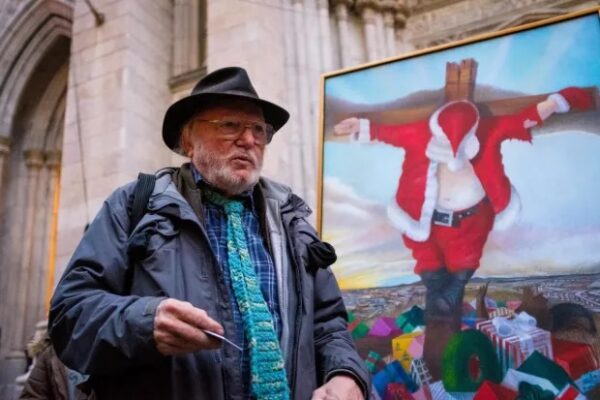
Robert Cenedella pictured with his painting The Presence of Man. Photo: courtesy of the artist
Immigrants is on view free through October 18. Visitors who navigated the opening crowd amid New York’s art-fair marathon gathered before the group portrait, trying to identify the obscure MAGA figures among the familiar faces. For anyone from Maine, where Cenedella now lives near a restaurant owned by Graham Platner’s mother, Senator Susan Collins was easy to spot. So was the toothy former Florida congressman Matt Gaetz, stationed on the far right — a nod to his politics, extreme even by Trump standards?
Lindsey Graham, next to Hegseth, wears an eerie grin. Rudy Giuliani appears to bellow. Pam Bondi, showing only the whites of her eyes, seems in a trance. A bloodied Stephen Miller peers over Trump’s shoulder like an eminence rouge.
The figures have horns, like those worn by the bearded, costumed Jacob Anthony Chansley, who broke into the US Capitol during the January 6 attack carrying a spear. He’s in the painting, too, mouth agape. Here, the horns suggest something more satanic than saintly.
Comic-strip figures, sinister or not, have long had a place in modern art. Philip Guston abandoned abstraction for what looked like oversized drawings of ghosts in Ku Klux Klan sheets. His Richard Nixon was another hulking figure, darkly bearded but mostly nose. Roy Lichtenstein, the subject of a new retrospective at the Whitney Museum in Manhattan, flattened the world into comics.
Cenedella recoiled from that style. The figures in Immigrants Are Poisoning the Blood of America are spectral and ominous, not remotely cute, not even snarky. Gone are the laughs of Santa on the cross or a dorm-room poster that substitutes SHIT for LOVE.
What remains is an honesty George Grosz might have admired. Cenedella echoes Grosz when he asks, “If you compromise art, why be an artist?”
Yet behind the grotesque Trump elites stand something darker still: a faceless army.
David D’Arcy lives in New York. For years, he was a programmer for the Haifa International Film Festival in Israel. He writes about art for many publications, including the Art Newspaper. He c0-produced and co-wrote the documentary Portrait of Wally (2012), about the fight over a Nazi-looted painting found at the Museum of Modern Art in Manhattan.
Tagged: Art Bastard, Art Students League of New York, Donald Trump, George Grosz, New York art exhibitions, Painting, group portraits, political satire, political-art