
Author Interview: Joseph Horowitz on Anton Seidl and the Lost Promise of American Classical Music
By Aaron Cohen
In The Disciple: A Wagnerian Tale of the Gilded Age, the cultural historian and novelist resurrects Wagner’s American apostle—and a progressive, populist musical culture that New York has largely forgotten.
In 1885, two years after Richard Wagner’s death, his foremost disciple, the Hungarian-born conductor Anton Seidl, arrived in America. He would become New York’s most beloved conductor before fading into near-total obscurity by the mid-20th century. Cultural historian Joseph Horowitz has spent decades recovering Seidl’s remarkable career from the archives. His new novel, The Disciple: A Wagnerian Tale of the Gilded Age (Blackwater Press, March 2026), brings the man, the musician, and his vanished cultural world vividly to life. We spoke about the Gilded Age’s lost American canon—and how a historian came to write fiction.
Arts Fuse: Anton Seidl is the central figure in your newest book, The Disciple: A Wagnerian Tale of the Gilded Age. So who was he?
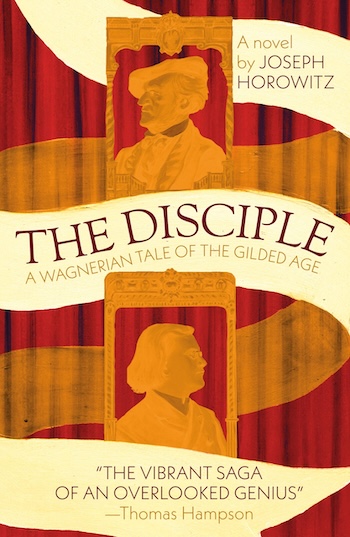
Joseph Horowitz: Anton Seidl was Wagner’s surrogate son, and he lived at Wahnfried. Wagner regarded him as the supreme interpreter of his music. It was Seidl who took Wagner’s Ring Cycle on tour in Europe and Russia, premiering it all over that part of the world. Wagner told him to get out of Wahnfried or he’d never grow up. He advised him to go to the New World. And Wagner predicted correctly that his operas would be more welcomed in America than in Europe and that he would be less controversial, which is exactly what happened. Seidl arrived in 1885 and became Wagner’s apostle in the New World. The more I read, the more I discovered that there was a halo around this man’s name. Every time you came across Anton Seidl, it was as if the heavens opened. You have Arthur Farwell in the 1940s remembering Anton Seidl in Musical Quarterly, and he says this was the greatest moment in the history of American classical music. Seidl wasn’t somebody like the celebrity conductors of today. He was not only esteemed but loved.
AF: How did you come to rediscover him?
Horowitz: I did it in the best possible way, which is digging into uncatalogued, undigitized archives. One was at Columbia University, called the Seidl Archive, and the other was the Seidl Society Archive at the Brooklyn Historical Society. What you had in the case of Seidl were two individuals who kept everything. One was his wife, then his widow. She kept everything. And then she gave it all to Columbia University, and everything is there. And the other was Laura Langford, whom we haven’t mentioned, who was the head of the Seidl Society. This is a woman who was a clairvoyant, a theosophist, a student of Madame Blavatsky in London, who became the major impresario in Brooklyn. Hello?! The major impresario in Brooklyn in the 1880s and 1890s was a woman, okay? They gave more concerts than the New York Philharmonic. That’s all due to Laura Langford, and she kept everything. Between these two women, there’s an immense repository of archival information that to this day has been very little explored except by me.
AF: That would explain why, when I read your books, I feel like you are a time traveler. You could not possibly have heard these concerts in the 1880s and 1890s, and yet when I read your books, you’re living with these people and events.
Horowitz: I somewhat live in the 1880s and 90s. It would not be a good time to be ill or to be poor. Other than that, it was a great time. Anyway, in Brooklyn Seidl conducted on Coney Island 14 times a week in the summertime. This is one of the things I discovered, something I had to absorb. I had to absorb many things. One day I’m rummaging through this stuff at the Brooklyn Historical Society, and I discover a piece of paper with handwriting in pencil. What is it? It’s a speech that Seidl had written to deliver somewhere in Brooklyn about the democratization of opera and music and how it’s more important that poor people hear this music than the rich people who chat in their boxes. We’re talking about a man who purchased a summer house in the Catskills, who became an American citizen, who spoke English (however imperfectly), who conducted concerts exclusively of American works, who threw open his door to the American composer. I was stunned. Had I not had the opportunity to actually finger Seidl’s letters and other memorabilia, I would never have acquired such a sense of intimacy. I could never have written a novel about him. That’s the cost of screens: they make everything vicarious.
AF: Your books Moral Fire and Wagner Nights argue that American classical music peaked in the 1890s, during Seidl’s time here. Why was that?
Horowitz: That’s when it’s most robust, most exciting, most influential nationally. And that’s when it’s healthiest because the focus was on the composer, on the prospect of creating an American canon. Not the great orchestras or the great violinists or the great pianists or the great conductors. But: how are we going to found an American compositional canon? And everybody assumed that by 2026 orchestras in this country would be mainly playing American music, which of course has not happened.
AF: Other than Seidl, who are the historical personalities we should be paying attention to?
Horowitz: There are a number of immense, colossal figures. Henry Higginson is one in Boston. Theodore Thomas is one. But in New York, it’s Antonín Dvořák and Anton Seidl. Of course, I was aware of Dvořák and his New World Symphony. I knew that he had taught at the National Conservatory of Music in New York, but I didn’t know the context. Jeannette Thurber, who ran the conservatory, offered free scholarships to all Black students. Why did she do that? It wasn’t only because she was a humanitarian; it’s because she knew that the future music of the United States would be Black. Henry Krehbiel, the leading music critic of the time, knew that too, and he wrote the first book-length musical study of African American folk songs. Dvořák knew that instinctively. And the climate was amazingly progressive, humane, and farsighted.
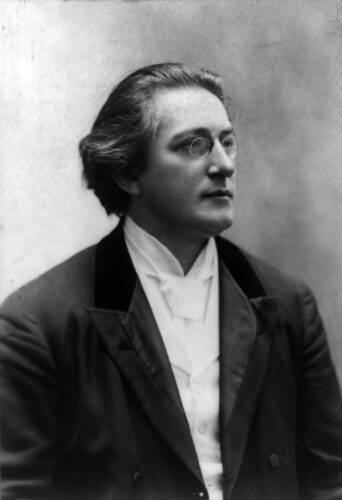
Anton Seidl in 1895. Photo: WikiMedia
AF: Henry Krehbiel and Laura Langford are the major secondary characters in The Disciple. What drew you to them as characters?
Horowitz: The whole saga – Anton Seidl, Laura Langford, Henry Krehbiel – is a gift to the novelist. You couldn’t make it up. Langford, who’s completely forgotten today, is a precursor to the New Woman. It’s revealing – of the times in which she lived – that she could only thrive in a contingent relationship to a man. Her husband ran the Brighton Beach Railroad. When he died and Seidl died, Langford drifted into obscurity. But she was a force: she drove her Seidl Society like a locomotive. Many men resented her as a bossy female in a man’s world. She grew up in the Civil War South, and her career as a journalist and impresario was partly an act of penance. The context, as with Wagnerism, was uplift. Her theosophy and clairvoyance were part of the same picture. Like Seidl, she was a moral force.
And so was Krehbiel, for whom the moral criterion was paramount – that’s what “great music” was about. It may sound musty today, but it was fabulously empowering, this emphasis on human betterment. Langford brought African American orphans to Brighton Beach for turkey dinner and Wagner for dessert. Krehbiel was a tireless advocate for “African American folksongs.” His innumerable friendships included Harry Burleigh – Dvořák’s Black assistant, who was the pivotal figure in turning the sorrow songs into concert songs. Americans have no idea how potent the arts were in the late Gilded Age. They only think of robber barons and wealth snobs in their opera boxes. It’s not only a caricature – it’s a caricature that deprives us of an arts legacy we need to know. Americans were much more intensely engaged in the arts in the late nineteenth century than they are today. There’s really no comparison.
The best-known image of Gilded Age opera is Gounod’s Faust at the Academy of Music, as evoked by Edith Wharton in The Age of Innocence as a showcase for the social elite. But the same Academy of Music housed an underground “beer cavern” where the hoi polloi congregated between acts, mingling with the artists. A lot of the chatter was in German or Italian. A few decades later, the Metropolitan Opera became a site of class warfare, with the Germanic Wagnerites shushing the boxholders. The boxholders rebelled in 1891 and threw the Germans out. But the Germans were strong and eventually came back. And yet there are social historians who insist that the museums and opera houses of the late Gilded Age manifested “class hegemony.” That’s an ideological hunch, not an empirical observation. It drives me crazy.
AF: What was the music of the 1890s like?
Horowitz: Well, first of all, you have the New World Symphony in 1893, an American work that was premiered by Seidl at Carnegie Hall. The American Suite by Dvořák and the Violin Sonatina are even more American. This is a guy who, for a period of three years, changed his tune and, like Kurt Weill, became an American composer. This is not an overstatement if you know the American Suite. The American Suite, unlike the New World Symphony, doesn’t even sound like “Dvořák.” It’s a series of American postcards. So the American output in the 1890s includes three or four pieces by Antonín Dvořák. “Stars and Stripes Forever” was composed in the 1890s. “Maple Leaf Rag” was composed in the 1890s. Victor Herbert’s Second Cello Concerto, an excellent work, was composed in the 1890s and premiered under Anton Seidl. “Jubilee” by George Chadwick was composed in the 1890s and should be as well-known as “Stars and Stripes Forever.” But the kicker is that Charles Ives is already composing some of the greatest American concert songs as a student at Yale in the 1890s. After World War I, Aaron Copland and Virgil Thomson sold us a bill of goods – that no American music of consequence was composed before 1910. I call that the “standard narrative.” It’s still stifling.
AF: You have been known primarily as a writer of nonfiction. When did you decide to write a novel about Seidl?
Horowitz: The crucial moment was when I wrote a young people’s book about Dvořák in America as fiction. I’d never thought to write fiction, but I figured, if I’m writing this book for kids, it’ll be more entertaining, more accessible, if I do it with dialogue. So there is a chapter where I’ve got Seidl and Dvořák at Fleischmann’s Cafe. Every afternoon, Dvořák and Seidl would sit at the round table on the second floor of Fleischmann’s Cafe, and one would be drinking beers and the other smoking cigars. They spoke very little, but they met every day, and they were well-known public personalities. I created a scene in which they’re discussing the impending premiere of the New World Symphony. This was one of the spookiest things that ever happened to me as a scholar. I discovered I could hear Seidl talk, that I knew what he would say. That planted a seed. And eventually I wrote my novel.
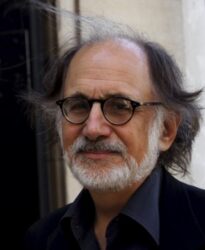
American cultural historian, author, concert producer, and former New York Times music critic Joseph Horowitz. Photo: courtesy of the artist
AF: The characters in The Disciple were real people, but most of the dialogue is your invention. Could we classify this book as historical fiction?
Horowitz: In some respects, The Disciple would be more accurately called “creative nonfiction” than “historical fiction.” For the most part, I did not create the events in the book – I elaborated events that we know took place. In any event, the distinction between “fiction” and “nonfiction” deserves to be scrutinized. My “nonfiction” account of Seidl in New York is Wagner Nights: An American History, which was published in 1994. But a book of that kind, if decently done, requires lots of imagination; it’s not just an assemblage of facts culled from the historical record. For instance, there’s a scene in Wagner Nights in which I imagine what’s in Laura Langford’s head when she speaks at a Brighton Beach “Wagner Night.” In fact, I believe I have discovered, at least for myself, that “historical fiction” is an invaluable tool for the historian – you learn new things when you add dialogue; it brings the story to life.
AF: In 2023, you published The Marriage: The Mahlers in New York, which focused on Gustav and Alma Mahler’s time here. This is the same world of classical music in New York as The Disciple, although ten years later. So The Disciple is a prequel to The Marriage?
Horowitz: The Disciple was written long ago. It’s only been published recently. But I wrote The Disciple and then I decided I should write a second novel as a sequel about Mahler in New York because Mahler in New York can only be understood in the context of Seidl in New York. Then I decided they were one big book. Then my friend Antonio Muñoz Molina, the famous Spanish novelist, read both novels and he said, no, these are two books. And I thought I better publish the Mahler one first because nobody’s heard of Seidl. And that’s why only now is the book The Disciple: A Wagnerian Tale of the Gilded Age being published, written so long ago that I actually cannot even recall the act of writing it. And I read it and marvel that I ever managed to write it.
AF: Seidl died suddenly in 1898. What was lost?
Horowitz: Seidl was bigger than Toscanini, bigger than Bernstein. Wagnerism is the dominant theme of American cultural and intellectual life for a period of about 20 years. If you read The Atlantic Monthly, you’re reading articles about Wagner. One thing that’s immensely important is that, if Seidl had not died at the age of 47 in the 1890s, he would have established a Wagner festival in Brooklyn, commensurate in importance and prestige with Bayreuth. This horrible tarnishing of Wagner’s legacy by swastikas at Bayreuth, there would have been an alternative to that. So the influence of Wagner via Seidl was immense. And Seidl himself is an indescribably charismatic personality. It was my good fortune to discover, or rediscover, Anton Seidl.
AF: A final word?
Horowitz: I wrote The Disciple partly as an exhortation to fundamentally rethink the Gilded Age. It’s not just a book for Wagnerites or music lovers.
Aaron Cohen is an award-winning radio producer and Director of Broadcast Operations at New York Public Radio. His classical-music features have been heard on WNYC, WQXR, American Public Media, the WFMT Radio Network, and the Canadian Broadcasting Corporation. He has produced more than 50 features for the Metropolitan Opera. Cohen is the creator, writer, host, and producer of the award-winning, chart-topping podcast series Embrace Everything—The World of Gustav Mahler, an ambitious exploration of Mahler’s life and music through his symphonies.
Tagged: American classical music, Anton Seidl, Gilded Age, Joseph Horowitz:, New York music history, Richard Wagner, The Disciple, classical music interview, historical fiction