
Film Festival Reviews: TIFF’s Uneasy Mirror — Apartheid, October 7, and Almodóvar’s Reflections
by David D’Arcy
Three Toronto premieres — John Trengove’s The Smell of Apples, Avi Nesher’s Our Loves, and Pedro Almodóvar’s Bitter Christmas — locate private lives within political violence, historical memory, and the seductive artifices of storytelling
As always, the Toronto International Film Festival offered some surprises.
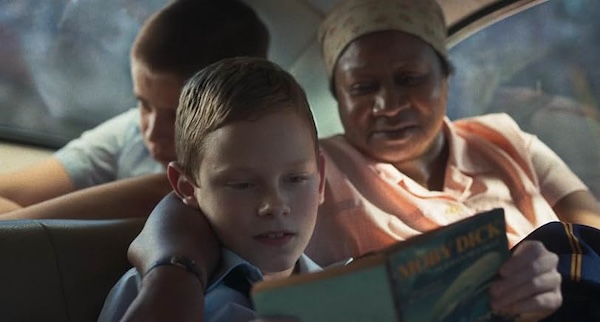
A scene from John Trengove’s The Smell of Apples. Photo: TIFF
One for me was the world premiere of The Smell of Apples, an ominous South African drama in Afrikaans, based on Mark Behr’s 1995 Afrikaans novel. The film is directed with a mood of understated tension by John Trengove, an established filmmaker whom you may not have heard of.
The story is set in 1974, in the comfortable home of a young general in the South African army. We see events through the eyes of his 11-year-old son, Marnus.
At first, what we see more atmosphere than action. The family lives pleasantly by the sea in Cape Town, without extravagant luxuries. A Black servant lives with them, as does her nephew, who eventually becomes the source of troubling conflict.
Marnus’s mother has put aside a career in music to raise her children and serve her husband, who is tasked with fighting opposition in countries around South Africa. The few pictures he shares from his missions reveal the violence involved. A guest at the house is a Chilean officer called Mr. Smith, a fun-loving emissary from the Pinochet regime that seized power in Chile’s bloody U.S.-supported coup of 1973. He is an authoritarian with a taste for wine and culture, unlike the mostly stiff Calvinist Afrikaners.
Marnus and a young friend have their own disruptive energy, but his stern father rules the household with a firm hand. The assumption is that the household serves as a metaphor for apartheid South Africa. The brood is may be modeled on Behr’s family, who left Tanzania for white-controlled South Africa after his family’s farm was seized by a new Black government.
Some have seen echoes in this film of Jonathan Glazer’s The Zone of Interest (2023), with its portrait of the “normality” of the Auschwitz commandant’s home life, But The Smell of Apples is less mannered and more rooted in its own conflicted story — it observes apartheid as a functioning system, largely from inside a household.
Two events deepen the narrative. Marnus’s fishing rod, a family heirloom, goes missing. Without evidence, he accuses the young nephew of the family’s maid of taking it. The boy is immediately presumed guilty and is tortured, a reminder of how harshly Black people were treated when accused of breaking rules.
Marnus is traumatically shocked when another rule is broken. He hears his closest friend being raped in the house, and the attacker turns out to be his father. The entire matter is kept secret. The friend leaves — a form of exile, which many South Africans chose, but worse.
The Smell of Apples made its world premiere in Toronto at a moment when apartheid’s darkest evils in South Africa, accepted as normal by most of the characters in the film, have been exposed through the efforts of the national Truth and Reconciliation commission. Images from that past are now being recalled — this time stimulated by an American program that aims to resettle as many as roughly 17,000 white Afrikaners, whom Trump claims are victims of Black violence. There is no evidence that Afrikaners have been subjected to violence at a rate greater than that of other groups in South Africa.
The film offers ample evidence that white South Africans once lived within a structure of extraordinary racial privilege. Nevertheless, the Trump administration proposes to spend about $500 million resettling up to 17,500 refugees, chiefly white Afrikaners, even as it constricts access to refuge for people escaping far more demonstrable persecution and violence elsewhere. The race-driven injustice may make The Smell of Apples unusually resonant for American viewers.
It is unusual to see a film in Afrikaans. It is even more unusual to see an Israeli film anywhere these days; in general, since the Hamas attack of October 7, 2023, they have been absent, aside from screenings at Jewish institutions and festivals. Israeli cinematic projects, which tend to be co-productions, have also seen their access to international funds cut off almost entirely since then, in response to the country’s savage war on Gaza. That cutoff is unlikely to change soon.
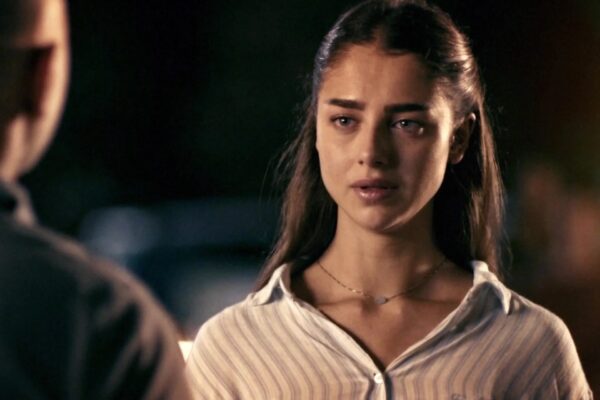
A scene from Avi Nesher’s Our Loves. Photo: TIFF
Our Loves, directed by Avi Nesher, made its world premiere at TIFF amid expected protests. The film is set on October 7, 2023, not far from the Gaza border. We see multiple Hamas attacks at the end of an all-night Israeli rave and on nearby kibbutzim. We watch Israelis — soldiers and civilians — move slowly at first to respond, then lurch into action.
Our Loves is a personal film. Nesher was not near Gaza on October 7, but he constructs a scripted mosaic from specific, individual stories. On the eve of the attack, the parents in one family wage a bitter divorce battle. Elsewhere, a policewoman angling for promotion struggles to conceal her new girlfriend from her traditional Moroccan mother. A young Orthodox woman, dumped by phone that same evening, ends up hiding beneath a vehicle, then tries to save a drug dealer sheltering nearby after masked gunmen shoot him. In Nesher’s film, rooted in individual experience, every Hamas attacker is masked.
Nesher frames the attacks as terrorism within a real war. Israeli characters are killed, often by gunfire, but he avoids scenes of mass murder and the documented torture and sexual violence. Those horrors are readily available online; his interest lies elsewhere.
Given the October 7 failure of Israel’s military and intelligence apparatus, in the film’s one-day panorama, badly outnumbered police officers appear largely on their own. That impression accords with the Israeli military’s subsequent inquiry, which found that the IDF had gravely underestimated Hamas, “misread” its intentions, and failed in its duty to protect civilians. Calling this a “misreading” is an astonishing understatement—rather like calling Israel’s ensuing assault on Gaza, in which some 70,000 Palestinians have been killed, an overreaction.
Our Loves deserves to be seen for its empathy and for its depictions of courage and tenderness under unbearable conditions. But beware its limits. Nesher himself argues that the film is not concerned with the historical, military, or political dimensions of October 7, but with people caught inside it. Its collage is therefore only one fragment of Gaza’s larger, far more troubling mosaic.
For that wider picture, consider NAZA, the new documentary by Yuval Abraham and Rachel Szor, whose distribution is being led by The Guardian. The film includes testimony about the IDF’s knowledge and acceptance of lethal “collateral damage.” In response, Israel’s culture minister, Miki Zohar, called for the filmmakers’ citizenship to be revoked; Prime Minister Benjamin Netanyahu later proposed legislation aimed at stripping citizenship from people who “smear” Israeli soldiers. (Arts Fuse review)
There is, however, one quietly hopeful note in Our Loves. One storyline follows a girl wounded in the attacks who is eventually found by her father, a police officer—one of the film’s many improvised heroes. At the all-night rave, she has furiously accused him of abandoning the family. Later, he finds her unconscious and wounded in a pool of water and carries her, barely breathing, to a medic called Dr. Mansour. Israeli viewers would recognize Mansour as an Arab name, and the actor as Hisham Suleiman, an Arab Israeli who is part of the film’s prominent ensemble. The girl survives because of an Arab doctor. Amid the carnage, it is a small, gentle movement in the right direction.

From left: Bárbara Lennie and Victoria Luengo in Bitter Christmas. Photo: Cannes Film Festival
Bitter Christmas (Amarga Navidad), Pedro Almodóvar’s latest, was also at TIFF. He has now been making films for half a century. Those of us old enough to remember his early work recall a young rebel jolting Spanish cinema—which seemed locked in a Catholic coffin—out of its somnolence and into a loud, messy, sexualized, defiant modernity. For Almodóvar, and for this sleek new film, “self-aware” scarcely begins to cover it.
His once-entropic style has since given way to films that feel less like billboarded declarations than reflections—sometimes reflections of reflections.
In Bitter Christmas. Elsa (Bárbara Lennie), once a filmmaker, now makes her living in advertising. She is involved with Bonifacio, a younger firefighter whom she first approached for an underwear commercial. Elsa’s ambitions remain unrealized, and this frustration also shadows her friends: one has a cheating husband—always good material for a screenplay—while another has just lost a child.
All this is observed by Raúl (Leonardo Sbaraglia), a screenwriter visually defined by lustrous gray hair and a perpetually open laptop. He has an attentive, buff boyfriend who seems to be his own Bonifacio. Raúl, internationally known for his scripts, says he is finishing a screenplay. The women in Elsa’s orbit appear to belong to its latest draft, and Elsa becomes his surrogate. The film makes much of the parallel between an endlessly revised script—“work in progress” sounds too positive—and the thwarted, largely artistic or literary ambitions of its characters, Raúl included.
It sounds like a puzzle, or at least a tale engineered to keep us watching. And there is plenty to watch. Almodóvar moves among shifting landscapes, from Elsa’s refuge with the sculpted Bonifacio to the black sands of Lanzarote in the Canary Islands, where she tends to her troubled friend. The studied interiors throughout Bitter Christmas make Architectural Digest look like a bedliner.
Color, as ever, is central to the emotional architecture of the film, as Almodóvar’s characters struggle both to write their stories and to live them. Yet disappointment can be just as acute in a flawlessly appointed room. Amid all that elegance, the images have a studied flatness, reminding us—as though the reminder were needed—that Almodóvar remains drawn to the heightened aesthetics and plot convulsions of the telenovela. Watch enough of the latter and you no longer know where one story ends and the next begins. That is the point. It also sounds a lot like Bitter Christmas.
David D’Arcy lives in New York. For years, he was a programmer for the Haifa International Film Festival in Israel. He writes about art for many publications, including the Art Newspaper. He produced and co-wrote the documentary Portrait of Wally (2012), about the fight over a Nazi-looted painting found at the Museum of Modern Art in Manhattan.
Tagged: "Bitter Christmas", "Our Loves", "The Smell of Apples", Avi Nesher, John Trengove, Pedro Almodovar