
Concert Review: Love, Roses, and Berlioz — Andris Nelsons’s BSO Farewell Season Begins
By Aaron Keebaugh
With Yo-Yo Ma and Emanuel Ax on hand—and an audience that repeatedly, rapturously made its feelings known—the Boston Symphony Orchestra’s opening weekend served as both a musical showcase and a public tribute to its departing music director.
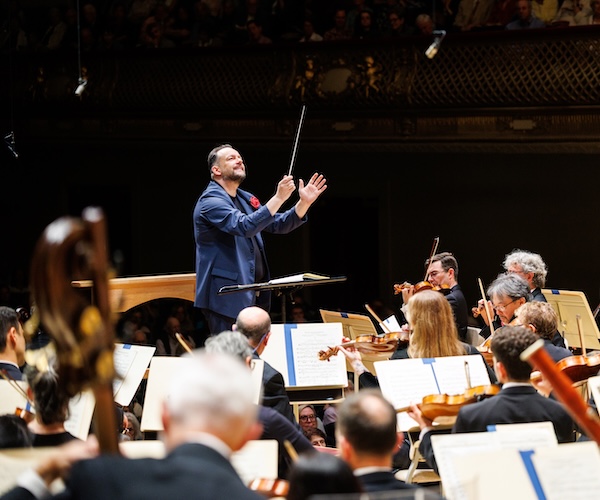
Music Director Andris Nelsons leads the Boston Symphony Orchestra in Berlioz’s Symphonie fantastique. Photo: Robert Torres
New seasons routinely bring a mix of the fresh and familiar. But the Boston Symphony Orchestra’s opening weekend offered more than congenial programming and polished playing. Launching his final season as music director, Andris Nelsons did what he has long done best: welcomed a packed Symphony Hall with warmth and collegiality, then led the music with his characteristic blend of sensitivity and conviction.
For Nelsons, the past six months have made clear that much of Boston’s musical public remains firmly in his corner. After the BSO board voted in March not to renew his contract beyond this season, musicians and listeners alike rallied to his defense. Many continue to wear red flowers in solidarity with the Latvian conductor, and Thursday and Friday’s concerts drew conspicuous numbers of supporters hoping the decision will be reversed.
“Why do we wear roses?” Nelsons asked in his opening remarks Thursday night. “It’s a sign of love, admiration, respect, and compassion.” “The music is about love, excitement, inner dreams, and brotherhood, darkness, and moments of sun and positivity,” he added.
His remarks struck a conciliatory note after BSO president and CEO Chad Smith outlined the season and invoked an expansive future for Symphony Hall: it was a venue remade for everyone, rather than simply the orchestra’s home. For the moment, at least, the institution’s opposed figureheads observed a public truce.
Politics aside, the weekend’s performances reaffirmed Nelsons’s instinct for emotional amplitude. Elgar and Mozart concertos supplied intimacy and inwardness; Brahms and Berlioz symphonies invited a broader, more extroverted response. Nelsons gave each its due, shaping the programs with sensitivity, force, and a Technicolor flair.
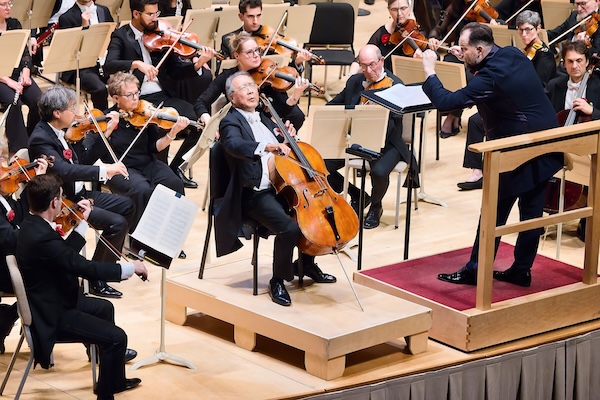
Yo-Yo Ma performs Elgar’s Cello Concert with Music Director Andris Nelsons conducting the Boston Symphony Orchestra. Photo: Hilary Scott
On Thursday, Yo-Yo Ma took the solo role in Elgar’s Cello Concerto, choosing contemplation over display. He began the opening cadenza at a breathy remove, as though recalling a distant experience; gradually, the music acquired a more deeply mournful gravity without losing its forward motion.
The second movement brought out Ma’s puckish, almost whimsical side. In the Adagio, he found a fuller warmth, his phrases rising into the orchestra’s plush sonority. Nelsons proved an attentive partner as the finale subsided once again into a guarded introspection, completing the work’s emotional arc.
Friday belonged to Emanuel Ax, whose account of Mozart’s Piano Concerto No. 22 in E-flat major was as idiomatically Mozartean as one could wish: pearly in tone, rhythmically alert, and seemingly effortless in its articulation. The lines danced and tumbled with unforced grace, while the Adagio unfolded with an unaffected lyricism.
Like Ma, Ax is an exceptional chamber musician, and his exchanges with the flute and bassoon had a piquant, conversational charm. In the Rondo, arpeggios and scales rippled above the strings’ pulse as Nelsons supplied a discreet, supple foundation.
Both soloists offered encores. Ma joined the BSO’s cello section for Pablo Casals’s arrangement of the traditional Catalan Christmas song El cant dels ocells (The Song of the Birds). Ax closed Friday’s concert with Chopin’s Nocturne in F-sharp major, Op. 15, No. 2.
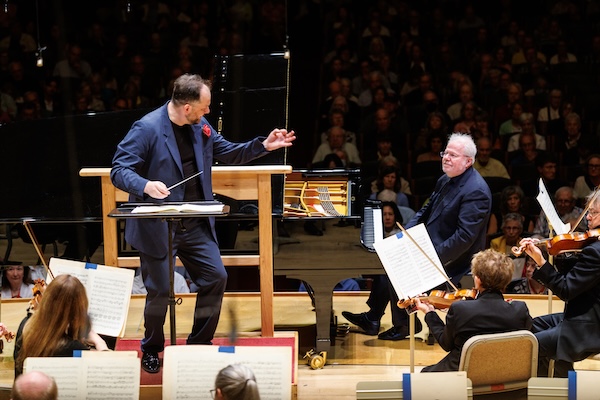
Music Director Andris Nelsons leads Emanuel Ax & the Boston Symphony Orchestra in Mozart’s Piano Concerto N. 22. Photo: Robert Torres
On both Thursday and Friday, Nelsons followed the concertos with large-scale works spanning consolation, exhilaration, and despair. His account of Brahms’s Fourth Symphony on Thursday was especially tragic and poignant. The symphony supplies some of that effect on its own—it is the only one of Brahms’s four to end in a minor key—but Nelsons’s expansive tempos and finely detailed direction gave it unusual weight and urgency.
He allowed the opening phrases to unfold in broad, vocal arcs, while the wind fanfares carried a palpable gravity. Yet the performance never slackened. Brahms’s hemiolas pressed and grated against one another, and the woodwinds and brass answered their summons with striking force.
Elsewhere, Nelsons brought a dance-like buoyancy to the score. Subtly inflected with rubato, the second movement’s phrases swayed and lilted; the Allegro giocoso bounded forward with bracing vigor. In the final passacaglia, he accumulated tension patiently and inexorably. The brass chorales erupted with near-Mahlerian intensity—a cry flung into the void. Brahms, in his own grave fashion, understood the terror of confronting a world that offers no consolation.
Few orchestral works are more gloriously melodramatic than Berlioz’s Symphonie fantastique, which occupied the second half of Friday’s program. Berlioz’s fevered musical fantasia, inspired by his infatuation with the Shakespearean actor Harriet Smithson, places him squarely among the nineteenth century’s great artistic radicals. It traces a young artist’s obsessive pursuit of an unattainable beloved—Smithson’s imagined double—through hallucination, execution, and eternal damnation.
This is precisely the repertory in which Nelsons’s theatrical instincts can flourish. In “Rêveries—Passions,” he lingered over the opening phrases, making clear that the young artist is already unsettled in his own mind. Then a sudden surge of energy sent the idée fixe—Berlioz’s theme for the beloved—yearning forward with the ardor of a fan’s impossible love letter. The second movement’s waltz suggested all the splendor of a ball, yet moved with an easy lightness, never weighted down by grandeur or fussiness.
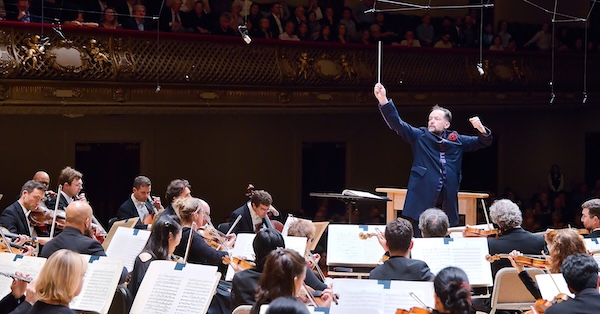
Music Director Andris Nelsons conducts the Boston Symphony Orchestra on Opening Night. Photo: Hilary Scott
“Scene in the Country” projected a warmly pastoral calm, though its peace was shadowed by the approaching storm, rendered in the timpani’s rolling thunder. From offstage, English hornist Mark McEwen and newly appointed assistant principal oboist Kip Zimmerman exchanged their lonely calls with a mournful, distant pall. “March to the Scaffold” arrived in all its lurid, bloodthirsty grandeur. In “Dream of a Witches’ Sabbath,” the orchestral lines flickered like hellfire; the low brass turned the Dies irae into a desperate cry for release. Tension churned through the final bars before the brass rang out in terrifying triumph.
Arturs Maskats’s Tango opened the season on a festive but faintly elegiac note. In its 12-minute span, the score treats the tango much as Ravel treats the waltz in La Valse: as a dance form already slipping into memory. Rhythms circulated seductively, while the solo clarinet spun a sly melody over the harpsichord’s throbbing figures. Julien Labro’s bandoneon lent the texture a silvery, bittersweet sheen.
Yet the work’s eruptions proved as arresting as its intimacies. Cellos and basses drove their rhythms with muscular force, and Nelsons relished the score’s bold, sharply contrasted colors.
The audience registered its devotion before the music began. “We love you, Andris,” one listener called out just before the downbeat. “We love you,” Nelsons replied. It was a gracious exchange—and a reminder that the conductor continues to command the loyalty of a substantial portion of the Symphony Hall faithful.
Aaron Keebaugh has been a classical music critic in Boston since 2012. His work has been featured in the Musical Times, Corymbus, Boston Classical Review, Early Music America, and BBC Radio 3. A musicologist, he teaches at North Shore Community College in both Danvers and Lynn.
Tagged: Andris Nelsons, Boston Symphony Orchestra, Emanuel Ax