Book Review: The Contradictory Voice of W.H. Auden
By Michael Londra
Peter Ackroyd’s breezy biography captures the poet’s divided nature—but leaves his political and poetic reversals largely unexplored.
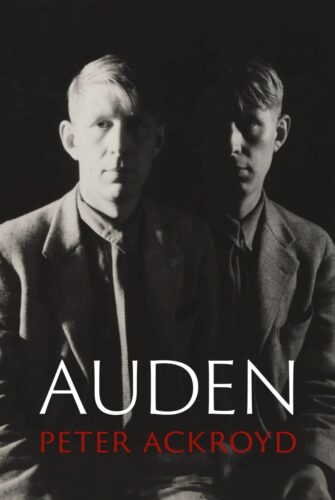
Auden by Peter Ackroyd. Reaktion Books, 400 pages, $30.
 Ahead in the polls during the 1964 presidential race, incumbent Lyndon Johnson wanted to win in a landslide, so he enlisted an advertising firm to create a television commercial portraying Republican opponent Barry Goldwater as eager to deploy the atomic bomb. Only broadcast once, the commercial shows a three-year-old girl counting petals as she plucks them from a daisy. When she gets to “nine,” her voice is replaced with a man counting backward to zero, as if launching a missile strike. Suddenly, a nuclear mushroom cloud fills a close-up of the girl’s right eye. Talking over this image, Johnson announces the “stakes” of the election: “To make a world in which all of God’s children can live, or to go into the dark. We must either love each other or we must die.” Historians attribute LBJ’s runaway victory to the ad’s shameless fearmongering. But it wasn’t solely the brainchild of Madison Avenue. The last sentence of the president’s voiceover was lifted from the poem “September 1, 1939” by W.H. Auden.
In Auden, biographer Peter Ackroyd tells us the poet was “infuriated” to discover Johnson’s misappropriation. Intended to denounce hypocrisy, his aphorism now perpetuated it. Named for the date on which Hitler invaded Poland, “September 1, 1939” famously begins: “I sit in one of the dives / On Fifty-Second Street.” The dive in question was the Dizzy Club (“the sex addict’s quick fix”), a secret gay bar where Auden “sought comfort and company.” Reflecting on the subsequent “conflagration of blood and violence,” happening in Europe. Auden endeavored to “identify the purely human within the ruthlessly political.” In other words, Auden believed ordinary citizens were not innocent bystanders to barbarity. He criticized both authoritarian leaders and apathetic populations: “All I have is a voice / To undo the folded lie / The romantic lie in the brain…The lie of Authority…no one exists alone…we must love one another or die.”
Auden’s “folded lie” alludes, of course, to newspapers circulating pro-war propaganda. Indeed, Auden’s notion that “we must love one another or die” signifies, among other things, resistance to such tribalism. Love, then, is a synonym for a worldview that recognizes that everyone’s destiny is interlinked. And in this context, death does not only mean mortality. Auden is arguably also pointing toward the spiritual rigor mortis of daily life under fascism. But almost as soon as the lyric appeared in The New Republic, Auden condemned it as “the most dishonest poem I have ever written.” Ackroyd notes that the poet now considered his line “we must love one another or die” to be “false rhetoric.” On the one hand, Auden wanted to speak on behalf of society, as W.B. Yeats did for Ireland in “Easter 1916.” But he loathed conforming to such bardic temptations. At odds with himself, he eventually stopped reprinting “September 1, 1939,” refusing to allow it back into circulation. Auden’s career is rife with such U-turns: “He altered lines, revised whole poems and discarded others…as if Auden were polishing the mirror to achieve a brighter reflection.” Indeed, his second-guessing symbolizes what fellow poet Delmore Schwartz posited as “the two Audens.” Borrowing Freud’s terms, Schwartz encouraged Auden to prioritize the id’s unconscious truths over his ego’s love of bombast. Auden‘s cover image, shot by Cecil Beaton in 1930, also reflects this duality. Beaton’s double exposure technique split Auden’s face right down the middle—one side layered in dark, the other rinsed in light.
 Peter Ackroyd’s Auden is a breezy chronicle that offers little contextual analysis, Freudian or otherwise. Amazingly, there are no footnotes. The biographer touches on the poetry sporadically; he seems more interested in delivering fun facts fast. It’s hard to discern, however, where he’s getting his information. For example, evocative quotes are sprinkled on almost every page, and I found myself wanting to learn more about them. After all, one of the purposes of a biography is to inspire further interest. Without citations, any additional investigation is impossible.This is apparent when Ackroyd details Auden’s years as a schoolmaster. While teaching at The Downs School in Herefordshire in 1934, Auden “encountered” a young student named Michael Yates: “Auden seems immediately to have been drawn to him.” Ackroyd reveals it “was not unknown for a schoolmaster and pupil to have a sexual relationship, but it was unusual;” and that “Yates, late in life, recalled that…there was considerable affection, you know, which I had for him too in a way.” What is the source of this statement? Given the serious nature of Auden’s actions, if Ackroyd did not want to analyze this incident in depth, he should point to where readers could for themselves. Why? “Lullaby” is one of Auden’s most famous love poems; and, according to Ackroyd, it was written for Yates when he was seventeen. Knowing more about the poem’s background affects how it may be perceived going forward.
So Auden reads like the literary equivalent of a gourmet smashburger. It kicks off with a banger—“Begin with the name. Wystan is singular and arresting. Auden thought it rare, almost unique; he confessed he would be furious if he found that anyone else possessed it.” But the book never goes beyond that sizzle. I was caught up in Ackroyd’s entertaining prose, honed across nearly eighty volumes of poetry, fiction, history, and portraits of Blake, Dickens, Shakespeare, and the River Thames, among others. But as I eagerly consumed his empty calories, I was left starved for deeper reflections on the poet and his life.
Born in York in 1907, Wystan Hugh was the son of a successful doctor. Arriving at Oxford to study biology, he soon swapped it out for English. After hearing J.R.R. Tolkien lecture on Beowulf, he decided that poetry “was going to be my dish.” Surprisingly, for someone Joseph Brodsky characterized as the “greatest mind of the twentieth century,” Auden graduated with the equivalent of a C average. For his gap year in 1928, he moved to Weimar Berlin, reveling in the city’s erotic freedoms, a “buggers’ daydream,” while the Nazis seized power. Back home, he published his debut collection with T.S. Eliot at Faber, earning instant acclaim. In 1936, Auden joined the Republican cause in the Spanish Civil War. After spending seven weeks feeling “useless” in Barcelona and Valencia, he returned to England and wrote “Spain 1937.”
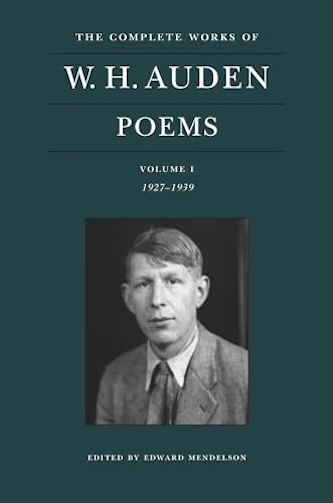
The poem is structured into stanzas that panoramically describe Spanish history: “Yesterday…[t]he trial of heretics among the columns of stone.” Auden then projects into a future utopia after the Republicans win: “To-morrow the rediscovery of romantic love …” Though his comrades must steel themselves to kill the enemy: “Today the deliberate increase in the chances of death, / The conscious acceptance of guilt in the necessary murder.” George Orwell criticized Auden for the phrase “necessary murder” because it seemed to justify political violence — without the poet being precise about what the idea entailed. Just as with “we must love one another or die,” Auden unsuccessfully sought to expunge the poem from his canon. He excluded both from his posthumous Collected Poems (1976). But they were appropriately restored to Princeton University Press’s Complete Works of W.H. Auden (2022).
Jaded by political scandal, he immigrated to America. Earning good money for appearances and teaching gigs, Auden prodigiously published poems and essays and became one of his era’s most admired poetic voices. Along the way, he fell in love with the poet, librettist, and translator Chester Kallman. Over the course of thirty-four eventful, sometimes tumultuous years, they considered themselves married. For decades, in addition to drinking vodka and gin excessively, he was addicted to nicotine, amphetamines, and Seconal. He died of a heart attack in 1973.
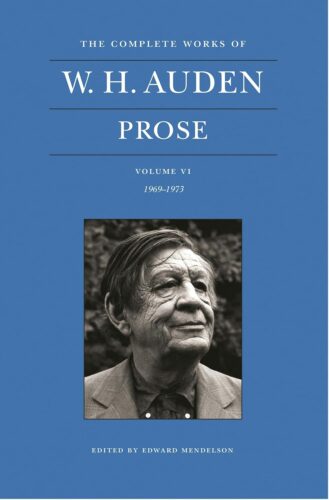 Jaded by political scandal, he immigrated to America. Earning good money for appearances and teaching gigs, Auden published copious poems and essays and became one of his era’s most admired poetic voices. Along the way, he fell in love with the poet Chester Kallman. Over the course of thirty-four eventful, sometimes tumultuous years, they considered themselves married. He died of a heart attack in 1973.
Auden does contain one or two errors. For example, Ackroyd places the George Washington Hotel on the Upper East Side, rather than at the eastern end of Lower Manhattan. The text also has its moments of intellectual absurdity, particularly its proposition that Auden’s childhood circumcision explains “his later fascination with the penis.” Is Ackroyd suggesting that Auden was gay because his foreskin was removed at age eight? Nevertheless, Auden stylishly portrays a complicated man who was riven with contradictions: “He was no egoist, but he was sharply conscious of his singularity.” Desperate for companionship, he refused to bathe regularly. Anti-sentimental, he wept at Garbo talkies. A snob, he penned endless limericks. Though puritanically Anglo-Catholic, he composed a ribald poem, “The Platonic Blow by Miss Oral.” It is a masterpiece of joie de vivre: “It was a spring day, a day for a lay, when the air / Smelled like a locker room, a day to blow or get blown.” For me, the paradox that resonates most tellingly is Auden’s vocational ambivalence. Disenchanted with his calling from early on, he continued to pursue it.
Ultimately, Auden was right to be disillusioned. President Johnson was very much a “shit” for having corrupted the meaning of his words. Language can be twisted to serve any agenda; a poet’s original intention means nothing. Auden never really trusted poetry after “September 1, 1939.” I think he believed verse was just another scam. When Auden rejected certain of his poems, does that imply that we should discard them as well? As Peter Ackroyd put it, “Does the poem belong to the poet or to its public?” Readers have the freedom to be inspired by the “rhetoric” any the poet later deems deceptive. Ironically, perhaps Auden’s poem “The More Loving One” best captures this complex dynamic. If he didn’t always value his literary achievement, we will: “If equal affection cannot be, / Let the more loving one be me.”
Michael Londra—poet, fiction writer, critic—recently introduced the Poets Confront AI and Surveillance Capitalism event at Poets House, available on YouTube. He also talks New York writers in YouTube indie doc Only the Dead Know Brooklyn (dir. Barbara Glasser, 2022). “Time is the Fire,” the prologue to his soon-completed novel of Delmore Schwartz and Lou Reed, appears in DarkWinter Literary Magazine. His poetry was translated into Chinese by scholar-poet Yongbo Ma. Two of his Asian Review of Books contributions were named Highlights of the Year for 2024 and 2025, one of which was translated into Vietnamese. “Life in a State of Sparkle—The Writings of David Shapiro” from The Arts Fuse was selected for the Best American Poetry blog. He can also be found or is forthcoming in Lana Turner: A Journal of Poetry & Opinion, Restless Messengers, The Fortnightly Review, spoKe, Cha: An Asian Literary Journal, and The Blue Mountain Review, among others. He added six essays and the introduction to New Studies in Delmore Schwartz, coming next year. Born in New York City, he lives in Manhattan.