
Film/Album Review: Sara Bareilles’s “Good Grief” Turns Loss into Communion
By Melissa Rodman
Josh Alexander’s intimate studio documentary follows Sara Bareilles and her collaborators as they shape songs of infertility, bereavement, friendship, and collective consolation.
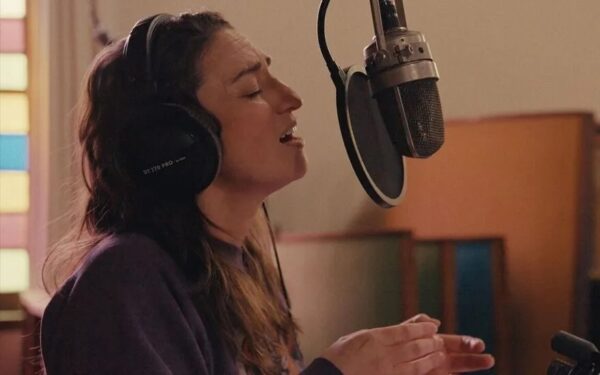
Sara Bareilles in a scene from Good Grief. Photo: Tribeca Film Festival
The premise is quaint, idyllic: A popular singer-songwriter and her small band rent a recording studio nestled in the quiet of Upstate New York to put together an album. On the surface, Sara Bareilles: Good Grief appears to be your typical “making of” documentary. But underneath swirls a musical drama of an artist’s mystical reckonings with deep loss.
Bareilles is perhaps best known for her catchy radio anthems “Love Song” or “Brave” or her score for Waitress the musical, although hardcore fans might cite a number of other songs from her six previous studio albums or from her dynamic live performances. As a performer, she is admired for the poignance of her piano playing, reinforced by her soaring mezzo-soprano vocals. Her material draws from her personal and professional experiences as well as collective spaces like the 2017 Women’s March. Good Grief, the title of both the documentary (directed by Josh Alexander) and Bareilles’s newest album explores, as she tells us in the film, “loss and transition and change and what we let go of.” The album will be released on August 28, the film will screen nationally on September 2, and Bareilles will be taking these new songs on tour this fall, opening at MGM Music Hall at Fenway on September 9 and 10.
Good Grief the documentary exudes an unfussy, unvarnished, home-movie quality, with fly-on-the-wall style footage and self-tapes made by Bareilles. “I’m not taking the traditional producer route,” she confides at the film’s outset, going on to describe how creative decisions will be shared by herself and her bandmates. The recording-room conversations between Bareilles and her fellow musicians are filled with the kind of goofball energy, off-the-cuff commentary, and hyper-sincerity that blooms among close collaborators and friends. “Oddly, there aren’t a lot of songs about fertility clinics that I have been able to find,” Bareilles jokes at one point, after the group listens back to their take of “Ladies in a Line,” a song that mines Bareilles’s cold, clinical experience of trying, unsuccessfully, to have a baby. Among the song’s lyrics: “empty arms / a list of names / the cruel truth of starting late” and “life was asking other questions ‘til now.” Bareilles encourages her bandmates to play the song as if “we were building the ocean floor,” and the music swells and crests emotionally. Bareilles often reaches for humor, a cheeky remark to cut through intense pain—as with the film/album’s title. But there are also real heartrending tears caught on camera.
In addition to fertility struggles, an experience shared by Bareilles and one of her bandmates, grief shadows the songs and the recording sessions. Two of Bareilles’s close friends passed away recently, both at too young an age. Her best friend from college and manager, Chad Joseph, died in 2020, and the actor Gavin Creel, who starred with Bareilles in productions of Waitress and a revival of Into the Woods, passed away in 2024. The documentary includes a short compilation of grainy footage from 2006, where we see Bareilles and Joseph as young nobodies, goofing off in a tiny tour van. There’s a “Sarah Bareilles” sign hung on her dressing room door. The clips provide a glimpse into their long friendship that defines and haunts Bareilles’s new song “Just a Kid,” her tribute to Joseph. “You never got to get married, and I hate where you’re buried,” she sings. The melody’s upbeat tempo propels an ongoing conversation with Joseph, Bareilles’s response to heartbreak. “Now I’m all alone, out on the street. Singing in a phone / They’re looking at me… This one’s for my best friend, so let them stare,” she sings.
“When we lose people we love, I think what I grieve is the parts that stop feeling so present,” Bareilles says during a short camera-facing interview in Good Grief. “There is a piece that fades. It does, whether you want it to or not…The truth is that, you know, life moves on.” Her words cut right to the incomprehensibility of loss in the face of life’s indifference. Bareilles’s music grapples with how powerless and frustrated someone left behind can feel, trying to love someone who is gone as if they were still here.
At one point in the documentary—which proceeds chronologically from day one of the recording sessions through day six—Bareilles describes the new album as a product of “the village mind,” the collective of creatives she has brought together. New songs, such as “Hands off My Body” and “Capsize Me,” emphasize the group’s harmonizing, demonstrating how braided multiple voices resonate with communal strength. Visitors like singer-songwriter Emily King and Bareilles’s husband, the actor Joe Tippett, also drop by the studio to listen to the work-in-progress, underscoring the shared atmosphere of the project, while shots of the landscape—trees rustled by the wind, an empty road—suggest a quiet reverence for existence.
As a film, Good Grief is sleepier than other recent pop music spectacles, such as Billie Eilish’s Hit Me Hard and Soft: The Tour (Live in 3D) (Arts Fuse review) and Taylor Swift’s “The Eras Tour.” In fact, the film comes off as somewhat incidental — it is complementary to the album, not the main attraction. Watching Bareilles and her band tune their instruments and then launch into a song makes it clear that the music is paramount — everything else serves it and the solace it may bring. “My prayer for this music” Bareilles says, “is that it offers comfort to other people who might be feeling the same way.”
Melissa Rodman is a journalist and critic based in New York.
Tagged: "Good Grief", Josh Alexander, Sara Bareilles, music documentary
4 Comments
Leave a Comment

What stood out to me most was the collaborative approach behind this project. Letting the musicians share in the creative decisions seems especially fitting for an album dealing with grief, change, and connection. The emphasis on layered harmonies also feels like a natural way to turn such personal material into something more communal.
I have no words.
I lost someone last December
The tears continue to replace words
I have a deep respect and adoration for your immense talent. It is uncanny how powerful your lyrics hit every part of me.
Looking forward to seeing you in Denver!!!
I lost my dad at the end of 2024. This is the part that gutted me: “When we lose people we love, I think what I grieve is the parts that stop feeling so present, …” 😭
The story of losing never ends.
It changes us and remains in us.
A reminder of the part of our heart that’s missing.
Some days, the gap is wide and loud.
Other days, it’s small and quiet.
But, it’s always here.
The forever in the never.