
Book Review: “The Frenchmen” — When Literary Theory Was Cool, French, and Sexy
By Henry Carrigan
In a lively blend of memoir, intellectual history, and philosophical primer, Emily Eakin revisits the French theorists who transformed American literary studies—and asks what their skepticism about language and power can still offer in the age of AI.
The Frenchmen: Or, My Life in Theory by Emily Eakin. Penguin, 496 pp, $35
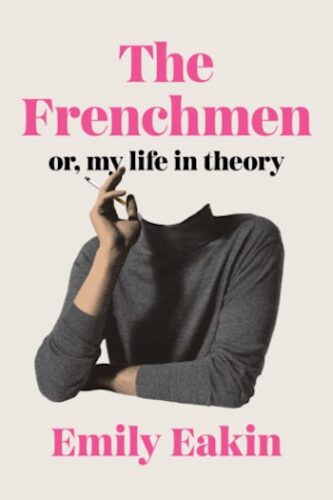
When Emily Eakin, a senior editor at the New York Times Book Review, entered Harvard in the mid-1980s, French theory had held sway for over a decade in the United States. At that point, graduate students and assistant professors were happily spouting theoretical jargon, excited, even entranced, at exercising their skill at spotting aporia. In her new book, The Frenchmen: Or, My Life in Theory, Eakin blends memoir and philosophical analysis as she explores the rise of theory and its strong hold on much of American academic life. She focuses on a group of “Frenchmen”—Louis Althusser, Roland Barthes, Gilles Deleuze, Jacques Derrida, Michel Foucault, Félix Guattari, Jacques Lacan, and Paul de Man—and their relationships with one another, their arguments, and their writings. She confesses now that “the passion they aroused among a generation of Americans—including me, a college student at the time—seems as improbable as it was extraordinary.” As a literature concentrator—Harvard’s title for theory-based studies—Eakin was a groupie, writing in her journal, “I had this euphoric moment at Widener Library tonight, sitting in a remote carrel reading a Marxist critique of Lacanian psychoanalysis. It was thrilling.”
Reflecting on her theory-besotted days, Eakin describes how deeply these ideas gave her not only an intellectual sensibility, but also a community: “Theory would be another giant step along my path to worldliness, a bildungsroman I was only dimly aware I was writing…. Theory was cool. Theory was French. Theory was also, strange though it might sound, sexy…. Like the little black dress that confers on its wearers a chicness belying its modest price tag, theory offered users automatic membership in an intellectual elite.”
In the mid-1970s, literature departments, still enamored of the revolutions of the 1960s, were ripe for the flashy flights of linguistic fancy and dazzling philosophical overtures drummed up by structuralism and poststructuralism. Cleanth Brooks’s “well-wrought urn,” his erstwhile image for the beauty and utility of “close reading” in New Criticism, had been seriously undercut, not only by Northrop Frye’s myth-driven criticism—which urged readers to look beyond the borders of the poem to gaze at the deep structure of literary archetypes below —but also by cries for relevance in the post–Vietnam War era. A decade later, by the time Eakin joined the ranks of star-crossed lovers of French theory, graduate students in comparative literature departments were carrying books by Derrida, Foucault, and others like talismans that permitted entrance into the mystical, magical society of fellow structuralists and poststructuralists. Their writings served, she writes, as “a symbol, however small, of intellectual nonconformism … that marked you as a member of the counterculture, different from—and critical of—the docile horde.”
In France, as Eakin points out, the revolution that moved philosophy away from a focus on Sartre’s discredited humanism and politicized existentialism was a hardened fact. Back in the mid-’60s Michel Foucault and Louis Althusser had, each in his own way, argued that ideology was a material force that shapes the ways we act. While Jean-Paul Sartre claimed that individuals were compelled to act, and to act responsibly, Foucault and Althusser rejoined that the institutions of our society—family, school, church, and prison—drive our choices and direct our actions. Their theoretical writings shifted the ground for critique from the individual to society, providing new ways to question the power of the state and the oppressive actions of those in power. As Eakin writes of Althusser, “the subject is not born into a particular family or cultural milieu. Instead, he or she is ‘interpellated’ by the ideology into the larger social system.”
Many philosophy departments at the time were turning away from Continental philosophy and theory, embracing analytic philosophy instead. But generations of US literature students rejoiced, with brio and bravado, in the abstruse language and ideas of the closed systems erected by the Frenchmen. According to Eakin, “the appeal of French theory … intellectually for insecure American students (like me)” was that in “its grand explanatory ambitions” it “swept away doubt, offering in its place the certitudes of an all-encompassing system.”
Reading Derrida, Barthes, Foucault, Lacan, and others can be confusing or bracing; such readings require us to enter hermetically sealed linguistic systems. As Derrida argued, “there is nothing outside the text.” As Eakin observes, these French philosophers “dedicated much of their careers to showing how they believed language actually worked: molding our thoughts and behavior, constraining and compelling us, tripping us up and deluding us—in a word, creating us. And not just us, but the world too.”
At the same time, these theorists were human, all too human, and struggled with “illness, depression, moral failure, emotional betrayal, and singular proclivities.” In short, lively chapters, Eakin “re-embodies” these Frenchmen. She admits that she focuses on these eight men because they were the ones that “figured most prominently in her education” and that they were “arguably the most influential in the United States.” Her goal is to recover the “hidden human element beneath their often stringent antihumanism.” Proceeding in nonlinear fashion, Eakin animates the philosophers’ words and thoughts while also looking at their emotional and psychological traits, examining how some of them interacted with one another. As she points out, French theory comes across as lifeless—weighted down by its two-ton jargon—and “if you had read only their philosophical writings … you might not have guessed that these philosophers experienced love, lust, madness, hope, envy, hatred, and deep despair.”
Indeed, as she notes, Althusser murdered his wife; Guattari worked in an experimental clinic in which patients and staff lived and worked together; Barthes was run over by a laundry van; Derrida was arrested on drug charges at the Paris airport; and Lacan famously delivered short lectures and famously once stood in front of a blackboard, obsessed with the knot he had drawn on it. Throughout, Eakin is trying to come to terms with her early enchantment with the Frenchmen. Would she have read Althusser differently had she known he had killed his wife? “My guess is probably not,” she confesses. “After all, Althusser was hardly alone in renouncing the individual as a romantic fiction; his stance was widely shared by other structuralists to whom I was unquestionably in thrall.”
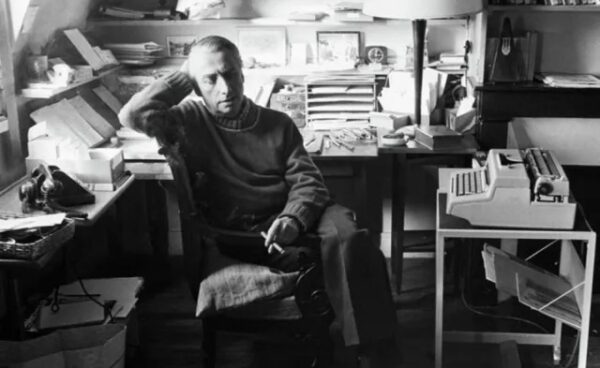
French critic Roland Barthes. Photo: YouTube
Among Eakin’s theorists, Derrida’s stimulating linguistic playfulness influenced a number of critics. Yale’s J. Hillis Miller, for example, used Derrida’s focus on differance and the deferral of meaning in his celebrated critical readings of Dickens, Elizabeth Gaskell, George Eliot, and Anthony Trollope. Yale’s Geoffrey Hartman did much the same in his work on Wordsworth. Hartman, in his classic Criticism in the Wilderness (Yale University Press, 1980), set out to show that Derrida’s critical work Glas should be considered a creative achievement. (A 50th-anniversary edition of Derrida’s Of Grammatology will appear this year from Johns Hopkins University Press, a revised translation with Gayatri Chakravorty Spivak adding a new preface to her original introduction.) That book famously declares, in Eakin’s words, that “all language defers rather than contains meaning, and speech ‘already belongs’ to writing.”
Even as Eakin provides deft and in-depth readings of these French theorists—her crisp readings of these philosophers could easily serve as a clear introduction to their writings—she points out that the American academy’s embrace of these ideas led to a predictable backlash by conservative critics. These skeptics pointed to the ways that deconstruction’s systemic destabilization of language and meaning could lead to the end of the humanities. The politically revved-up culture and canon wars of the late 1980s and 1990s were driven by charges that theory might short-circuit an appreciation of literature by placing cultural identity at the center of reading.
Eakin left theory for journalism, but her page-turning book offers elegant testimony to the enduring value of—indeed, the entrenched nature of—theory. Theory might not have taught students how to live with ease, but it “taught us a new way to think. Be skeptical. Be alert. Pay very close attention. Beware political claims posing as timeless truths. Notice arguments that seem to boil down to … neat binaries in which one term is championed at the expense of the other.” The Frenchmen succeeds as an elegant summary of the difficult thought of these theorists, usefully pointing to how they effectively underlined the ways that language shapes the world around us. With the homogenization of artificial intelligence looming, the French theorists’ skeptical approach to language and social structures offers a refreshing return of critical thinking.
Henry Carrigan is lecturer in the English department at Lake Forest University. He writes for Publishers Weekly and BookPage, and his writing has appeared in the Washington Post Book World, the Atlanta Journal-Constitution, the Christian Science Monitor, the Cleveland Plain Dealer, the Charlotte Observer, and the Fortnightly Review. As a graduate student in the early 1980s, he also imbibed the heady draughts of French theory.
Tagged: "The Frenchmen", Barthes, Derrida, Emily Eakin, Foucault, French theory, Lacan, deconstruction
1 Comment
Leave a Comment
Like Henry Carrigan, I was a graduate student in those “heady” days. This is a well-written review, but Emily Eakin’s mémoire amoureuse smacks more of “Oo la la” than l’esprit critique. She fangirls her way around the “the citadel of talk” (George Steiner’s sobriquet for poststructuralism) rather than seriously considering its legacy.
Revisiting the dawn of theory in American English departments should strike at the core of the late-20th-century crisis in the humanities. What Eakin feels was a “heady” intellectual awakening was, in practice, an institutionally subsidized exercise in stylistic posture and intellectual abdication. Poststructuralism provided holy writ: interpellation, aporia, différance, or legitimation that functioned less as an analytical tool and more as a password for academic gatekeeping. To this day, journal editors dictate revision with two words: “insufficiently theorized.” If a paper’s thesis was thin, enveloping it in dense syntax and theoretical buzzwords conjured profundity. It wafted the theory-spouter away on a magic carpet of Derridiana, far from the threat of refutation.
By declaring that “there is nothing outside the text” and treating language as a self-referential void detached from objective reality, theory alienated students, discarded the traditional appreciation of literature, and eroded public trust in the humanities. Departments effectively replaced philology and historical context with programmed, cookie-cutter deconstruction.
This posturing wasn’t limited to obscure literary jargon; it extended to the abuse of hard science to contrive an aura of authority. Julia Kristeva’s early work used advanced mathematical and scientific terminology as pretentious decoration without understanding definitions or demonstrating relevance to linguistics. (Though she largely abandoned these heavy mathematical analogies in later work). Lacan’s critics demonstrate that his extensive use of mathematics was an arbitrary parlor trick that misused specialized terminology to put up a false front of scientific rigor.
Much worse, the intellectual genealogy running from Martin Heidegger’s unrepentant Nazi past into French poststructuralism isn’t a game of intellectual Twister. Heidegger’s radical skepticism regarding objective truth and humanism laid the foundation for a framework where moral accountability could be rationalized away as mere discourse. When Paul de Man’s wartime, pro-Nazi, anti-Semitic writings came to light, the response from the loyalists was telling. Rather than facing up to it, the wagoneers of theory circled around the argument that text has no fixed meaning: transforming collaboration into a linguistic exercise précieux.
Furthermore, the theory crowd managed to overlook Louis Althusser’s strangling of his wife. Treating violent acts and radical anti-humanism as mere eccentricities of brilliant minds exposes the disconnect between abstract theory and real-world ethics. By prioritizing jargon and linguistic games over clarity and moral responsibility, poststructuralism didn’t just transform literary studies; it played a central role in hollowing out academic discourse from within and making it child’s play for the right-wing to decimate the humanities.