
Visual Arts Review: The Great Elephant Migration — Elephants on Parade, Conservation at Stake
By Mark Favermann
On Boston’s Commonwealth Avenue Mall, 100 handcrafted elephants turn an exuberant family attraction into a persuasive call for human-wildlife coexistence.
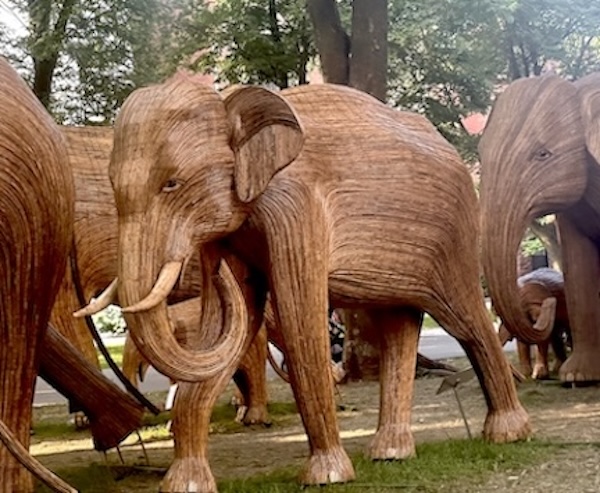
A look at The Great Elephant Migration in Boston. Photo: Mark Favermann
In Back Bay’s elegant 19th-century Commonwealth Avenue Mall, a surprising summertime apparition has arrived: a herd of elephants. They do not thunder past, but stand in a quiet procession, projecting an uncannily elephantine presence. The Great Elephant Migration, a free, traveling public-art exhibition, brings 100 life-size sculptures of Asian elephants to the Mall between Arlington and Fairfield Streets through September 13. Installed as though moving east toward Boston Common, the herd is at once an environmental warning, an occasion for wonder and curiosity, and a persuasive instance of art made genuinely public.
The monumental art tour aims to build support for conservation by raising awareness of endangered elephants, using public art to celebrate human-wildlife coexistence as it calls for funding for global conservation and international cultural organizations. Its commitment to social justice–and the future of the natural world–speaks directly to today’s ecological crises.
According to Aristotle, “The aim of art is to represent not the outward appearance of things, but their inward significance.” The Great Elephant Migration achieves both. Moving among the herd, visitors encounter the monumental scale of each sculpture and the cinematic sweep of the installation as a whole: forest giants become a forest of distinct individuals. The experience prompts an outward encounter and an inward dialogue—one about the animals’ particularity, our shared habitation of the planet, and the urgent need for environmental intervention. Here, aesthetics gives that conversation animating force and flow.
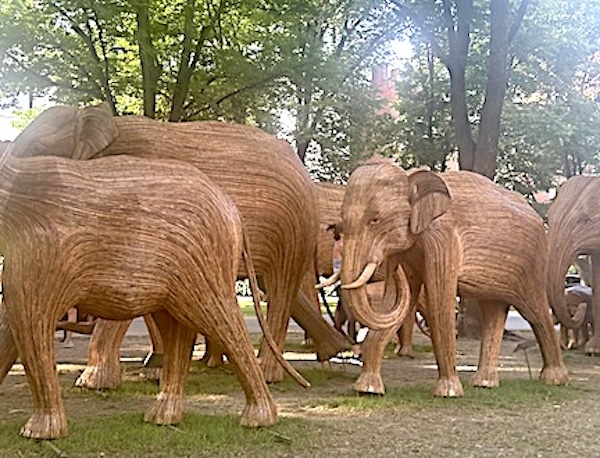
A look at The Great Elephant Migration in Boston. Photo: Mark Favermann
The Asian Indian elephant is endangered, its population threatened by habitat loss and human-wildlife conflict. Deforestation and expanding infrastructure are fragmenting traditional forests and migration routes, cutting off access to precious food and water. Crop-raiding and shared living spaces also bring elephants and people into dangerous contact, sometimes resulting in fatalities.
The Great Elephant Migration tour has attracted support from Cher, Padma Lakshmi, Susan Sarandon, and Diane von Furstenberg. “We can’t only think about nature as separated from ourselves,” says co-founder and creative director Ruth Ganesh, articulating the project’s central argument for coexistence.
In Boston, the Mayor’s Office of Arts and Culture and the Boston Art Commission served as civic sponsors for the free installation, with additional backing from private sponsors and conservation NGOs. Local charities benefit at each stop; Boston’s beneficiaries are the Boston Public Art Triennial and the New England Aquarium. Individuals and businesses may also purchase sculptures: baby elephants cost $8,000 and adults $23,500.
More than 300 paid artist-artisans in southern India’s Nilgiri Hills make these pachyderms from dried vines of Lantana camara, an invasive and ecotoxic plant introduced to India during British colonial rule. Its berries are poisonous to humans and animals. Each work takes three to four months to complete and is modeled on local endangered elephants. A steel armature is covered in lantana strips, then individualized with varying colors, sizes, trunk positions, cast-resin eyes, wooden tusks, and toenails.
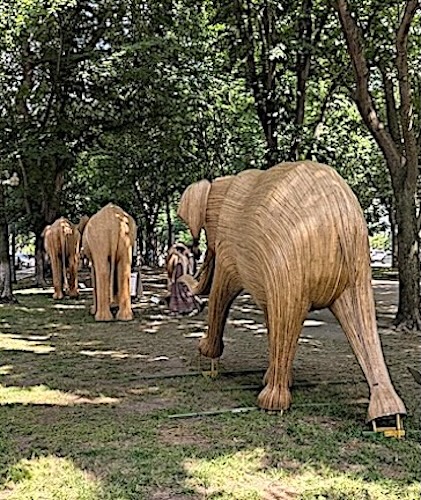
A look at The Great Elephant Migration in Boston. Photo: Evan Eisert
Since summer 2024, the herd has traveled to England; India; Newport, Rhode Island; New York City; Miami Beach; Houston; Jackson Hole, Wyoming; the Blackfeet Nation in Montana; and Beverly Hills. The 2026 tour is beginning in Boston before continuing to Washington, DC, Las Vegas, and then Rome.
The elephants attract crowds wherever they appear. In Boston, visitors can move easily among them, and the installation has quickly become a family destination.
My four-year-old grandson visited the exhibit. He may know Babar, Horton, the Heffalump, and Snuffleupagus, but he has never seen a living elephant. I wondered what he made of these silent, monumental creatures on parade. He smiled throughout, evidently responding to their presence and their message.
At its best, public art tells a story. The Great Elephant Migration frames urgent questions about coexistence, inviting viewers not only to reflect on them but to act.
Mark Favermann’s firm, Favermann Design, was one of five design consultancies chosen from 481 to design the 1996 Centennial Olympic Games in Atlanta. He is an urban designer specializing in strategic placemaking, civic branding, streetscapes, and retail settings. In 2024, he was awarded the Journalism and Communications Award by the American Planning Association/Massachusetts for his decades of writing on the built environment. In 2025, the Mass Cultural Council awarded him a Creative Individual Award for Sculpture.
2 Comments
Leave a Comment
OMG the creative director’s name is Ganesh??!!!
Love this! The thoughtful article was incredibly informative. Amazing about using an invasive plant to construct the elephants. What an awe-inspiring exhibit.