Book Review: The Long Great War That Still Haunts Europe
By Tom Connolly
Jesse Kauffman’s sweeping history links the imperial collapse of 1905–1921 to the nationalist conflicts that still shape the region today.
The Blood-Dimmed Tide: Central Europe’s Long Great War 1905-1921 by Jesse Kauffman. Harvard University Press. 285 pages. $35.
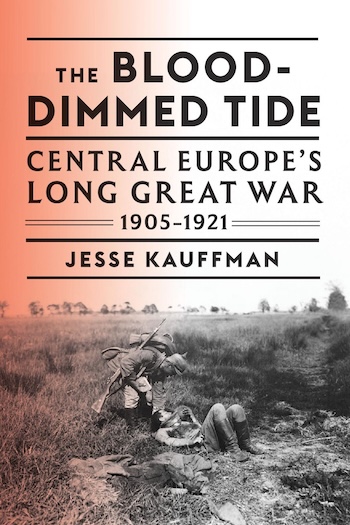 Jesse Kauffman has written a chillingly relevant book. His re-centering of the geography of World War I — from the Eastern Front to the “Bloodlands” of the various Polands, East Prussia, Galicia, Ukraine, and the Baltic states — probes a neglected historical reality. These regions were, by far, a more significant theater of war than the Western Front. (When did “Alsace-Lorraine” last come up in an international forum?) One look at today’s news explains why.
For example, it has been rumored that Russia plans to expand its invasion of Ukraine to Poland and/or the Baltic. Many scholars believe that Putin’s goal is to restore the borders of the former U.S.S.R. Of course, he is not the first Russian ruler to strive for westward conquests or to insist on securing an empire. A tragically absurd example is detailed in Kauffman’s book. During the Russian Civil War, various White Russian generals were offered alliances by the emerging ethnic states that had freed themselves from the Czar in the wake of the Revolution. All of the generals refused to cooperate, to sacrifice an inch of territory, none of which the Russians controlled any longer. They refused to discuss autonomy for any former peoples of the Russian Empire. It is likely that, if the Whites and the Poles had joined forces, they would have captured Moscow and swept away the Bolshevik regime.
The touchstone of Kauffman’s argument is a report by General Louis Moulin, who was the French military attaché in St. Petersburg in 1905. He observed how quickly the riots in the Russian capital had spread to the Empire’s borderlands. He concluded that, if the Russians pacified the rebellious Poles with concessions, the move would stir up the Poles who were living under German and Austro-Hungarian rule. One of Kauffman’s important insights is to remind us that Germany too was a multi-ethnic empire. The Polish ‘problem’ was the potential trigger for a general European war because of France’s alliance with Russia. Worse, the Austro-Hungarians, Germans, and Russians might come to a rapprochement over their mutual need to calm the restless Poles and other nationalities. A revived Dreikaiserbund would mean France’s total isolation.
Kauffman argues that World War I itself was only one segment in the Great War in Central Europe. The 1905 Russian Revolution set the conflict in motion and it only came to a tentative conclusion with the 1921 Treaty of Riga. Your average history buff is familiar with the Treaty of Versailles — Riga or Trianon, not so much. Yet these pacts still stir up nationalist resentment among interested parties in Central Europe. In 1914, Germany, Austria-Hungary, and Russia sent millions of soldiers into the roiling borderlands of Central Europe, pursuing victories that never came to pass, suffering millions of casualties in the process. The Eastern Front remained a slaughterhouse for years; the fighting continued after 1918, propelled by the collapse of three empires, their end catalyzed by civil, international, and revolutionary wars.
Kauffman writes that the rise of sovereign nation-states in postwar Central Europe was neither inevitable nor accidental. It was caused by the blinders donned during the fog of war. The combatants’ strategy was a bizarre attempt to instigate nationalist fervor among the imperial subjects of their enemies– the hope was promising them some sort of statehood would follow their rising up against their overlords. The most obvious example of this approach was how the three empires manipulated the dream of Polish nationalism: each power promised to revive the Kingdom of Poland. Poles fought for and against each of the empires during different times throughout the conflict. An example of the double and sometimes triple dealing with the Polish factions : the false promise the Russian foreign ministry made to establish an autonomous Kingdom of Poland, linked to Russia — only through the person of the Czar. When Czarina Alexandra learned of the offer, she demanded that the Czar renege on it because of “Baby’s future rights” — meaning that their son must inherit every acre that Nicholas II had.
The subterfuge and distrust that these stratagem inspired continue to resonate. Kauffman proves this point by showing how the war in Ukraine today is an aftereffect of the “long” Great War.
Kauffman also details the social history of what he terms the “shatterzones” of empires. He documents the fate of civilians who lived in the vanishing boundary between military fronts and civilian “rear.” From 1914 to 1918, the borderland populations were mobilized by default. Thousands of refugees were caught between enemy armies or forces in their own country that scorched the earth in an attempt to slow down their opponents. In many regions, the enraged and displaced took their helplessness out on others with pogroms. Anti-Semitism was unleashed with an invigorated frenzy. On the Austro-Hungarian side, the violence was particularly pernicious. Ironically, among all the variegated groups in Austria-Hungary, the Jews were the most steadfastly loyal to the Habsburgs. As the Austro-Hungarian empire crumbled and cities and towns changed hands, the Jews were blamed for the chaos. After the empires fell, the resentment against them became more virulent because they were accused of fomenting further upheaval. A powerful myth arose: the “Jewish Reds” were the cause of it all.
Kauffman also argues that it may be time to reevaluate British historian Eric Hobsbawm’s “short twentieth century” thesis, which insisted that the “century” lasted from 1914 to 1991. But undercutting this assumption, Kauffman is proposing that we consider Central Europe’s Long Great War as part of a longue durée, the kind of slow change that would align with the methodology of Fernand Braudel. Add the Russo-Turkish wars of the late nineteenth century to the horrific mix, and European imperial zones could be seen as roiling over three centuries. Kauffman’s deft use of multi-language sources helps to establish his authority, and he brings an effortless ease to relating this fascinating story of people and places at each other’s throat; each other’s throats ; he can be excused for spreading the gossip about Alexander Kerensky’s cocaine use. The The Blood-Dimmed Tide is a painfully relevant work of history: it is an essential asset for understanding the war in Europe today.
Tom Connolly is Professor Emeritus of Humanities and Social Sciences at Prince Mohammad Bin Fahd University. He recently edited a historical study (in English) of the 19th- and 20th-century Jewish community of Döbling for the Österreichischen Akademie der Wissenschaften, Institut für Kulturwissenschaften. His book Goodbye, Good Ol’ USA: What America Lost in World War II: The Movies, The Home Front and Postwar Culture is forthcoming from Houghton Mifflin/PMU Press.