Visual Arts Review: “Troubleshooting — Making Photographs with Dona Ann McAdams”
By Yvonne Owens
A retrospective survey of a photographer who has long worked at the intersection of art, activism, and community.
Troubleshooting: Making Photographs with Dona Ann McAdams at Yester House, Southern Vermont Arts Center (SVAC) through January 3, 2027
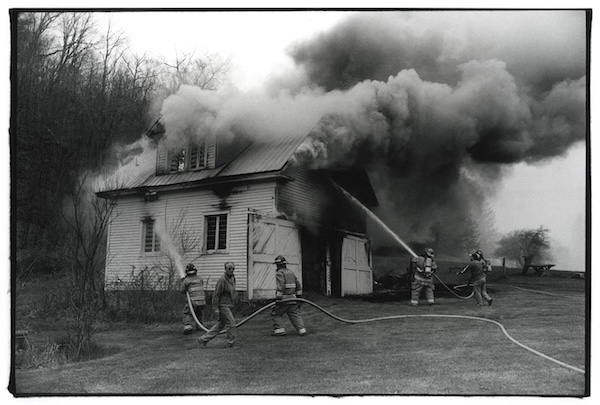
Dona Ann McAdams, Suzy’s barn, Sandgate, VT, 2018. Silver gelatin photograph, 16 x 20 in. Photo: courtesy of the artist
Southern Vermont Arts Center (SVAC) presents Troubleshooting: Making Photographs with Dona Ann McAdams as their premier exhibition inaugurating their new Van Degna Contemporary Gallery space. Documenting people, places and events across five decades of American life, the current exhibition unites photographs from the backroads of America’s marginalized subcultures alongside action shots of the pioneers of the Lower East Side performance art heyday and portraits of the habitually underrepresented of urban and rural America. Both retrospective and survey, the show focuses a wide-angle lens upon an epic flow of work, and demonstrates how McAdams has consistently worked across performance, activism, and community-based contexts. It was curated with a specific experiential, process-oriented theme—one that works to reveal the artist’s apparent knack for precognition—the ability to sense great images about to manifest within her sight. McAdams’s ability to anticipate uncanny synchronicities—the organizing shapes and movements unfolding in the visual field—explains the lyrical nature of many of her images.
As described by curator Danny Volk, the show is a testament to McAdams’s consciousness of timing, flow, and continually evolving patterns in her visual surroundings. “Troubleshooting begins from the idea that a photograph is not simply taken, but made through a set of conditions that have to come into alignment. Across this work, what comes forward is a way of being present—of staying with a moment long enough for something to happen. The photographs hold that process.” Rather than positioning the photographer at a distance, “capturing” an image as an aloof, dispassionate observer, Troubleshooting puts the viewer inside the tableaux, present and accounted for along with the artist and subject(s). The show “highlights McAdams’s long-standing commitment to working within the contexts she photographs. Across these images, the camera becomes part of an ongoing exchange—one shaped as much by attention and care as by formal or technical decisions.”
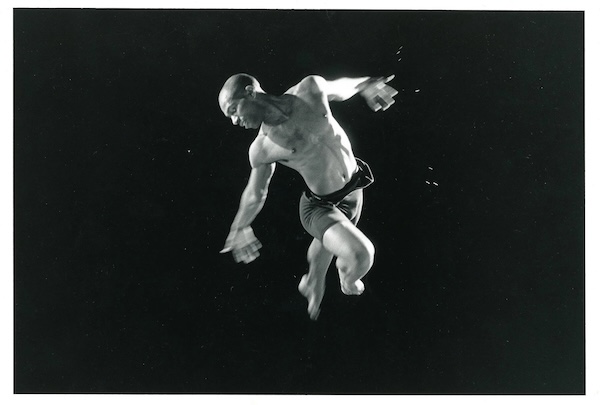
Dona Ann McAdams, Ronald K. Brown, Combat Review, P.S. 122, New York, NY, 1993. Silver gelatin photograph, 8 x 10 in. Photo: courtesy of the artist
Images documenting New York’s downtown performance scene, taken during McAdams’s lengthy tenure as house photographer at New York City’s PS 122 Gallery are joined with photographs of political organizing and protest movements. Sequences of photos taken at New York and DC protests against US political and military interventions in Central America join images from the Saratoga racetrack backstretch (where McAdams worked as a licensed hot-walker). Images of farm animals and their keepers feature prominently, including McAdams’s scenes from around her goat farm in Sandgate, Vermont, where she resides with her husband, writer Brad Kessler. Also included are photos from The Last Country portfolio (1995-98), a portrait of rural Appalachia focusing on elderly farmers in a southern West Virginia mountain community.
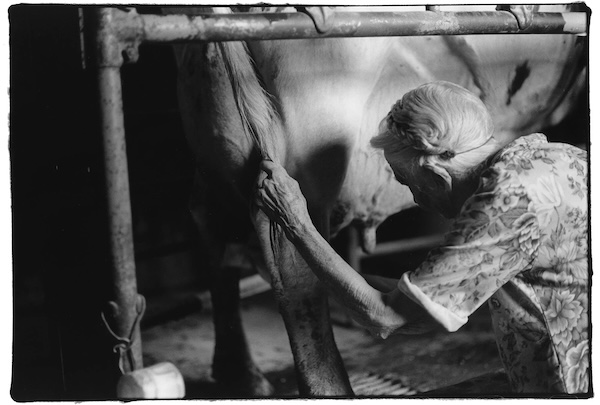
Dona Ann McAdams, Georgie Hurd, Williamsburg WV, 1997. Silver gelatin photograph, 16 x 20 in. Photo: courtesy of the artist
Images featured in McAdams’s recently published book Black Box: A Photographic Memoir (Saint Lucy Books, 2024) are scattered throughout the exhibition. The recipient of numerous accolades, Black Box features scenes from iconic American cross-country highways, bleak truck stops, and notorious mountain passes (such as the site of the Donner Party tragedy in the Sierra Nevada). A major exhibition featuring McAdams’s 50-year archive presented in Black Box was mounted by the Pratt Manhattan Gallery (opening April 18, 2025), timed to coincide with the release of the book. Like the book and Pratt Institute’s Black Box exhibition, the SVAC show renders an illuminated history of the Queer Liberation Movement, the Culture Wars, and beyond. In solidarity with the multitude of racetrack workers and nuns, cheerleaders and ballerinas, feminists and adult entertainment actresses, titans of philosophy and art are pictured at home, in the garden, or on stage. Renowned artists, activists, and culture critics like Meredith Monk and the late Maurice Sendak appear in incidental circumstances, speaking or socializing, agitating or hanging out.
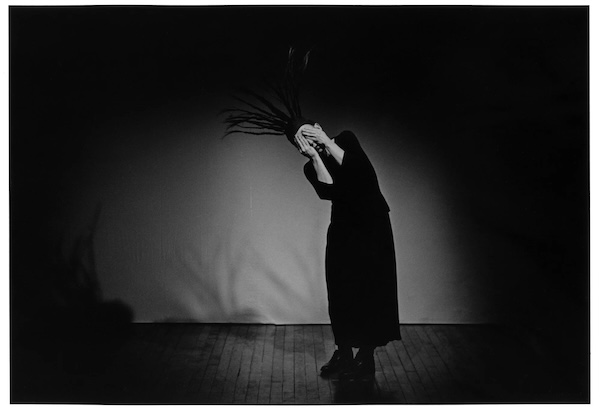
Dona Ann McAdams, Meredith Monk, Volcano Songs, P.S. 122, New York, NY, 1994. Silver gelatin photograph, 23 x 29 in. Photo: courtesy of the artist
McAdams began her sustained look at the nuclear industry in America in the late 1970s with The Nuclear Survival Kit project (1978-1985), predating the critically acclaimed Emmy-winning documentary Dark Circle (1982) by a few years. Directed by Judy Irving, Christopher Beaver, and Ruth Landy, the film explored the human and environmental impacts of nuclear weapons production and nuclear power, and echoed many of McAdams’s concerns. With footage of antinuclear protests at California’s Diablo Canyon and other demonstrations of resistance, the documentary traced the trail of plutonium from its production in a reactor to the military labs that processed the highly fissionable material into bomb triggers at the Rocky Flats nuclear facility. Through interviews with residents near the Colorado nuclear plant, contextualized by accounts from survivors of Hiroshima and Nagasaki, the record showed how concerns about nuclear energy and weapons proliferation were anything but specious—a reality that the disasters at Chernobyl and the Fukushima Daiichi Nuclear Power Plant made clear. Despite the dangers, US utilities in league with the US military have historically made a concerted effort to greenwash nuclear research facilities and power plants. There are no better testaments to the long-term existence of this campaign than the (now obsolete) nuclear-plant “recreation areas” sited at the San Onofre, Rancho Seco, and Turkey Point reactors.
The artist’s self-portrait in the recreation area of the Rancho Seco nuclear reactor shows an almost idyllic scene in the background. Sailboats ply the artificial lake behind her, built to supply water for the reactor, and the twin cooling towers belching superheated steam in the background. She lounges casually at a picnic table laden with groceries next to a large portable playpen. The family to whom the playpen belongs is a slight distance away, gathered on a picnic blanket, pointedly ignoring the strange woman who’s commandeered their little corner of the recreational site to take selfies. (They likely didn’t want to provoke her, given her unusual, mildly alarming behavior.) Their full-size Coleman cooler is perched on the picnic table, testifying to some serious outdoor lunching having taken place amid the cosmeticized industrial setting. The photograph is a testament to the insidious military-industrial campaign maintained through the 1970s and ’80s, aimed at making nuclear energy seem both “user-friendly” and safe for public consumption.
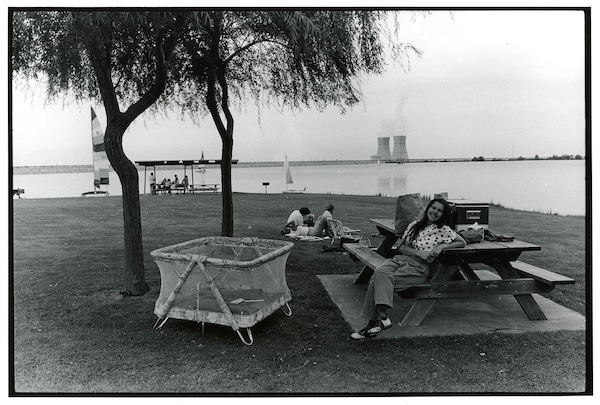
Dona Ann McAdams, Self portrait, Rancho Seco Nuclear Generating System, Sacramento, CA,
1979. Silver gelatin photograph, 16 x 20 in. Photo: courtesy of the artist
A current of dark humor runs through McAdams’s oeuvre. The moody coloration of the black-and-white photographs operates in ambiguous ways—subliminal yet profound, subtle yet cathartic. A tongue-in-cheek tone of irony (or perhaps, more accurately, of ruefulness) over what might be termed “the human condition” imbues the political tableaux of Arresting Images (1980-present), a portfolio of street protests, demonstrations, and political actions focusing on queer, antiwar, and women’s issues. Transfixed, pinioned by self-recognition and reflection, we’re forced to laugh at ourselves, albeit with some chagrin. Playing out in the personal, the public, and the universal realms, the revelation of an ineffable human strangeness—and even, when viewed from within McAdams’s oblique framings, a kind of social creature perversity—stalks us.
The artist manages to make these fond, funny, potentially catastrophic aspects of human nature apparent, even as she seems to commiserate with the viewer over what, when viewed from a certain angle, appear as occasional cautionary tales. The emotional payload of certain of McAdams’s images is the inescapable realization of the inevitability of human foibles, uncoiling in our awareness as we witness confounding scenes of human paradox and complexity. A 1994 image from the Arresting portfolio shows a bare-breasted woman with crucifix marked nipples confronting a priest during a NYC Women’s Reproductive Rights rally. (Though abortion was legalized nationwide in the US in 1973, women’s right to bodily autonomy was constantly under threat, while being continually relitigated, only to be rescinded again in 2022.) The photograph captures the gendered political moment like a fly in amber, its gesture apprehensive and already tired–as accurate a postscript to the present as it was then.
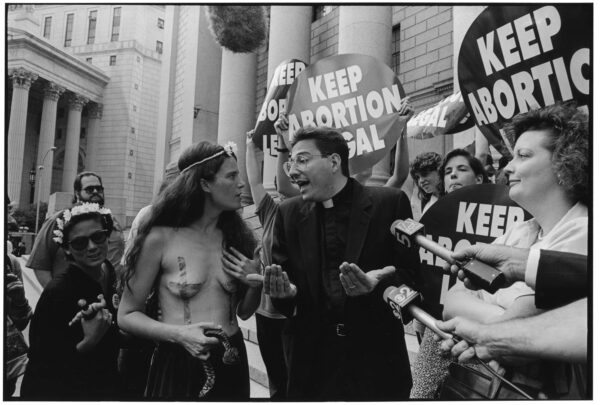
Dona Ann McAdams, Keep Abortion Legal, City Hall, New York, NY, Summer 1994. Silver gelatin photograph, 16 x 20.
The works on view, and the featured, behind-the-scenes glimpses of how they were made, collectively reveal a deeply intuitive practice. McAdams’s idiosyncratic process has served her well. Her predictive ability to anticipate surprising, balletic movements of crowds of strangers, external natural forces, sudden weather, and other elemental agents has informed the intricate choreographies of scores of her photographs. Her success might be the result of heeding subtle presentiments of compositional gestures about to evolve in her immediate environment—of never doubting the creative’s “inner voice.” Or maybe what is revealed is simply a hyperattenuated state of readiness. Whatever her secret, the Queer activists and farmers, performance artists, Coney Island habitues, and institutionalized adults of McAdams’s long acquaintance shine in her representations. But the real heroine of SVAC’s Troubleshooting is photography itself, revealed as an unimpeachable, ineluctable steward of memory.
Arts Fuse review of Dona Ann McAdams’s 2025 book Black Box: A Photographic Memoir.
Yvonne Owens writes art and cultural criticism, exploring contemporary post-humanist discourses in art, literature and new media. Her essay “The Saturnine History of Jews and Witches” appeared in Preternature Vol. 3, No. 1 (Penn State University Press, 2014), and her book chapter “Pollution and Desire in Hans Baldung Grien: The Abject, Erotic Spell of the Witch and Dragon” appeared in Images of Sex and Desire in Renaissance Art and Modern Historiography (Taylor & Francis/Routledge, 2017). Her chapter “The Hags, Harridans, Viragos and Crones of Hans Baldung Grien” appeared in the landmark survey,Hans Baldung Grien: New Perspectives on His Work (Staatliche Kunsthalle Karlsruhe, 2019), and her book Abject Eroticism in Northern Renaissance Art: The Witches and Femme Fatales of Hans Baldung Grien was published in 2020 (Bloomsbury, London). She served as editor for an anthology of essays titled, Trans-Disciplinary Migrations: Science, the Sacred, and the Arts (Cambridge Scholars Publishing, 2024).