Film Review: Married to Amazement — “Mary Oliver: Saved by the Beauty of the World”
By Michael Londra
This documentary about poet Mary Oliver is a moving study of solitude, partnership, and the stubborn power of wonder.
Mary Oliver: Saved by the Beauty of the World, directed and produced by Sasha Waters. Limited theatrical release; broadcast premiere on PBS/American Masters premiere on August 25
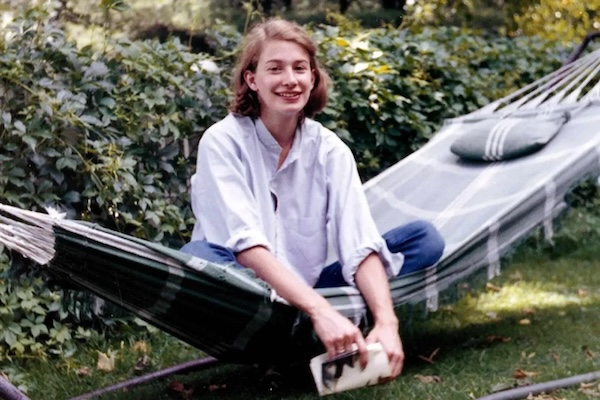
Poet Mary Oliver in a scene from Mary Oliver: Saved by the Beauty of the World. Photo: courtesy of Kino Lorber
Mary Oliver concludes what may be her best poem, “The Summer Day,” with a question: “Tell me, what is it you plan to do, / with your one wild and precious life?” In it, meditating on her vocation as a poet, Oliver justifies a lifetime dedicated to completing over thirty books of verse. The image of a grasshopper feeding on sugar in the poet’s hand elicits the same astonishment that decades of close examination of the world awakened in her. Without mentioning the word, she equates the act of writing poetry to “prayer.” Both actions, for her, are derived from diligent observation. Following in the tradition of Thoreau and Emerson, she advocated that we ecstatically meld with the universe. A visionary mystic, Oliver gently warns that our “one wild and precious life” will be over before we realize it — so surrender yourself to all that is beautiful before it’s too late.
Directed by Sasha Waters, Mary Oliver: Saved by the Beauty of the World begins with Stephen Colbert attempting to read “The Summer Day.” He becomes so caught up in his feelings so quickly he can’t get out much beyond the first line. He is part of a cadre of celebrity readers interspersed throughout the documentary—a roster that includes Oprah, Helena Bonham Carter, and Steve Buscemi. Colbert’s struggle is representative of the powerful emotions generated by Oliver’s stanzas. Unlike some poets, who worry that the slightest passion slides into gauche sentimentality, Oliver had the courage to embrace poetry’s age-old power to make us feel deeply
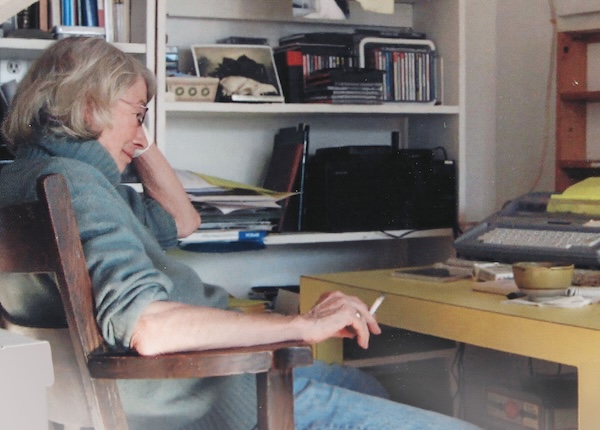
Poet Mary Oliver in a scene from Mary Oliver: Saved by the Beauty of the World. Photo: courtesy of Kino Lorber
Saved by the Beauty of the World traces the arc of the poet’s trajectory toward an admired career. Born in 1935, Oliver endured a difficult Ohio childhood in Maple Heights. Her temporary means of escape from a sexually abusive father (described by her in “Flare” as a “demon of frustrated dreams”) were long private sojourns into nearby woodlands. It was during these formative years that she first “learned to love the earth” while also discovering and devouring the verse of Whitman and Shelley. Oliver freed herself from the “dark and broken house” she grew up in when she left to attend Vassar. But she didn’t stay there long. Departing without a degree, she went to live in Edna St. Vincent Millay’s Victorian farmhouse, Steepletop, in Austerlitz, New York, a 700 acre wooded estate. She’d accepted a live-in position to help Millay’s sister Norma organize her sibling’s posthumous archive. It was a relationship that lasted for four years. For Oliver, Pulitzer Prize-winner Millay stood as an attractive example of rebellion against bourgeois conformity. A “scandalous woman,” Millay was a “flapper feminist” who took the complexities of female desire seriously as poetic subject matter, and unapologetically practiced polyamory in her marriage.
While at Steepletop, Oliver met Village Voice photographer Molly Malone Cook, her partner for the next forty years. They moved to Provincetown, Mass., renowned for its queer-friendly, hippy atmosphere of “outcasts” and “misfits.” Going initially for a single summer stay, the couple chose to drop anchor there full time, sharing a house on Cape Cod for almost fifty years, until Molly died at age 80 from emphysema in 2005. For Oliver it was a devastating loss; she subsequently began to drink, eventually seeking out Alcoholics Anonymous. After Oliver met Anne Taylor, her second long-term partner, the poet departed her beloved Provincetown for good. Taylor wanted to go elsewhere and Oliver accommodated her. They settled in Hobe Sound, Florida, remaining there for fourteen years. Oliver passed away at 83 from lymphoma in 2019.
Making the most of family photographs (many taken by Cook); recorded interviews and poetry readings; as well as selections from Oliver’s notebooks and personal correspondence; along with a foray into animation (which seems to be unavoidable in the documentary genre of late), Saved by the Beauty of the World is structured around smart and insightful interviews with literary luminaries Mark Doty, Ada Limón, V (formerly Eve Ensler), Donika Kelly, Major Jackson, Ariana Reines, and Gabrielle Calvocoressi. Oliver biographer Lindsay Whalen and New Yorker contributor Ruth Franklin provide valuable backstory and career context. One fun revelation: Norman Mailer was a personal friend. To earn extra money, in fact, Oliver typed the final manuscript of The Executioner’s Song for him. The star witness, however, is underground filmmaker John Waters, director of cult classics Pink Flamingos and Female Trouble, among others. During the late ’60s he lived in Provincetown and worked at the East End Bookshop, which was run by Cook and Oliver. His intimate recollections of both artists are particularly moving. He can also be refreshingly irreverent. Among his humorous anecdotes, this witty take on Oliver suddenly attending Presbyterian worship services stands out: “She joined the church because she was after the woman preacher.”
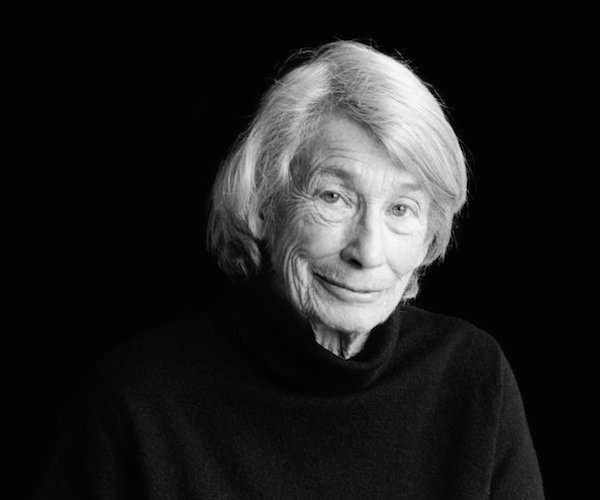
Poet Mary Oliver. Photo: Wiki Commons
The film shows the vital role Cook played in Oliver’s life and art. John Waters explains that “Molly was a very strong character. Molly gave [Oliver] the belief that she was a great, great talent and that she was going to succeed.” Moreover, Cook respected her partner’s need for solitude, which made the poetry possible. And Oliver needed a ton of alone time. Enamored of wooded trails, bodies of water, wild plants and flowers, insects, and birds since her youth, Oliver believed “even stones” were alive. Her devotion never waned. She applied the same meticulous concentration gleaned from communing with what Kepler called the “book of nature”—a metaphorical notion also credited to Galileo and St. Augustine—to her practice of poetry. Plenty of compelling samples are included: “A Note Left on the Door,” “Sleeping in the Forest,” “The Fish,” “Wild Geese,” and “The Journey.”
Indeed, Saved by the Beauty of the World makes a strong case for Oliver’s literary value without devolving into corny hagiography. Director Waters accomplishes this by creating dramatic momentum: Oliver’s lyrics are sonorously read in between brief looks at talking heads and sumptuous images of the places the poet loved. Along the way, we learn why Oliver’s writings “really spoke to people.” Her books have reportedly sold more than a million copies to date. To its credit, the documentary does not shy away from questioning that accessibility. Nick Flynn expresses frustration with what he considers Oliver’s lack of engagement with darker themes: “I read a lot at the beginning and then I was like, I get this.” His skeptical opinion is shared by many. For instance, the title of Maggie Millner’s recent piece in The Yale Review confronted the charge of schmaltzy mawkishness head on: “Is Mary Oliver Embarrassing?” That perspective should be given its due, but there will always be a backlash — especially in the competitive literary world — to popularity. After years of subsisting on a shoestring, Oliver’s American Primitive won the 1984 Pulitzer Prize. Suddenly, she became famous and was fêted. Rather than celebrate the overdue recognition of a serious poet, certain folks turned bitter, mocking Oliver, overlooking the fact that her oeuvre addressed concerns found in the verse of Robert Frost (human vulnerability colliding with the indifference and brutality of the physical world); Rimbaud (walking as a ritual to widen acuity and enter into a deeper state of hyper-conscious awareness); Pessoa (identifying with Otherness as the only conduit to truth); and Rilke (how the visible and the invisible are the same reality mediated by poetry).
Truth is, if Flynn had continued to read more of her work, he would surely have found the pain he so wanted to see. Like in “When Death Comes,” which Mary Oliver recites in the film. An act of anticipatory grieving, she mourns the mortal separation from her lover, Molly. She refuses to allow bereavement to steal her awe of existence. Some readers may judge “When Death Comes” as a “simplistic” response to the traumatic crisis C.S. Lewis once bluntly characterized as “The death of a beloved is an amputation.” For those of us who are terrified of mortality, Oliver gifts us the companionship of these apt words: “When death comes…and takes all the bright coins from his purse // to buy me…I want to step through the door full of curiosity, wondering: / what is it going to be like, that cottage of darkness?…When it’s over I want to say: all my life / I was a bride married to amazement. / I was the bridegroom, taking the world into my arms.”
Michael Londra—poet, fiction writer, critic—recently introduced the Poets Confront AI and Surveillance Capitalism event at Poets House, available on YouTube. He also talks New York writers in YouTube indie doc Only the Dead Know Brooklyn (dir. Barbara Glasser, 2022). “Time is the Fire,” the prologue to his soon-completed novel of Delmore Schwartz and Lou Reed, appears in DarkWinter Literary Magazine. His poetry was translated into Chinese by scholar-poet Yongbo Ma. Two of his Asian Review of Books contributions were named Highlights of the Year for 2024 and 2025, one of which was translated into Vietnamese. “Life in a State of Sparkle—The Writings of David Shapiro” from The Arts Fuse was selected for the Best American Poetry blog. He can also be found or is forthcoming in Lana Turner: A Journal of Poetry & Opinion, Restless Messengers, The Fortnightly Review, spoKe, Cha: An Asian Literary Journal, and The Blue Mountain Review, among others. He added six essays and the introduction to New Studies in Delmore Schwartz, coming next year. Born in New York City, he lives in Manhattan.