
Book Review: Voices From Inside Richard Foreman’s Ontological Theater
By Alexis Greene
I’ve Got the Shakes pieces together a restless, collaborative portrait of a defining avant-garde visionary.
I’ve Got the Shakes: Performing Richard Foreman by Shauna Kelly, Preface by Helen Shaw, Foreword by Jay Sanders (Bloomsbury, Feb 2026, 314 pages, 20 performance photographs)
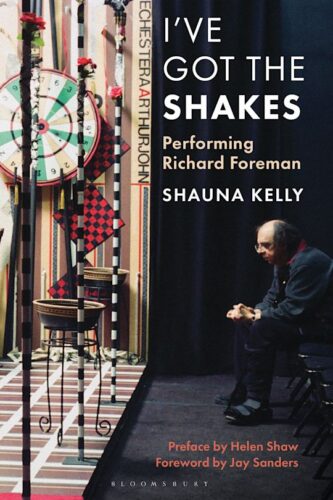
In January 1994, Richard Foreman directed his play I’ve Got the Shakes, a production of his adventuresome, avant-garde Ontological-Hysteric Theater, which he founded in 1968. The performances took place at the 75-seat Ontological Saint Mark’s Theater, at Saint Mark’s Church on the Bowery in lower Manhattan. Foreman, as was typical for him, had also designed the performance. David Steritt, a staff writer for the Christian Science Monitor, reviewed the production and adored it. Sterrit wrote,
“The most exciting thing about Foreman’s latest production… is that it has more emotional appeal than any play he’s presented in years. He has always possessed a gift for eliciting deeply felt, even passionate acting from the performers who play the strange, sometimes inexplicable characters in his surreal scenarios. But this time he has outdone himself, collaborating with a talented cast to weave a spell that’s extraordinary by his own high standards.”
I’ve Got the Shakes is also the title of Shauna Kelly’s excellent book about Richard Foreman and his innovative creations for the theater. Foreman died in New York City on January 4, 2025, at the age of 87; Kelly’s book is the first about him since his passing. She illuminates Foreman’s artistic explorations through more than three dozen interviews with theater artists who, like herself, worked with Foreman. She also interviewed the director, and asked Foreman to write his own descriptions of what he created.
A standard biography written in a narrative style? No. Drawing on the techniques of oral history made popular by Studs Terkel (Hard Times: An Oral History of the Great Depression) and Jean Stein (Edie: An American Girl), Kelly has created a kaleidoscopic portrait of Foreman’s theater art that is divided into two parts:
Part I: Richard Foreman: An Introduction
Part II: Performing Richard Foreman
Kelly’s interviews with Foreman over the years make up Part I. They are personal and revelatory. Foreman also made films, and filmmaking becomes part of the conversation, as does art in general, particularly during his talk with Kelly in 2017, during which Foreman tells her:
“I feel increasingly problematic about making art, about making films even, because I think the time has passed for art really but I’m not mobile enough to go out and make situations.”
But in 2018, when Kelly talked with Foreman again, he was more positive.
She asked, “Was there a point in your career where you were happy but kept experimenting?”
“Yeah. I did. I mean I never thought of it in terms of a point where I was happy. It was like a continual task. I’ve got to make something that does what I want art to do. And I know that I changed and evolved over the years. As I got older, the work got gentler in a way.”
Part II includes sections such as “Watching Foreman’s Theater”; “Roles”; “Rehearsal”; and “Performing the Show.” Each section is made up of descriptive interviews with actors, other theater artists, and members of various audiences. Their memories, descriptions, and observations enrich this engrossing book.
Most of the people with whom Kelly communicated told her or wrote to her about how they experienced Foreman’s art, and about how they experienced working with the director and bringing his art to audiences.
Some of the descriptions in Part II are brief, others run more than a page. Helpful, concise biographies of the contributors, and a list of the Foreman productions in which they participated, can be found at the end of the book.
The section “Foreman’s Character” is especially stimulating and moving. Paula Gordon, a translator who has worked in experimental theater and dance, remembers.
“I did appreciate that he was not above a corny joke or a pratfall, and it was always a point of pride to be able to make him smile or laugh during rehearsal…”
The playwright, librettist, and critic David Cote contributes that,
“[Foreman] is a big fan of lack of affect, which he often adopts in his personal speaking style. Of course, Richard can also be very warm, goofy, sweet, and vulnerable. But he can also sound austere, withholding, and emotionally cold.”
The American actor T. Ryder Smith gives a lengthy, detailed, evocative description about what it was like to audition for Foreman, often in the director’s apartment, even in his kitchen.

Director Richard Foreman — critic Robert Brustein called him “the Renaissance man of avant-garde American theater.” Photo: courtesy of the artist
In the “Roles” section, actors enthusiastically describe performing in Foreman’s productions. Kelly was “the woman in the white dress” in King Cowboy Rufus Rules the Universe, directed by Foreman in 2004 at the Ontological Theater.
“I wore a lacy, white, elegant, floor-length dress, and gold nose and lip jewelry,” says Kelly in her book. “In one scene I played a chicken rolled out in a cart on wheels wearing a yellow feather headband, beak, and tutu over the white dress.”
“Rehearsal” follows “Roles” and, not surprisingly, a rehearsal of a Foreman production was intense. Actor James Urbaniak describes how performers were “required” to have memorized their lines when they arrived for the first day of rehearsals. But then, as several other actors recalled, Foreman would often severely cut and change his scripts.
Willem Dafoe, who has acted in films and television for more than 40 years, performed in two Foreman productions, Miss Universal Happiness and Idiot Savant. He observed,
“So much of theater is very square and very traditional and is very tied to literature and psychology. And of course Richard’s theater liberates us from that and lets us know that there are all kinds of ways to make events and to make these things for spectators that enliven us.”
Theater at its best is a vibrant art form, dependent on a dramatist, a director, and especially on actors.
Foreman’s theater was not a theater of plays with linear structure, psychologically motivated characters, and realistic scenic design. Rather, Kelly’s book describes and evokes for theater lovers the experimental and stimulating body of work in which Foreman shaped a different vision of theater, with a vibrancy all its own.
Alexis Greene is a longtime writer on theater, and author of ten books including Emily Mann: Rebel Artist of the American Theater (Applause Theater and Cinema Books, 2021) and Shakespeare Theatre Company: The History of a Classical Theater (Peter E. Randall Publisher, 2025). She lives in New York City.
2 Comments
Leave a Comment
Here is what I wrote on Richard Foreman the month he died:
Critic Robert Brustein called Richard Foreman, who died at the age of 87 on January 4, “the Renaissance man of avant-garde American theater” and there is truth to that. In 1968 Foreman founded the Ontological-Hysteric Theater, which was dedicated to putting on the over 50 shows he wrote, designed, and directed — simultaneously flaky and brainy funhouse visions that won copious Obie Awards. He also penned, designed, and directed musical works in collaboration with composer Stanley Silverman and directed scripts by a range of dramatists, from the traditional (Mozart, Molière) to modernists early (Gertrude Stein, Bertolt Brecht, Georg Büchner) and late (Kathy Acker, Botho Strauss, Vaclav Havel, Philip Glass)
For Foreman, the art of the drama should be dedicated to overturning deadening conventionality. The director expounded his artistic credo in his invaluable 1993 essay/play collection Unbalancing Acts: Foundations for a Theater: “My plays are an attempt to suggest through example that you can break open the interpretations of life that simplify and suppress the infinite range of inner human energies; that life could be lived according to a different rhythm, seen through changed eyes.” Foreman’s experimentalism dissolved “mind-forg’d manacles” in order to nurture transformation.
In 2013 I reviewed Old-Fashioned Prostitutes, the last play Foreman produced and directed himself. I noted that “an element of pathos has crept into the machinery, a sense of curdled mortality, as if Foreman is beginning to acknowledge that his mental gears are grinding down, or at least they are in search of an inspiring anima.” I am fortunate to have encountered Foreman at the peak of his theatrical powers, and not only via the Ontological-Hysteric Theater. Foreman’s tinker-toyish staging of the American Repertory Theater’s 1988 production of Philip Glass’s opera The Fall of the House of Usher was a disappointment. But in 1990 I witnessed his glorious, primal scream presentation at Hartford Stage of Woyzeck, which is on my short list of most dazzling theatrical experiences ever. I remember reading, bemused, Brustein’s review of the production. He concluded that the evening was “a little bit too relentless.” Both Foreman and Büchner knew that, in the theater, it takes unyielding determination to break out of the prisonhouse of the commonplace.
This is a fitting and fascinating coda to the review of I’ve Got the Shakes: Performing Richard Foreman.